Generative AI Enterprise Applications in 2026: From Pilot to Production-Scale Impact
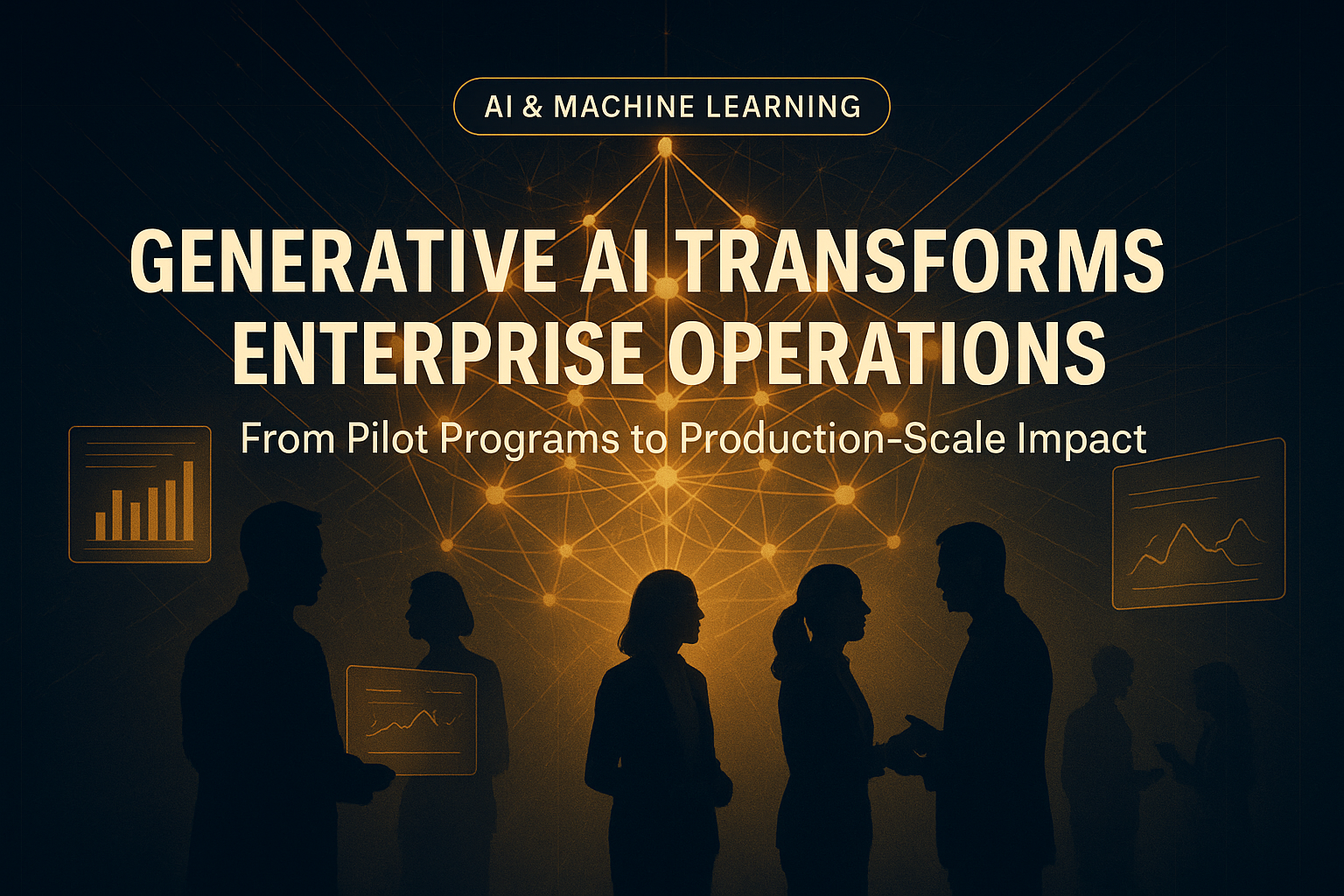
Generative AI has transitioned from a buzzword into a mission-critical business tool. Organizations worldwide are moving beyond proof-of-concept projects and deploying generative AI systems that directly impact revenue, efficiency, and competitive advantage. The question is no longer “if” enterprises should adopt generative AI, but how to scale it responsibly and measurably.
The Shift from Experimentation to Production Deployment
In 2024 and 2025, many enterprises treated generative AI as an experimental technology—interesting pilots that demonstrated potential but lacked clear ROI pathways. By 2026, this landscape has fundamentally changed. Organizations are integrating generative AI into core business processes, with measurable productivity gains and cost reductions.
According to industry research, enterprises are now focusing on high-impact use cases rather than broad exploratory deployments. Customer service automation, content generation, code development assistance, and knowledge management have emerged as the primary drivers of enterprise adoption. Companies that moved quickly in 2025 are now reporting double-digit productivity improvements in affected departments.
The shift reflects a maturation in both technology and organizational readiness. Generative AI models are more reliable, faster, and increasingly customizable for specific industry needs. Simultaneously, enterprises have developed better governance frameworks, security protocols, and change management strategies to handle large-scale AI deployment.
Key Enterprise Use Cases Delivering Measurable Value
Customer Service and Support Automation represents one of the most tangible applications. Organizations are deploying generative AI-powered chatbots and virtual agents that handle routine inquiries, troubleshooting, and initial customer interactions with natural language understanding that rivals human agents. These systems reduce response times, lower support costs, and free human agents to focus on complex, high-value customer issues.
Content Generation and Marketing Acceleration is another high-impact area. Generative AI tools are now standard in marketing departments, automating email campaigns, social media content, product descriptions, and even long-form blog posts. This doesn’t replace human creativity—it amplifies it, allowing marketing teams to test more variations, personalize at scale, and iterate faster than ever before.
Software Development and Code Assistance continues to be a productivity multiplier. Developers using AI-powered code generation tools (whether integrated into IDEs or standalone platforms) report significant time savings on routine coding tasks, boilerplate generation, and debugging. This allows engineering teams to focus on architecture, innovation, and complex problem-solving rather than repetitive implementation work.
Enterprise Knowledge Management is emerging as a sleeper application. Organizations are using generative AI to synthesize internal documents, policies, research, and institutional knowledge into searchable, conversational interfaces. This democratizes access to expertise and dramatically reduces the time employees spend hunting for information.
The ROI Reality: Where Organizations See Real Returns
Organizations that have successfully deployed generative AI at scale are reporting strong returns, though the metrics vary by use case. Customer service operations see reductions in handling time and cost per interaction. Content teams measure output volume and time-to-market improvements. Development teams track velocity gains and defect reduction.
However, the path to ROI isn’t automatic. Companies that treat generative AI as a simple cost-cutting tool often underperform. The most successful enterprises use generative AI to augment human capability rather than simply replace workers. This creates a different value equation: employees become more productive, more strategic, and better positioned for higher-value work.
Integration challenges remain significant. Enterprises must contend with data quality issues, model hallucinations (where AI generates plausible-sounding but incorrect information), regulatory compliance, and the need to maintain human oversight. Security and data privacy concerns have also become more pressing as organizations integrate proprietary data into AI systems.
Critical Challenges Slowing Broader Adoption
Despite strong momentum, several obstacles prevent wider enterprise adoption of generative AI. Data governance is a major concern—enterprises need to ensure that AI systems aren’t trained on sensitive information or that proprietary data isn’t exposed through model outputs. This requires robust data classification and access control frameworks.
Model reliability and accuracy remain problematic in regulated industries. Financial services, healthcare, and legal sectors require near-perfect accuracy, and generative AI’s tendency to produce confident-sounding but incorrect responses (hallucinations) creates significant liability. Organizations in these sectors are moving more cautiously, often using generative AI for augmentation rather than autonomous decision-making.
Skills and organizational change represent another barrier. Deploying generative AI effectively requires new skills—prompt engineering, AI ethics, model evaluation, and human-AI collaboration design. Many organizations lack these capabilities internally and struggle to hire talent in a competitive market.
Regulatory uncertainty is also a factor. As governments worldwide develop AI governance frameworks, enterprises are holding back on aggressive deployments until regulatory requirements become clearer. This is particularly true in the EU, where AI Act compliance is reshaping how organizations approach generative AI implementation.
The Future of Generative AI in Enterprise: 2026 and Beyond
Looking ahead, generative AI will become increasingly embedded and specialized. Rather than general-purpose models, we’ll see more industry-specific, domain-tuned AI systems optimized for particular business processes. Financial institutions will deploy AI models trained on financial data; healthcare organizations will use clinical AI systems; manufacturing will leverage production-specific models.
Multimodal AI (systems that process text, images, video, and audio) will expand enterprise use cases beyond text-based applications. This will unlock new possibilities in quality control, design, and creative industries.
Responsible AI and AI governance will move from nice-to-have to essential. Organizations that build robust frameworks for monitoring, auditing, and controlling AI systems will gain competitive advantage and avoid regulatory and reputational risks.
The organizations that will thrive in this landscape are those that view generative AI not as a technology to deploy, but as a capability to develop strategically. This means investing in talent, building governance frameworks, integrating AI thoughtfully into business processes, and maintaining the human judgment that AI cannot replace.
The Bottom Line
Generative AI in 2026 is no longer a future technology—it’s a present-day business tool reshaping how enterprises work. The companies that have successfully scaled generative AI are seeing real productivity gains and competitive advantages. But success requires more than deploying the latest model; it demands thoughtful integration, robust governance, and a commitment to augmenting human capability rather than simply automating it.
What generative AI application would create the most value in your organization, and what’s preventing you from scaling it today?
—
📖 **Recommended Sources:**
– **Gartner** – Enterprise AI adoption trends and market research on generative AI maturity
– **McKinsey & Company** – Business impact studies on generative AI ROI and organizational change
– **CoinDesk / CoinTelegraph** – Emerging technology trends and enterprise blockchain-AI integration
– **Industry analyst reports**