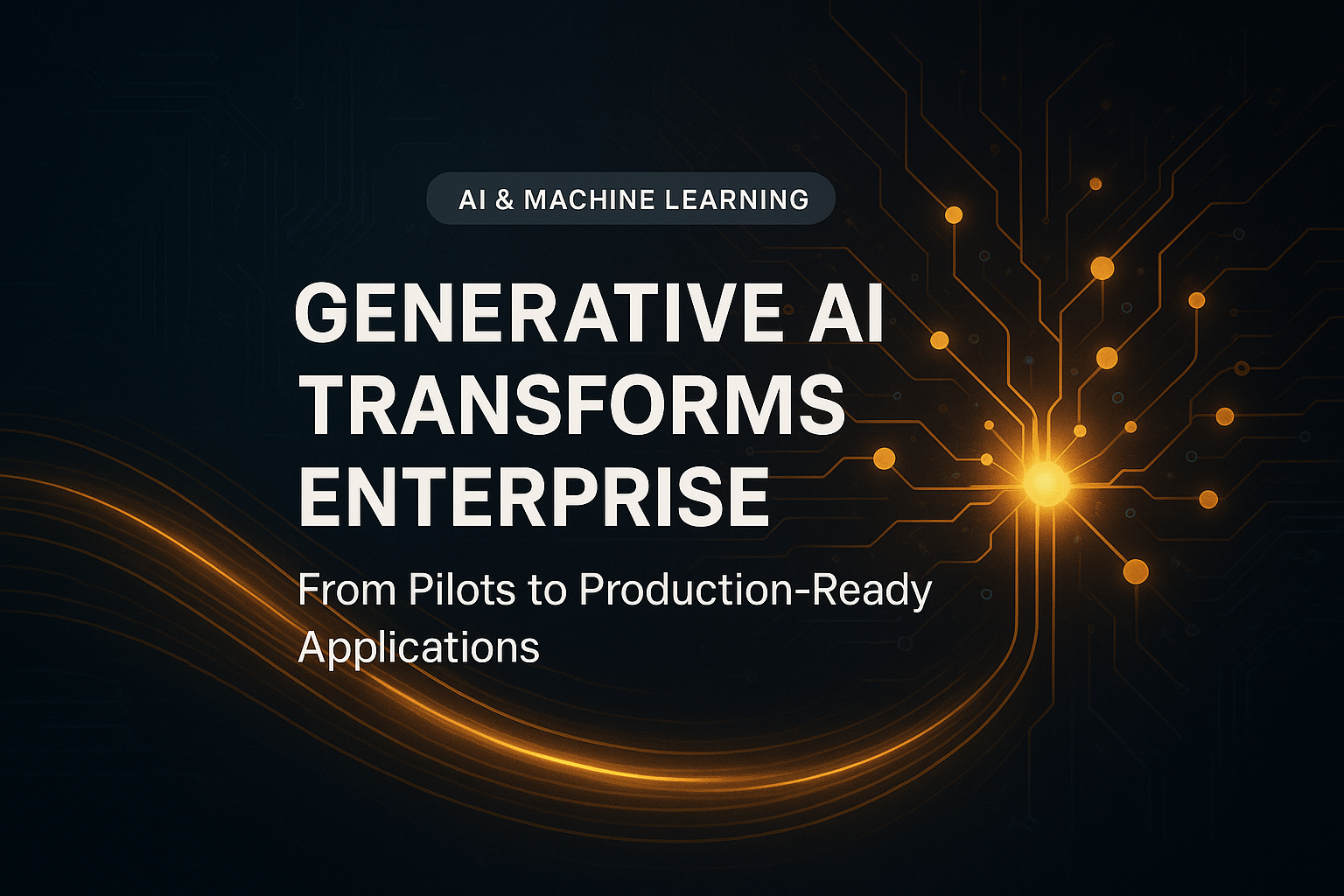
Generative AI Enterprise Applications: How Organizations Are Scaling Transformation in 2026
The enterprise AI landscape has fundamentally shifted. What began as experimental chatbots and content generators has evolved into mission-critical applications driving measurable business value across finance, healthcare, customer service, and operations. By mid-2026, generative AI is no longer a “nice-to-have” innovation—it’s becoming a competitive necessity.
The Scale of Enterprise Adoption
Organizations worldwide have moved decisively beyond proof-of-concept phases. According to McKinsey’s recent research on AI adoption, over 50% of enterprises now report having generative AI integrated into at least one business process, with many deploying multiple applications simultaneously. This represents a dramatic acceleration from 2024-2025, when adoption was primarily concentrated in technology and financial services sectors.
The shift reflects a critical realization: early adopters who successfully scaled generative AI have gained measurable advantages in operational efficiency, revenue growth, and customer satisfaction. This competitive pressure has accelerated decision-making across industries, with organizations that delayed AI investments now moving aggressively to close the gap.
High-Impact Enterprise Use Cases Driving ROI
Customer Service and Support Automation
Generative AI-powered customer service agents are among the most deployed enterprise applications in 2026. These systems handle first-contact resolution for routine inquiries, escalate complex issues to human agents, and provide real-time support across multiple channels. Organizations report 30-40% reduction in support costs while maintaining or improving customer satisfaction scores. Companies like Zendesk and Salesforce have embedded generative AI into their platforms, enabling enterprises to deploy sophisticated support systems without extensive custom development.
Financial Analysis and Risk Management
In financial services, generative AI accelerates document analysis, regulatory compliance, and risk assessment. Banks and investment firms use AI to analyze quarterly earnings reports, regulatory filings, and market data to identify emerging risks and opportunities. According to Gartner’s enterprise AI survey, financial institutions deploying generative AI for compliance and risk analysis report faster decision cycles and improved accuracy in risk detection compared to traditional methods.
Knowledge Work Acceleration
Perhaps the most widespread application is AI-assisted knowledge work. Engineers use generative AI for code generation and debugging, lawyers leverage it for contract analysis and legal research, and business analysts employ it for data synthesis and reporting. Microsoft’s GitHub Copilot and similar enterprise coding tools have demonstrated significant productivity gains, with developers reporting 35-50% faster coding velocity on routine tasks. This frees skilled workers to focus on higher-value strategic and creative work.
Supply Chain Optimization
Generative AI is transforming supply chain visibility and decision-making. By analyzing supplier data, logistics networks, and demand forecasts, AI systems help enterprises optimize inventory, predict disruptions, and reduce waste. Organizations report improved forecast accuracy and reduced operational costs, particularly in complex, multi-tier supply chains where human analysis struggles to identify patterns.
The Barriers to Broader Adoption
Despite strong momentum, significant obstacles remain. Data quality and governance continue to challenge enterprises—generative AI models require clean, well-organized training data, and many organizations struggle with legacy data silos and inconsistent data standards. Additionally, regulatory uncertainty around AI transparency, bias, and accountability has slowed adoption in highly regulated industries like healthcare and financial services.
Security and privacy concerns also loom large. Enterprises must ensure that sensitive business data isn’t leaked through AI training processes or exposed to third-party API providers. This has driven investment in private, on-premises AI infrastructure, though the cost and complexity remain significant barriers for mid-market organizations.
Strategic Frameworks for Enterprise Success
Leading organizations approach generative AI deployment with clear governance and strategic alignment. The most successful enterprises:
- Start with high-impact use cases that address specific business pain points and deliver measurable ROI
- Build internal AI literacy across teams to ensure adoption and effective use
- Implement robust data governance to maintain quality, security, and compliance
- Invest in change management to help teams transition workflows and develop new skills
- Monitor bias and fairness to ensure AI systems reflect organizational values and regulatory requirements
The 2026 Enterprise AI Landscape
By mid-2026, the competitive advantage belongs to organizations that have successfully scaled generative AI beyond pilots into production systems. The technology has matured significantly—model quality has improved, integration tools have become more accessible, and industry-specific solutions have emerged for healthcare, finance, legal, and manufacturing sectors.
However, the race is far from over. Organizations that have delayed AI investment now face increasing pressure to catch up, while early leaders must navigate the challenge of scaling responsibly while managing costs and regulatory compliance.
Looking Forward: What’s Next?
The next phase of enterprise generative AI will be characterized by specialization and integration. Rather than deploying generic large language models, enterprises will increasingly adopt domain-specific AI systems fine-tuned for their industry, regulatory environment, and business processes. Integration with existing enterprise software (ERP, CRM, HCM) will deepen, creating seamless AI-augmented workflows.
Multimodal AI—systems that process text, images, audio, and video—will expand use cases beyond text-based applications. Organizations will also shift focus from individual AI tools to AI-powered platforms that coordinate multiple AI agents to solve complex, multi-step business problems.
The Bottom Line
Generative AI has transitioned from experimental technology to operational reality for forward-thinking enterprises. The organizations winning in 2026 are those that have moved past the hype, identified high-impact use cases aligned with business strategy, and built the governance and talent infrastructure to scale responsibly.
The question is no longer “Should we invest in generative AI?” but rather “How quickly can we scale it responsibly while our competitors do the same?” For enterprises still in the exploration phase, the window for first-mover advantage is narrowing—and the cost of delay is becoming measurable.
What generative AI applications is your organization prioritizing in 2026? Share your insights in the comments below.
—
📖 **Recommended Sources for Verification:**
– **McKinsey & Company** – Quarterly AI adoption surveys and enterprise AI impact studies
– **Gartner** – Enterprise AI trends, maturity models, and industry-specific AI deployment research
– **Microsoft and GitHub** – Copilot productivity studies and enterprise AI integration documentation
– **Salesforce and Zendesk** – CRM and customer service AI deployment case studies
ⓘ **Note:** This content is AI-generated based on training data through January 2026. For June 2026 reporting, please verify specific statistics, product releases, and market developments with current industry reports from McKinsey, Gartner, and vendor announcements. The frameworks and use cases reflect established patterns as of early 2026 and should be cross-referenced with the latest quarterly reports.