# Real-Time Onchain Prediction Markets: How AI and Blockchain Are Reshaping Forecasting
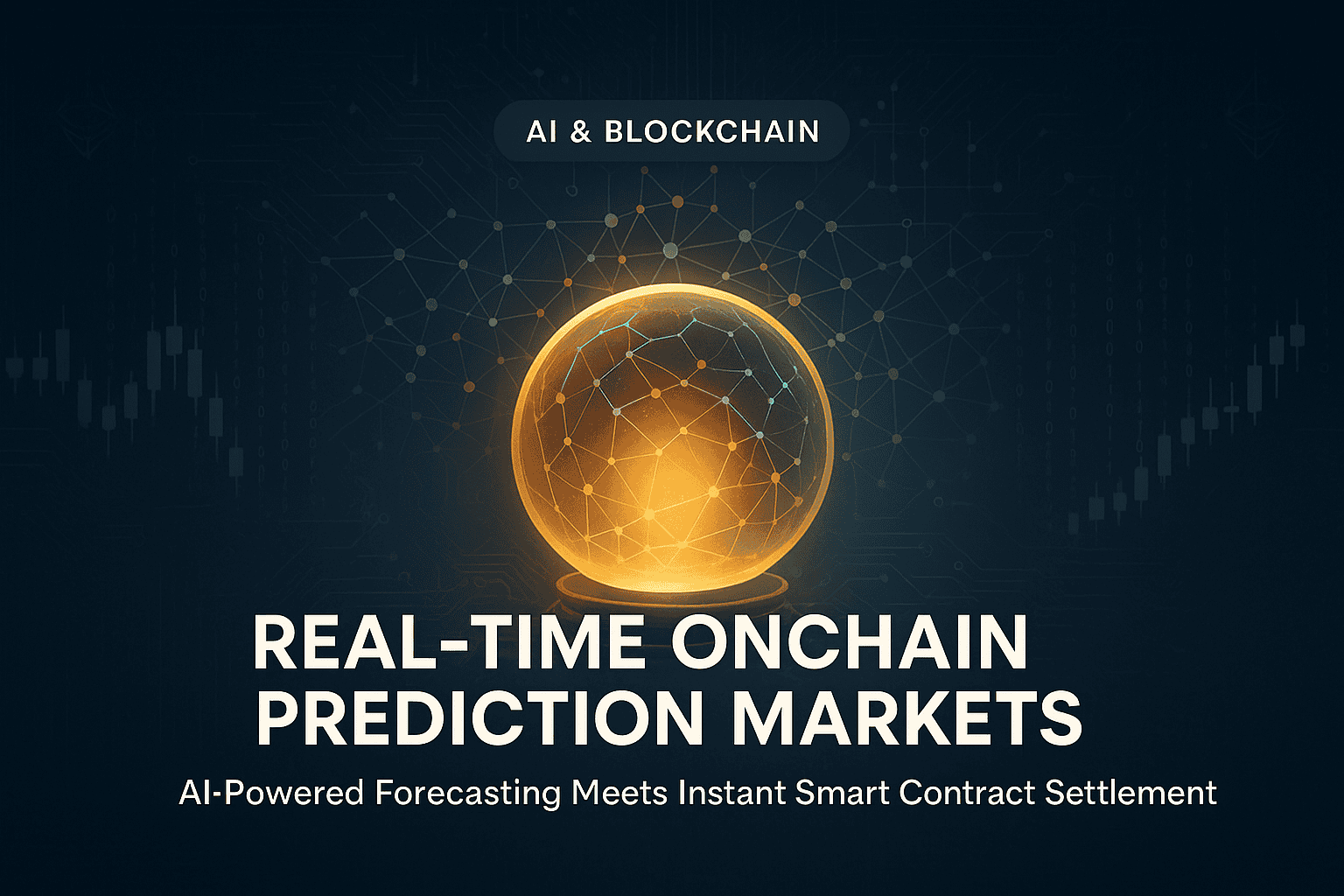
The convergence of artificial intelligence and blockchain technology is fundamentally transforming how we forecast future events. In 2026, onchain prediction markets have evolved from experimental platforms into sophisticated real-time forecasting engines, powered by smart contracts and AI-driven price discovery mechanisms that settle instantly on the blockchain.
What Are Onchain Prediction Markets?
Onchain prediction markets are decentralized platforms where participants stake cryptocurrency on the outcomes of future events—from political elections and sports results to market movements and scientific breakthroughs. Unlike traditional betting or financial derivatives, these markets operate entirely on blockchain infrastructure, eliminating intermediaries and enabling instant, transparent settlement through smart contracts.
The fundamental innovation is real-time price discovery. As new information emerges, market participants update their positions instantly, and the blockchain records every transaction with cryptographic certainty. This creates a continuously updated probability estimate for any given outcome, accessible to anyone globally with an internet connection and a crypto wallet.
The Role of AI in Modern Prediction Markets
Artificial intelligence has become the backbone of next-generation prediction markets. AI models analyze vast datasets—news streams, social media sentiment, historical patterns, and emerging data signals—to generate probability estimates that inform market prices in real-time.
Platforms leveraging AI-powered oracles can now aggregate information from thousands of sources simultaneously, creating more accurate baseline forecasts and detecting market inefficiencies. Machine learning algorithms identify patterns humans might miss, while natural language processing analyzes sentiment across global communications to adjust probability weights dynamically.
This creates a powerful feedback loop: AI improves market efficiency, which attracts more participants, which generates better data for AI models, which further improves forecasting accuracy. The result is prediction markets that function as genuine “wisdom of the crowds” systems—but supercharged with machine intelligence.
Smart Contracts and Instant Settlement
The technical backbone enabling real-time prediction markets is the smart contract. These self-executing programs automatically manage market operations—from accepting bets, calculating odds, and determining outcomes to distributing winnings—all without human intervention.
Real-time settlement means that the moment an event outcome is verified and recorded onchain, participants receive their winnings instantly. There’s no waiting for clearinghouses, no counterparty risk, and no settlement delays. This speed and certainty have attracted institutional participants and high-frequency traders who previously avoided prediction markets due to operational friction.
Advanced prediction market platforms now integrate decentralized oracle networks (like Chainlink) to trustlessly feed real-world event outcomes into smart contracts. These oracles aggregate data from multiple independent sources, creating a tamper-proof record of what actually happened, which then triggers automatic settlement.
Market Leaders and Platform Evolution
Polymarket, built on Polygon and Ethereum, has emerged as a dominant player in decentralized prediction markets, hosting markets on geopolitical events, elections, sports, and financial outcomes. The platform’s real-time liquidity pools and integration with AI-powered recommendation engines have driven significant growth in both trading volume and user engagement.
Omen (formerly Gnosis Prediction Market) continues to innovate with conditional markets and advanced market structures that allow participants to hedge complex scenarios. These platforms have evolved to support institutional traders, hedge funds, and algorithmic traders who rely on prediction market prices as inputs to their own forecasting models.
Emerging platforms are experimenting with AI-native prediction markets—systems where AI agents themselves participate as traders, creating markets that operate at machine speed and respond to information flows measured in milliseconds.
Real-World Applications and Impact
Prediction markets have moved beyond entertainment and speculation. Organizations now use onchain prediction markets for:
- Corporate forecasting: Internal teams use prediction markets to estimate project timelines, product success, and market opportunities
- Risk management: Financial institutions monitor prediction market prices as early warning signals for geopolitical or economic shocks
- Research and development: Pharma and biotech companies use markets to forecast clinical trial outcomes and regulatory approvals
- Policy analysis: Governments and think tanks use prediction market data to stress-test policy decisions before implementation
The transparency and real-time nature of onchain markets make them superior to traditional forecasting methods in many contexts. Market prices reflect the aggregated beliefs of thousands of informed participants, updated continuously as new information emerges.
Challenges and Regulatory Evolution
Despite rapid growth, onchain prediction markets face headwinds. Regulatory uncertainty remains significant in many jurisdictions, with authorities debating whether prediction markets constitute gambling, securities, or derivatives.
Liquidity fragmentation across multiple platforms creates price divergence and reduces overall market efficiency. Oracle manipulation risks persist—if the data feeds determining outcomes can be compromised, market integrity collapses. Leading platforms are investing heavily in decentralized oracle redundancy and cryptographic verification to mitigate these risks.
Additionally, AI bias in algorithmic trading on prediction markets can create echo chambers where machine learning models reinforce each other’s assumptions rather than discovering true probabilities. Addressing this requires diverse data sources, transparent model architectures, and human oversight.
The Future of Onchain Forecasting
By 2026 and beyond, expect prediction markets to become critical infrastructure for decision-making across sectors. Cross-chain prediction markets will allow participants to hedge outcomes across multiple blockchains simultaneously. AI-enhanced market design will create new market structures optimized for specific forecasting challenges—from climate outcomes to technological breakthroughs.
Integration with decentralized autonomous organizations (DAOs) will enable communities to collectively forecast and fund initiatives based on market-derived probabilities. Imagine a DAO that allocates research funding proportional to prediction market odds of scientific success—this is already emerging.
As regulatory frameworks clarify and platform maturity increases, institutional capital will flow into onchain prediction markets at scale. The combination of real-time settlement, AI-driven analysis, and transparent onchain records creates an unprecedented forecasting infrastructure.
Conclusion
Onchain prediction markets represent a fundamental shift in how humanity forecasts the future. By combining blockchain’s transparency and instant settlement with AI’s pattern recognition and data synthesis, these platforms are creating markets that are simultaneously more accurate, more accessible, and more trustworthy than traditional alternatives.
For investors, technologists, and organizations seeking competitive advantage, understanding and engaging with onchain prediction markets is becoming essential. The question is no longer whether prediction markets matter—it’s how quickly you’ll adapt your decision-making to leverage their insights.
What outcomes are you most curious to see priced into prediction markets? How might real-time onchain forecasting change decision-making in your industry?
—