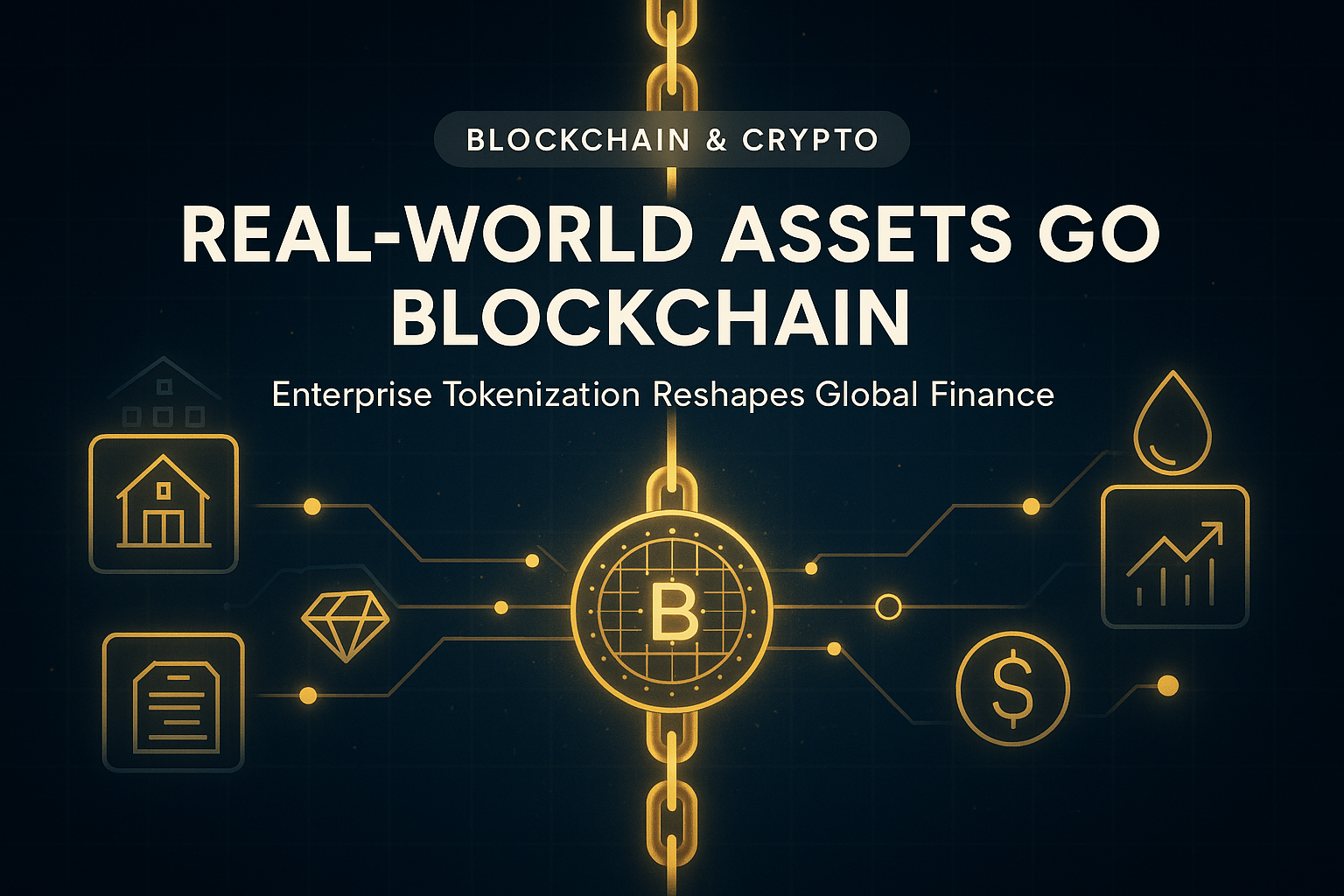
# Real-World Asset Tokenization Goes Mainstream: How RWA Blockchain Integration is Reshaping Enterprise Finance
The financial world is witnessing a fundamental shift in how assets are created, traded, and settled—and blockchain-based real-world asset tokenization is at the center of this transformation. What was once relegated to experimental crypto projects has evolved into a serious enterprise technology that major financial institutions, regulators, and corporations are actively deploying.
The Evolution from Experiment to Infrastructure
Just a few years ago, real-world asset (RWA) tokenization remained largely theoretical. Today, it represents one of the most practical applications of blockchain technology in institutional finance. The transition reflects a critical maturation: from speculative cryptocurrency use cases to regulated, compliant infrastructure that bridges traditional finance and decentralized networks.
This shift accelerated through 2025 and into 2026 as regulatory frameworks became clearer. Central banks, securities commissions, and financial authorities began establishing standards for tokenized assets. Major financial institutions—including investment banks, asset managers, and insurance companies—launched dedicated RWA divisions. The momentum is undeniable: RWA platforms are now moving beyond proof-of-concept to production-grade deployments that handle billions in asset value.
What Makes RWA Tokenization Compelling for Enterprises
Fractional ownership and liquidity represent the most immediate benefits driving mainstream adoption. Traditional assets like real estate, fine art, and commodity futures are illiquid—they require months to sell and involve significant friction. Tokenization enables these assets to be divided into smaller, tradeable units on blockchain networks, creating 24/7 markets with dramatically lower settlement times.
Consider a commercial real estate portfolio valued at $500 million. Historically, investors needed substantial capital and lengthy due diligence periods to participate. Through RWA tokenization, that property can be represented as millions of digital tokens, each representing fractional ownership. Investors can buy and sell these tokens in minutes, rather than months. Liquidity increases, capital flows more efficiently, and asset owners access a global investor base.
Beyond liquidity, cost reduction is compelling. Traditional settlement of securities involves multiple intermediaries—custodians, clearinghouses, transfer agents, and settlement networks. Each adds cost and delay. Blockchain-based RWA settlement eliminates redundant intermediaries, reducing transaction costs by 20-40% depending on the asset class. For institutional investors managing trillions in assets, this efficiency compounds into substantial savings.
Transparency and programmability add another dimension. Tokenized assets on blockchain networks create immutable audit trails. Smart contracts can automate dividend distributions, redemptions, and compliance checks. A tokenized bond can automatically distribute interest payments to all token holders instantly. A real estate token can programmatically enforce ownership restrictions or trigger actions based on predefined conditions. This automation reduces operational overhead and human error.
Real-World Deployment Across Asset Classes
The RWA tokenization wave is spreading across multiple asset categories, each with distinct use cases and adoption curves.
Tokenized bonds and fixed-income securities have emerged as the largest RWA category by value. Central banks and major governments are exploring central bank digital currencies (CBDCs) paired with tokenized government bonds. Private companies are tokenizing corporate bonds, enabling broader investor participation and faster issuance cycles. The appeal is clear: bonds are standardized instruments with established legal frameworks—tokenizing them requires less regulatory innovation than other assets.
Real estate tokenization is accelerating in major financial hubs. Commercial property managers are tokenizing office buildings, shopping centers, and apartment complexes. Residential real estate platforms are enabling fractional ownership of homes. These platforms leverage blockchain to create transparent, divisible ownership records while maintaining compliance with local property laws. The geographic arbitrage is significant—investors in Asia can now easily invest in U.S. real estate tokens without navigating traditional cross-border barriers.
Commodity tokenization—including precious metals, agricultural products, and energy futures—benefits from blockchain’s ability to represent physical assets with cryptographic proof of ownership. A tokenized gold bar can move between investors globally while remaining stored in a regulated vault. Verification is instantaneous, reducing counterparty risk and fraud.
Private equity and venture capital are exploring RWA tokenization to create secondary markets for illiquid fund shares. Historically, LP investors in venture funds are locked in for 7-10 years. Tokenization enables earlier liquidity through peer-to-peer trading of fund shares on blockchain platforms, improving capital efficiency and investor returns.
The Regulatory Framework Accelerating Adoption
Regulatory clarity has been the critical catalyst for mainstream RWA adoption. In 2025-2026, major jurisdictions established comprehensive frameworks for tokenized assets:
- The European Union’s Markets in Crypto-Assets Regulation (MiCA) provides clear rules for RWA tokenization and trading platforms
- Singapore’s Monetary Authority approved multiple RWA platforms and tokenized bond issuances
- The U.S. Securities and Exchange Commission (SEC) clarified that tokenized securities remain securities, subject to existing securities laws—reducing legal ambiguity for issuers
- Switzerland and the UAE positioned themselves as RWA innovation hubs with favorable regulatory regimes
This regulatory clarity removed the primary barrier to institutional participation. When major pension funds, insurance companies, and sovereign wealth funds understood they could legally and compliantly invest in RWA platforms, capital deployment accelerated rapidly.
Technology Infrastructure Maturation
The underlying blockchain infrastructure supporting RWA tokenization has matured significantly. Enterprise-grade RWA platforms now offer:
- High throughput and low latency: Networks like Ethereum, Polygon, and specialized RWA chains process thousands of transactions per second with settlement finality in minutes
- Institutional-grade custody and security: Regulated custodians and multi-signature wallets provide enterprise-standard asset protection
- Compliance automation: Smart contracts enforce Know-Your-Customer (KYC), Anti-Money Laundering (AML), and investor accreditation rules automatically
- Interoperability: RWA tokens issued on different blockchains can be traded and settled through cross-chain bridges, creating unified liquidity pools
These technological advances removed technical barriers that previously limited institutional adoption.
The Competitive Landscape and Market Leaders
The RWA tokenization space has attracted significant capital and talent. Major players include:
- Traditional finance infrastructure providers (JPMorgan, Goldman Sachs, BNY Mellon) launching tokenization divisions
- Blockchain-native platforms (Ripple, Chainlink, Aave) building RWA-specific features
- Specialized RWA platforms (Ondo Finance, Centrifuge, Maple Finance) focused exclusively on institutional-grade tokenization
- Custody and settlement providers (Fireblocks, Copper, Ledger Enterprise) enabling secure RWA infrastructure
Competition is intensifying, driving innovation in user experience, compliance automation, and cross-asset liquidity.
Looking Ahead: The Next Frontier
The RWA tokenization market is projected to expand dramatically through 2026 and beyond. Institutional adoption is accelerating, regulatory frameworks are solidifying, and technological barriers are dissolving. The next wave of growth will likely focus on:
- Cross-border RWA settlement: Enabling seamless trading of tokenized assets across jurisdictions
- Central bank integration: