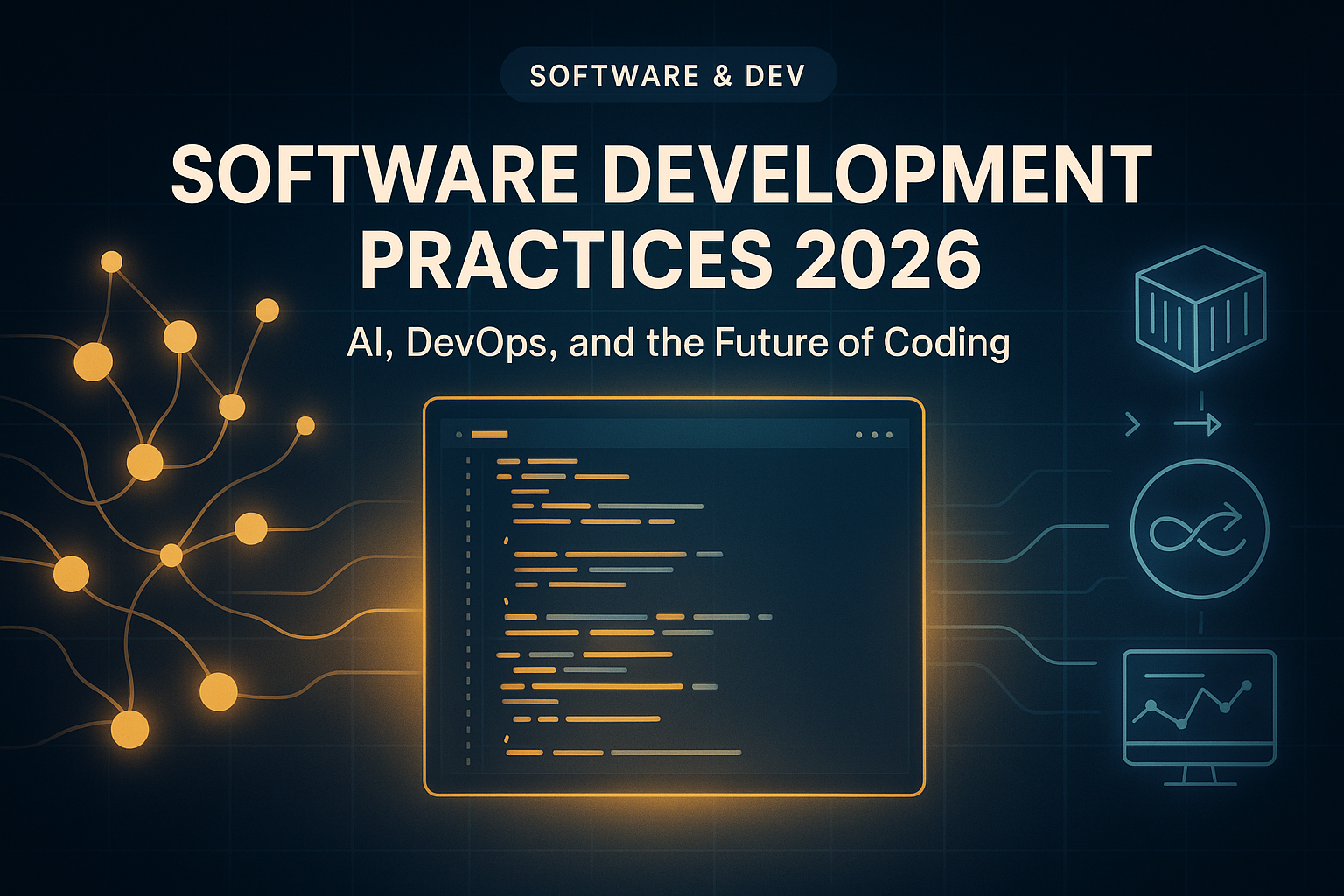
# Software Development Practices 2026: AI, DevOps, and the Future of Coding
The software development landscape is undergoing a seismic shift as AI-powered tools, advanced automation, and distributed team models converge to redefine how code gets written, tested, and deployed in 2026.
Introduction
As we move deeper into 2026, the traditional boundaries of software development are dissolving. The convergence of artificial intelligence, DevOps maturity, and cloud-native architecture is creating a fundamentally different development experience. Teams that embrace these shifts are seeing measurable improvements in velocity, quality, and team satisfaction. This isn’t about replacing developers—it’s about amplifying their capabilities and freeing them from repetitive tasks to focus on high-impact architectural and strategic work.
AI-Powered Code Generation: From Assistant to Collaborator
The most visible shift in 2026 is the evolution of AI code generation tools from novelty to necessity. What started as GitHub Copilot and similar assistants has matured into sophisticated development partners that understand context, architectural patterns, and business logic.
Modern AI coding assistants in 2026 now handle entire function implementations, test case generation, and even architectural suggestions. According to industry observations, teams leveraging these tools report 20-30% improvements in development velocity for routine tasks. More importantly, these tools are learning team-specific patterns—understanding your codebase’s conventions, preferred libraries, and architectural decisions.
The key shift is trust and integration. In 2026, AI isn’t just suggesting code snippets in isolation—it’s integrated directly into your development workflow, understanding pull request context, previous decisions, and project requirements. Developers spend less time on boilerplate and more time on algorithmic complexity and user experience design.
DevOps Automation: The Path to True Continuous Everything
DevOps practices in 2026 have moved beyond CI/CD pipelines into what might be called “Continuous Everything”—continuous integration, deployment, monitoring, security, and optimization all running in parallel.
Infrastructure-as-Code (IaC) has become the baseline expectation, not an advanced practice. Teams are now automating security scanning, performance testing, and compliance checks directly into deployment pipelines. Observability has evolved from basic monitoring to AI-driven anomaly detection that catches issues before users experience them.
The real transformation is GitOps—where your entire infrastructure and application state lives in version control. A single pull request can trigger infrastructure changes, code deployments, and configuration updates simultaneously. This creates unprecedented visibility and auditability while dramatically reducing deployment risk.
Distributed Development and Async-First Collaboration
The 2026 software development team is increasingly distributed and asynchronous. Remote work has matured from “working from home” to intentional async-first design where collaboration happens through documentation, recorded walkthroughs, and thoughtful code reviews rather than constant synchronous meetings.
This shift is forcing better practices: clearer architecture documentation, more comprehensive code comments, and stronger emphasis on pull request quality. Teams are discovering that async collaboration actually improves code quality because developers have time to think deeply rather than defend decisions in real-time meetings.
Distributed teams also mean access to global talent pools, reducing geographic constraints on hiring and creating more diverse, innovative teams.
Security and Compliance: Shifting Left and Staying Left
Security practices in 2026 have fundamentally shifted from “test for security at the end” to “security from the first line of code.” This “shift left” movement means developers are running security scans locally, using pre-commit hooks to catch vulnerabilities, and receiving real-time feedback on security implications of their code.
Compliance automation is equally critical—tools now continuously verify that deployments meet regulatory requirements (SOC 2, GDPR, HIPAA, etc.) without manual audits. This is particularly important for teams building regulated systems or handling sensitive data.
The Future Outlook
Looking ahead, the convergence of AI, automation, and distributed work will likely accelerate. The teams winning in 2026 aren’t necessarily the ones with the most developers—they’re the ones who’ve invested in tooling, automation, and practices that amplify human capability.
We should expect further integration of AI into every stage of development, more sophisticated observability and self-healing systems, and continued maturation of security automation. The developer experience will continue improving as tools become smarter and more context-aware.
Conclusion
The software development practices that define 2026 share a common thread: automation of routine work and amplification of human expertise. Whether it’s AI-assisted coding, automated DevOps pipelines, or distributed async collaboration, the goal is the same—let developers focus on problems that require creativity, judgment, and deep thinking.
The question isn’t whether your team should adopt these practices—it’s how quickly can you implement them while maintaining stability and team morale? What’s the biggest bottleneck in your current development process that AI or automation could address today?
—
📖 **Recommended Sources:**
• **GitHub Copilot and AI Code Generation Trends** – Industry adoption reports on AI-assisted development tools and their impact on developer productivity
• **DevOps and Continuous Integration Best Practices** – CNCF surveys and reports on modern deployment automation and infrastructure-as-code adoption
• **Distributed Development and Remote Work Studies** – Research on async-first development practices and their impact on code quality and team dynamics
ⓘ This content is AI-generated based on training data through January 2026 and current industry trends. Please verify specific statistics and claims with primary sources for your own analysis.