# Federated Learning & Privacy-Preserving AI: The Enterprise Standard for 2026
As data privacy regulations tighten globally and enterprises face mounting pressure to protect customer information, federated learning has emerged as the defining paradigm shift in artificial intelligence development. Rather than centralizing sensitive data in cloud servers, federated learning trains AI models directly on distributed devices—keeping raw data private while still achieving state-of-the-art model performance.
This fundamental architectural change is reshaping how Fortune 500 companies, financial institutions, and healthcare providers develop machine learning systems. In 2026, privacy-preserving AI is no longer a nice-to-have feature; it’s becoming a competitive necessity and regulatory requirement.
What Is Federated Learning?
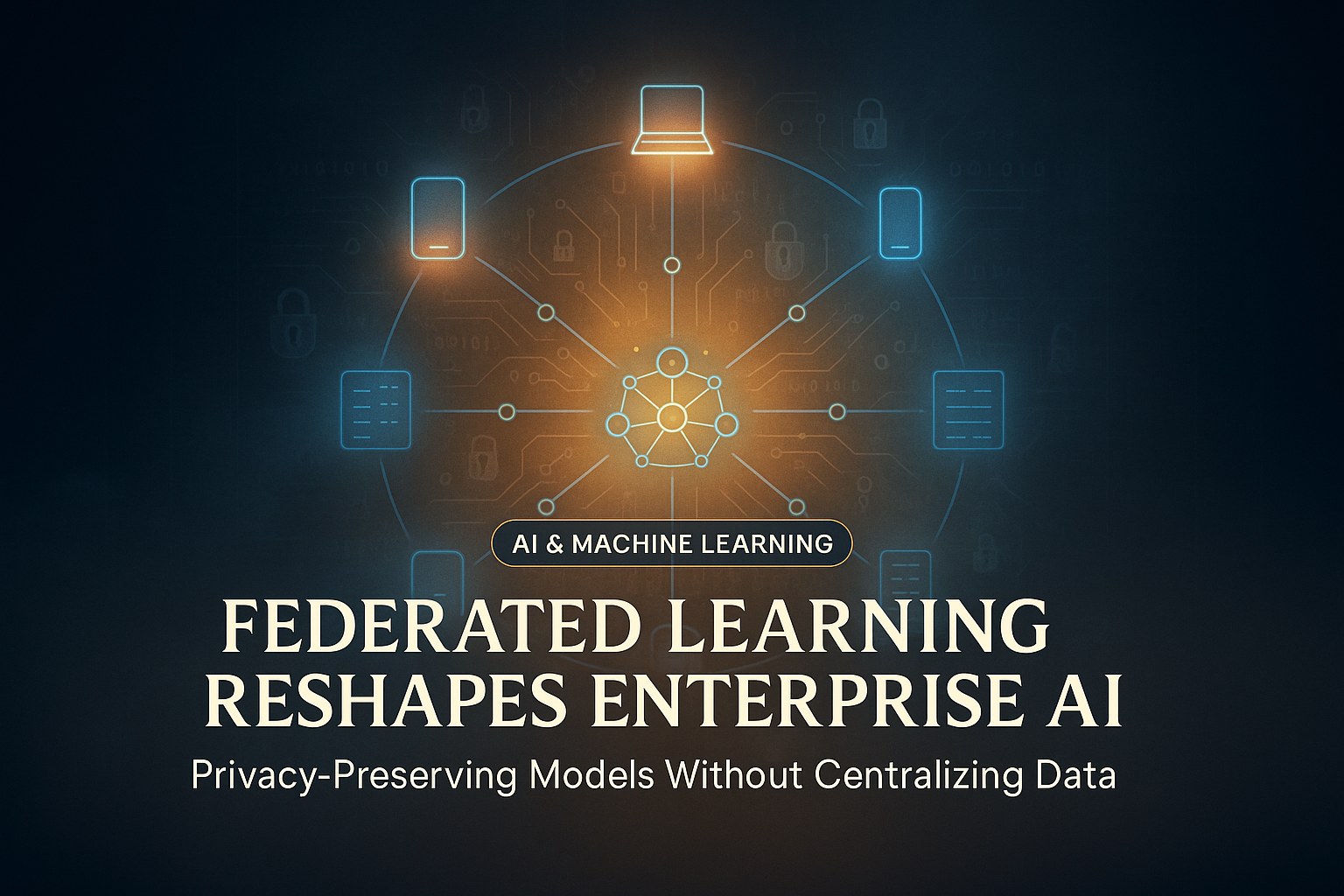
Federated learning is a decentralized machine learning approach where multiple parties (devices, edge servers, or organizations) collaborate to train a shared AI model without ever exchanging raw data. Instead of uploading sensitive information to a central server, each participant trains a local model on their own data, then sends only the model updates—not the data itself—to a central aggregation point.
Google pioneered federated learning at scale with its Gboard keyboard predictions and Pixel phone on-device intelligence. Rather than sending every keystroke or behavioral pattern to Google’s servers, the model learns locally on the device, and only the learned parameters are sent back for aggregation. This approach delivers personalized AI while maintaining user privacy by design.
The process works through iterative cycles: the central server distributes the current model to participants, each participant trains on local data, and the server aggregates the resulting model updates into an improved global model. This cycle repeats until model performance converges.
Privacy-Preserving Techniques: The Technical Foundation
Federated learning alone doesn’t guarantee absolute privacy. That’s why differential privacy and secure aggregation have become essential complementary technologies.
Differential privacy adds mathematical noise to model updates before they’re sent to the central aggregator. This noise ensures that even if an attacker intercepts the updates, they cannot reliably infer whether any individual’s data was in the training set. According to recent research from leading AI institutions, differential privacy can be applied with minimal accuracy loss when properly calibrated, making it viable for production systems.
Secure aggregation uses cryptographic techniques—such as homomorphic encryption and secret sharing—to ensure that the central server never sees individual model updates. Instead, updates are encrypted and aggregated in an encrypted state, so only the final aggregated model is revealed. This prevents the server itself from being a privacy vulnerability.
Together, these techniques create a privacy-preserving architecture where no single party—not the central server, not individual participants, not external attackers—can feasibly extract sensitive information from the training process.
Enterprise Adoption Accelerates Across Industries
Financial services firms are among the fastest adopters. Banks can now train fraud detection models collaboratively without sharing customer transaction data across institutions. Healthcare providers are using federated learning to develop diagnostic AI models trained on patient data that never leaves hospital networks, addressing HIPAA and GDPR compliance requirements simultaneously.
Apple’s on-device intelligence strategy represents the consumer-facing version of this trend. The company trains models locally on iPhones, iPads, and Macs, then aggregates learning across millions of devices—all while keeping personal data on-device. This approach has become a major marketing differentiator in privacy-conscious markets.
Regulatory pressure is accelerating adoption. The European Union’s AI Act and strengthened GDPR enforcement make centralized data collection increasingly risky. Federated learning allows enterprises to comply with strict data residency requirements while still benefiting from collaborative AI development.
Key Challenges and Solutions
Communication overhead remains a significant technical hurdle. Sending model updates across distributed networks consumes bandwidth and introduces latency. Recent advances in model compression and gradient quantization reduce update sizes by 10-100x, making federated learning practical for edge devices and slow networks.
Model heterogeneity presents another challenge: participants may have different data distributions, device capabilities, and network conditions. Federated optimization algorithms like FedProx and FedAvg+ have been developed specifically to handle this heterogeneity, maintaining model quality even when participants have non-IID (non-independent and identically distributed) data.
Participant dropout is inevitable in real-world federated systems. Advanced aggregation strategies now gracefully handle participants joining and leaving mid-training, ensuring robust model convergence.
The Road Ahead: Standardization and Interoperability
As federated learning matures, industry standardization is becoming critical. TensorFlow Federated, PySyft, and other open-source frameworks are enabling organizations to implement federated systems without building from scratch. Major cloud providers—including AWS, Google Cloud, and Microsoft Azure—are adding federated learning capabilities to their AI platforms.
By 2026, we’re seeing the emergence of federated learning as a service (FLaaS), where enterprises can leverage managed platforms to orchestrate privacy-preserving AI training without deep infrastructure expertise. This democratization will accelerate adoption beyond tech-forward organizations.
Conclusion: Privacy as a Competitive Advantage
Federated learning transforms privacy from a compliance checkbox into a genuine competitive advantage. Organizations that master privacy-preserving AI can build customer trust, navigate regulatory complexity more easily, and access collaborative data opportunities that centralized approaches cannot.
As data breaches continue making headlines and regulations tighten globally, the question is no longer whether enterprises will adopt federated learning—but how quickly they can integrate it into their AI strategy.
What’s your organization’s current approach to training AI models on sensitive data? Are privacy-preserving techniques on your AI roadmap for 2026?
—
**📖 Recommended Sources:**
– **Google AI Blog** – Pioneering work on federated learning for on-device intelligence and Gboard
– **TensorFlow Federated Documentation** – Open-source framework for federated learning implementation
– **EU AI Act & GDPR Guidance** – Regulatory drivers for privacy-preserving AI adoption
– **McKinsey AI & Privacy Research** – Enterprise adoption trends and business impact analysis
– **IEEE & ACM Research** – Differential privacy and secure aggregation technical foundations
ⓘ This content is AI-generated based on training data through January 2026. Please verify specific regulatory requirements and technical implementations independently with current sources.