# World Models Meet Generative Virtual Environments: The Future of AI Training and Robotics in 2026
The line between simulation and reality is blurring. By 2026, world models have evolved from academic curiosities into powerful, interactive generative systems that serve as fully-fledged virtual training environments for artificial intelligence agents and robots.
What Are World Models and Why They Matter Now
A world model is fundamentally an AI system that learns to predict how the world evolves in response to actions. It generates realistic observations—pixels, audio, sensor data—and simulates the dynamics of physical environments. But in 2026, the field has matured beyond simple predictive models. These systems now function as interactive simulators where entire policy training pipelines run without ever touching the physical world.
According to recent research, world models are now systematized into three core components: renderers (which generate observations), simulators (which evolve state over time), and planners (which generate actions). The most cutting-edge systems excel at combining the first two—creating visually realistic, physically coherent environments where AI can learn and adapt.
The timing matters. As embodied AI and robotics scale, the need for safe, efficient, and infinitely reusable training environments has become critical. Physical robots are expensive, slow to iterate, and constrained by safety concerns. Generative virtual environments solve this by providing risk-free, infinitely scalable alternatives.
From Text to Interactive Worlds: The Generative Revolution
The breakthrough of 2026 lies in systems that convert text prompts or single images into fully explorable virtual environments—a capability that seemed impossible just years ago.
Google DeepMind’s Genie 3 exemplifies this shift. Rather than simply generating static images or video clips, Genie 3 produces convincing interactive virtual environments from natural language descriptions. Describe “a snowy mountain at dusk,” and the system generates a world where a user or agent can move freely, trigger dynamic events like rainfall, and interact for sustained periods. It’s a video generator that functions as a playable game engine.
Similarly, World Labs’ Marble generates coherent 3D scenes from text prompts, creating explorable environments where agents can act and learn. And Tencent’s Hunyuan World 1.0 takes a different approach: it converts a single photograph or artwork into an interactive 3D panorama, allowing users to navigate and view the scene from multiple angles. This bridges static content creation with dynamic world generation.
Perhaps most ambitiously, Roblox’s Reality vision—built on foundations from Morpheus AI—allows users to upload any image—photographs, concept art, paintings, even sketches—and step into it as a live, interactive world. This represents a genuine shift toward general-domain generative world engines that prioritize both visual realism and physical responsiveness.
World Models as Full Training Environments for Embodied AI
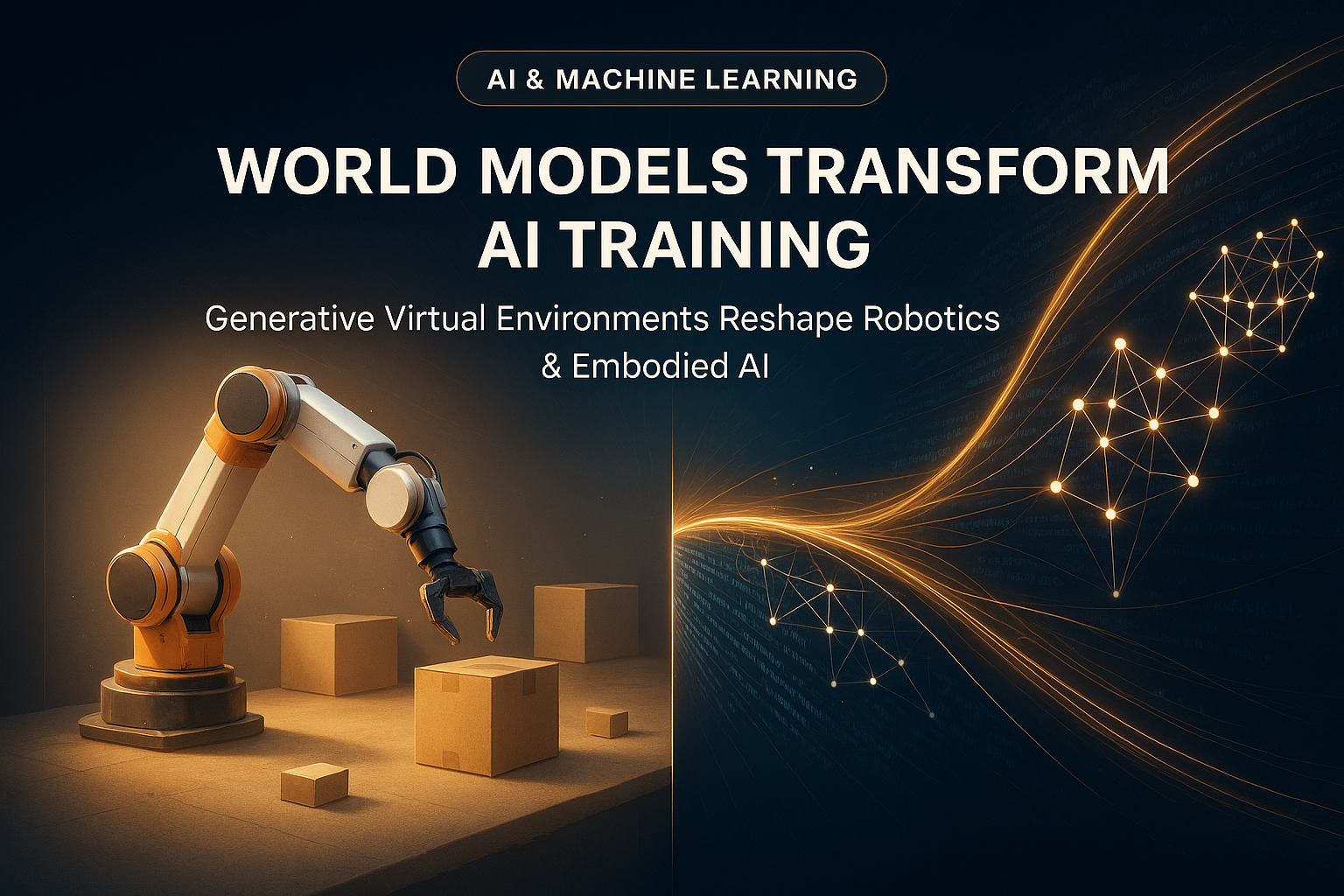
The most profound shift in 2026 is treating world models as complete virtual environments—not just auxiliary tools, but the primary training ground for AI agents and robots.
A cluster of 2025–2026 projects now explicitly leverage this approach:
- World-Env uses world models as the entire environment for post-training Vision-Language-Action (VLA) agents, allowing policy refinement without real-world interaction.
- World4RL employs diffusion-based world models to refine robotic manipulation policies inside generative environments.
- WorldGym treats the world model itself as a gym-like environment for policy evaluation and testing.
- WorldEval uses world models to evaluate how robot policies would behave in realistic settings before real-world deployment.
- GigaWorld-0 positions world models as a data engine, generating massive amounts of synthetic but structured experience for embodied agents.
This represents a fundamental architectural shift: instead of using world models to estimate value functions or rewards (classic model-based reinforcement learning), new systems conduct entire policy training pipelines inside generative simulators. The model provides both the dynamics and the observation space—it is the environment.
Real-to-Sim-to-Real: Closing the Robotics Loop
For robotics specifically, World Labs’ R2S2R (Real-to-Sim-to-Real) engine exemplifies how generative world models are enabling practical deployment at scale.
R2S2R reconstructs physical robots, sensors, environments, and tasks into interactive virtual worlds while preserving visual fidelity, geometry, and contact physics. This creates a bidirectional loop: real-world scenarios are captured and digitized, policies are trained and refined in simulation, and then deployed back to physical robots with confidence that the sim-to-real gap is minimal.
Related systems like BWM (A Low-Cost High-Fidelity World Simulator for Robots) extend this approach, offering controllable generative simulators specifically designed for robot manipulation and policy improvement. By integrating diffusion and Transformer-based architectures, these systems can generate diverse, realistic training scenarios on demand—eliminating the need for expensive physical data collection.
Multimodal and Foundation-Scale World Models
Beyond visual-only systems, 2026 has witnessed the emergence of multimodal world models that integrate audio, video, and action into unified generative systems.
Starchild-1 is positioned as “the world’s first real-time multimodal world model.” Rather than training on text descriptions, Starchild-1 learns directly from video: pixels, motion, and actions. It autoregressively generates synchronized audio and video in real time while responding to streaming user input—creating a genuine interactive loop. This richness is critical for embodied agents; robots need to understand not just what they see, but the sonic and tactile consequences of their actions.
At foundation-model scale, NVIDIA Cosmos and related systems like Microsoft’s VideoWorld represent the next evolution. These world foundation models (WFMs) are trained on massive video corpora and aim to perceive, predict, and simulate environments in motion. Cosmos integrates video generation, physics-aware simulation, and robotics workflows, forming a blueprint for connecting high-quality generative video with embodied AI training loops. The vision: train AI agents “in a safe, scalable world before acting in the real one.”
Beyond Raw Generation: Causal and Multi-Agent Worlds
As generative world models mature, researchers are pushing beyond pure visual fidelity toward causally structured simulators that support robust planning and multi-agent interactions.
Recent work on Implicit Causal World Models addresses a critical gap: standard model-based RL world models often conflate correlations with true causal mechanisms, especially in multi-agent scenarios. Implicit Causal World Models recover environmental dynamics from offline multi-agent demonstrations without requiring predefined causal graphs, leveraging policy variance to identify causal structure. This is essential for building generative environments that remain robust under distribution shift and complex strategic interactions—a prerequisite for real-world deployment.
The Ecosystem Matures: From Research to Infrastructure
By mid-2026, the field has developed enough breadth that taxonomies, surveys, and curated infrastructure are emerging. Comprehensive panoramic surveys on world model architectures, methods, and reasoning paradigms are now standard. Curated lists like the Awesome Embodied Data Pyramid catalog the expanding ecosystem of generative simulators, task generators, data engines, and sim-to-real pipelines.
This signals a transition from isolated research papers to systems and ecosystem thinking. The field is asking: How do we standardize interfaces between world models and RL algorithms? How do we benchmark generative environments? How do we ensure that training in simulation transfers reliably to the physical world?
The Convergence: Why This Matters for AI’s Future
The convergence of generative models, world models, and embodied AI is reshaping how we train intelligent systems. Rather than collecting vast amounts of real-world data—expensive, slow, and often unsafe—AI developers can now generate infinite diverse scenarios in virtual worlds that are both visually realistic and physically coherent.
For robotics, this means faster iteration, lower costs, and safer development pipelines. For embodied AI more broadly, it means the ability to train agents in scenarios too dangerous, expensive, or impractical to recreate physically. For foundation models, it opens the door to training on diverse, synthetic yet realistic experiences at unprecedented scale.
The systems of 2026—Genie 3, Cosmos, Starchild-1, Marble, and the broader ecosystem—are not just incremental improvements. They represent a fundamental shift in how AI agents learn about and interact with the world.
What Comes Next?
As these systems mature, the critical challenges ahead involve closing the sim-to-real gap, scaling multimodal generative environments, and building causal world models that support robust planning under uncertainty. The next frontier isn’t just generating more realistic worlds—it’s creating environments that are predictably aligned with physical reality and enable AI systems to transfer learned skills seamlessly from simulation to the real world.
How do you think generative virtual environments will reshape robotics development in your industry? Share your thoughts in the comments below.
—
**📖 Recommended Sources:**
• **Perplexity Research (August 2026)** – Comprehensive panoramic survey on world models, generative virtual environments, and the ecosystem of systems including Genie 3, Cosmos, Starchild-1, and R2S2R robotics simulators.
• **Fei-Fei Li’s “Building Worlds That Train Robots”** – A16Z article framing generative world models as the core infrastructure for robot training, emphasizing the progression from scene generation to highly aligned simulators.
• **Awesome Embodied Data Pyramid (GitHub)** – Curated taxonomy of 2025–2026 generative simulators, including World-Env, WorldGym, WorldEval, GigaWorld-0, and sim-to-real pipelines.
────────────────────
ⓘ *This content is AI-generated based on research conducted on August 5, 2026. Please verify specific product claims and timelines independently with official sources.*