# AI Hardware Accelerators Trends 2026: From Single Chips to Full-Stack Infrastructure
The race for AI hardware dominance is no longer about who can build the fastest single chip—it’s about who can architect the most efficient system-level infrastructure. In 2026, the industry is experiencing a fundamental shift in how AI accelerators are designed, deployed, and optimized.
The End of Chip-Centric Thinking
For years, AI hardware competition centered on raw compute performance and raw TFLOPS (floating-point operations per second). A faster GPU meant a better solution. That narrative is changing dramatically.
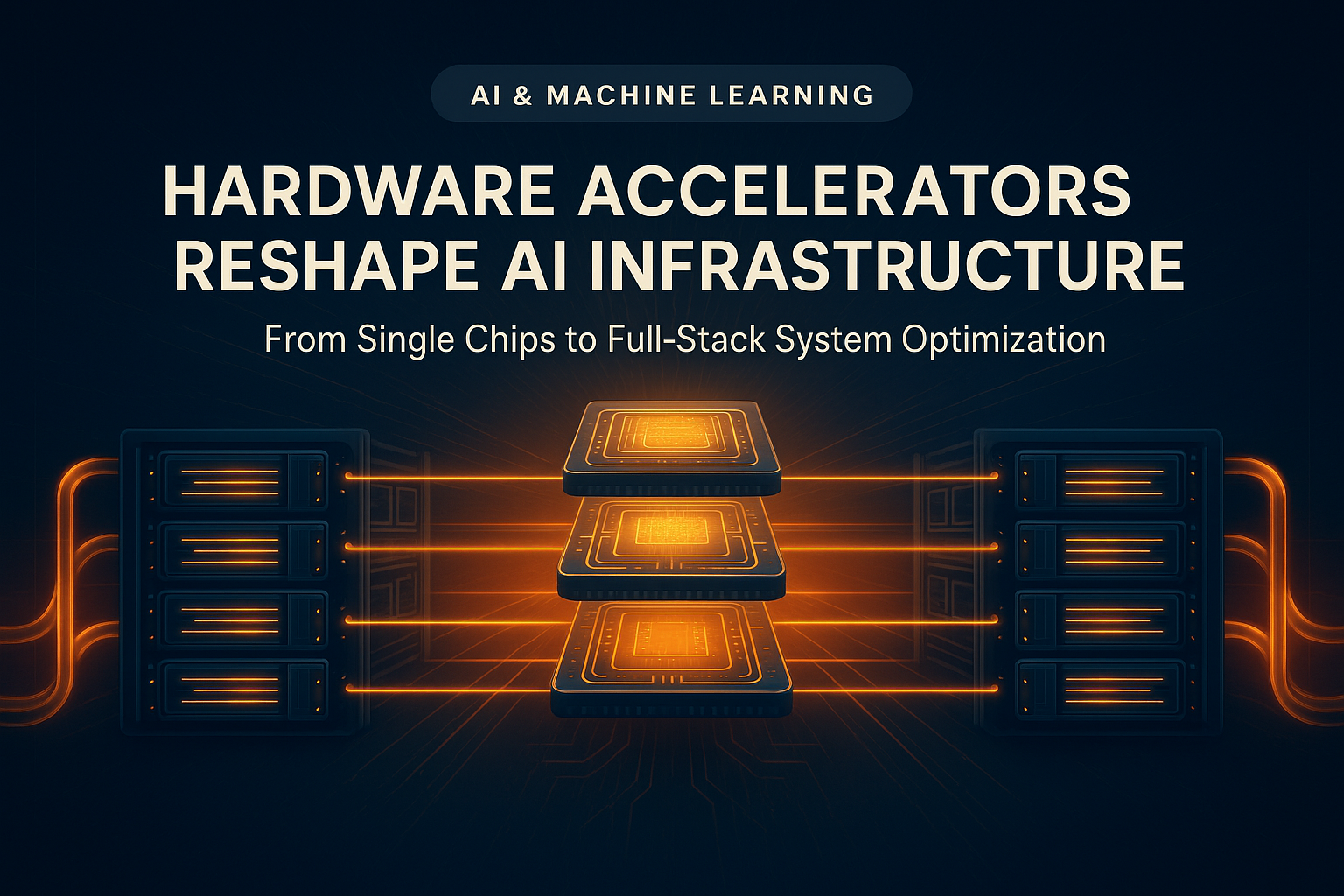
According to recent industry analysis, the focus has shifted from isolated accelerator performance toward rack-scale co-design—optimizing the entire stack including accelerator, CPU, memory, networking, storage, and cooling as a unified system. This represents a maturation of the AI infrastructure market. Individual chip specs matter far less than how well components communicate, how efficiently data flows, and how power is managed across the entire deployment.
NVIDIA, AMD, and emerging custom silicon providers are now competing on system architecture, not just transistor density. This is a seismic shift in how enterprises evaluate AI infrastructure investments.
Memory Bandwidth and HBM: The New Bottleneck
One of the most critical trends in 2026 is the recognition that memory bandwidth has become the primary constraint, not compute capacity. Large language models and foundation models are fundamentally limited by how fast data can move between the accelerator and memory.
High-bandwidth memory (HBM) is now central to every competitive accelerator design. The industry is investing heavily in next-generation HBM architectures that can sustain the data throughput required for trillion-parameter models. This has created a secondary market for memory manufacturers, with companies like SK Hynix and Micron competing fiercely for premium HBM contracts.
The implication for data center operators is clear: total system cost of ownership depends more on memory architecture than on accelerator core count. This is reshaping purchasing decisions and vendor strategies across the board.
Inference: The Next Battleground
While training still drives massive GPU demand, inference has emerged as the decisive competitive arena for 2026 and beyond. According to industry research, inference workloads are becoming increasingly specialized, with custom ASICs and purpose-built accelerators outperforming general-purpose GPUs on cost and efficiency metrics.
Hyperscalers—Google, Amazon, Meta, Microsoft—are accelerating investment in proprietary AI inference chips. This trend reflects a fundamental economic reality: inference at scale is where the margin opportunity lies, and custom silicon can deliver 2–5x better cost-per-inference than general-purpose accelerators.
Startups and emerging vendors are also capitalizing on this shift. Companies focused on inference-specific architectures and lower-precision compute formats (FP4, INT8, and beyond) are gaining significant market traction. The software ecosystem around these specialized formats is maturing rapidly, making adoption more feasible for enterprise deployments.
Interconnect and Cooling: The Hidden Differentiators
Modern AI infrastructure requires accelerators to work in concert, not isolation. Ultra-fast interconnects—whether optical, electrical, or hybrid—are becoming critical differentiators. Intra-rack and inter-node bandwidth directly impacts training speed and inference latency at scale.
Equally important is thermal management. As AI server density increases, direct liquid cooling is transitioning from a premium feature to a standard requirement. Companies that can deliver efficient cooling solutions—whether through advanced liquid cooling, immersion cooling, or hybrid approaches—gain significant deployment advantages.
These infrastructure elements are often overlooked in benchmark comparisons but represent the real competitive moat in production AI deployments.
Custom Silicon and Hyperscaler Independence
The move toward custom AI accelerators by cloud providers and platform companies is accelerating. Rather than relying exclusively on NVIDIA GPUs, major players are developing proprietary silicon to optimize for their specific workloads and reduce vendor lock-in.
This trend is reshaping the competitive landscape. NVIDIA remains dominant, but the market is fragmenting as custom silicon becomes more viable. According to industry forecasts, custom ASICs and specialized accelerators will capture an increasing share of the AI infrastructure market through 2026 and beyond.
For enterprises, this fragmentation creates both opportunity and complexity. Customers can now negotiate better pricing and performance from multiple vendors, but managing heterogeneous hardware ecosystems requires more sophisticated software abstraction layers.
Lower Precision and Efficiency Gains
FP4, FP8, and other reduced-precision formats are gaining critical importance as the industry optimizes for inference efficiency. Lower precision compute can deliver 2–4x throughput improvements with minimal accuracy loss for many inference workloads.
This trend is democratizing AI deployment. Smaller organizations and edge deployments can now achieve competitive performance with more modest hardware investments. The software ecosystem—compilers, quantization tools, and runtime optimizations—is maturing rapidly to support these precision formats at scale.
Edge AI Accelerators: Distributed Intelligence
While data center AI continues to dominate investment, edge AI accelerators are experiencing accelerated growth. Mobile, IoT, and embedded AI applications require specialized hardware that balances power efficiency with inference performance.
Vendors like Qualcomm, Apple, and specialized edge AI companies are delivering increasingly sophisticated accelerators for on-device AI. This trend reflects the broader shift toward distributed AI inference, where models run locally on edge devices rather than exclusively in cloud data centers.
The Software Ecosystem Matters More Than Ever
One of the most underappreciated trends in 2026 is the critical importance of software ecosystems. Raw hardware specs mean little without mature compilers, runtimes, frameworks, and developer tools.
Vendors with strong software ecosystems—NVIDIA with CUDA, AMD with ROCm, and emerging players with PyTorch/TensorFlow optimization—have significant competitive advantages. This is driving consolidation around established platforms and creating barriers to entry for pure hardware startups.
Future Outlook: System Optimization Over Raw Performance
Looking ahead, the AI hardware market will continue to mature around full-stack system optimization. Single-metric benchmarks (TFLOPS, memory bandwidth, latency) will become less relevant. Instead, total cost of ownership, energy efficiency, software maturity, and deployment flexibility will drive purchasing decisions.
Training will remain GPU-intensive, but inference specialization will accelerate. Custom silicon will capture growing market share. Edge AI will become increasingly important. And the companies that can deliver integrated hardware-software solutions—not just chips—will dominate the competitive landscape.
Conclusion: The Infrastructure Imperative
The AI hardware accelerator market in 2026 is no longer about who builds the fastest chip. It’s about who can architect the most efficient, scalable, and cost-effective AI infrastructure system. Memory bandwidth, interconnects, cooling, software ecosystems, and specialized inference silicon are now the real competitive battlegrounds.
For enterprises investing in AI infrastructure, this shift creates both challenges and opportunities. The diversity of solutions means more choice, but also greater complexity in evaluation and deployment. The winners will be those who recognize that AI hardware success is ultimately a systems problem, not a pure compute problem.
What aspects of AI hardware architecture matter most for your organization’s AI strategy—raw performance, cost efficiency, or software ecosystem maturity?
—
📖 **Recommended Sources:**
• **NewTechZy** – Comprehensive 2026 AI chip advancements analysis and vendor roadmaps
• **Data Center Knowledge** – Deep dive into inference-focused chip design and market dynamics
• **The Business Research Company** – Global AI accelerator market sizing and forecasts
• **Omdia/Informa Tech** – AI data center chip market projections and custom ASIC trends
• **Next Platform** – Critical analysis of AI infrastructure spending forecasts and ROI considerations
ⓘ This content is AI-generated based on training data and live research through August 2026. Please verify specific vendor announcements and financial projections independently through official sources.