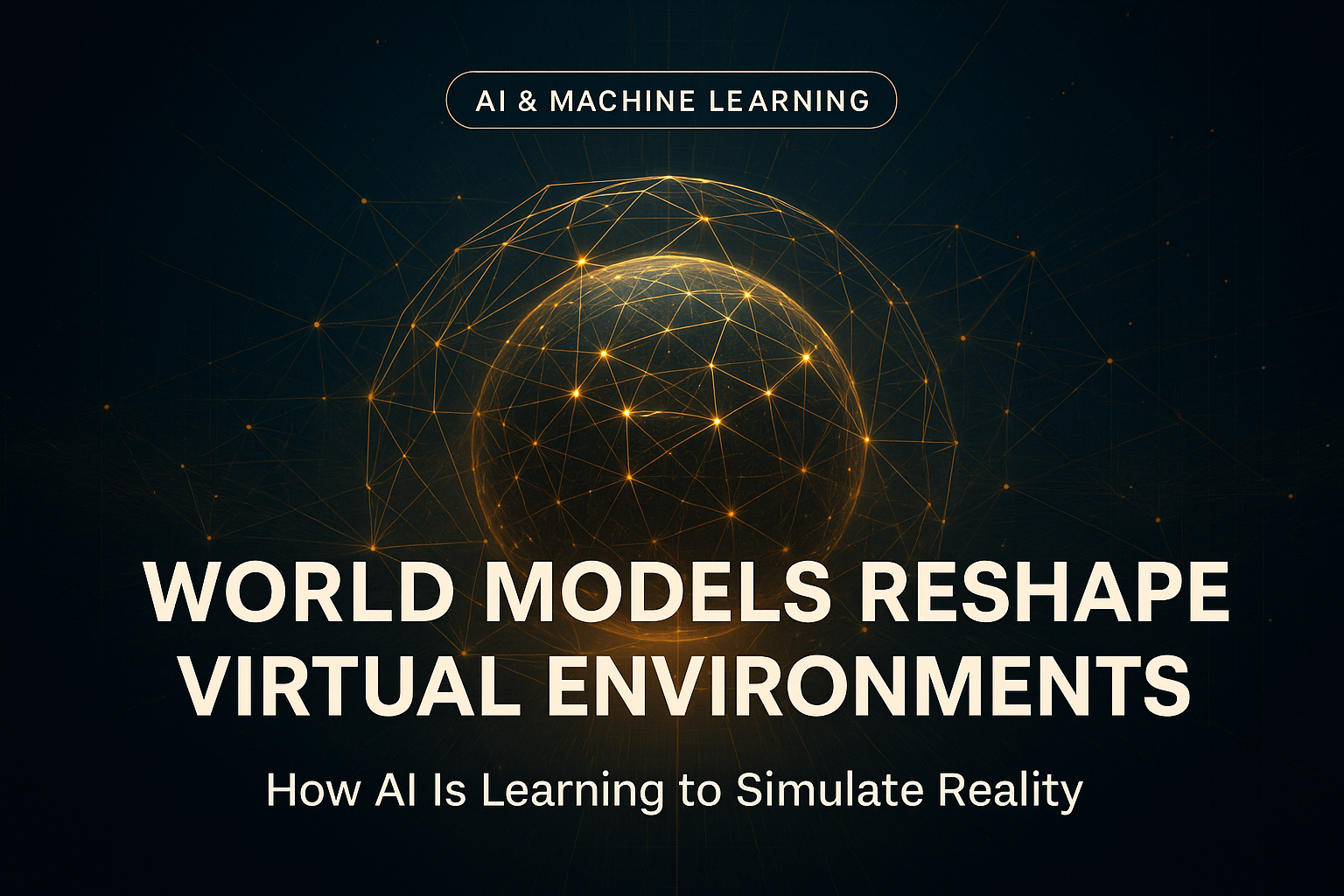
# World Models & Generative Virtual Environments: The Next Frontier in AI Simulation
Imagine an AI system that doesn’t just recognize objects in a video, but can predict what will happen next—and then generate entirely new scenarios that follow the same physical laws. This is the promise of world models, one of the most transformative technologies emerging in AI research today.
Understanding World Models: AI’s Internal Simulation Engine
World models are AI systems trained to build internal representations of how the world works. Rather than processing raw sensory data directly, these models learn to compress and encode the essential rules governing environments—physics, causality, object interactions—into a compact digital “understanding.”
Think of it like this: humans don’t need to watch thousands of hours of footage to understand gravity. We develop an intuitive model of how objects fall, bounce, and interact. World models aim to give AI systems similar capabilities. By learning these underlying patterns, they can predict future states, generate novel scenarios, and reason about cause-and-effect relationships in ways that traditional neural networks cannot.
According to recent advances in the field, world models combine representation learning with generative capabilities. The system first learns a latent space—a compressed mathematical representation of the environment—and then learns to navigate and manipulate that space to generate new, physically plausible scenarios.
The Generative Leap: From Prediction to Creation
The real breakthrough comes when world models become generative. Traditional predictive models answer the question: “What happens next?” Generative world models go further and ask: “What could happen?” and “What if we changed this variable?”
This shift unlocks several powerful applications:
- Robotics Training: Robots can practice complex tasks in infinitely varied simulated environments before touching the real world, dramatically reducing training time and physical wear.
- Game Development & Metaverses: Game engines can use world models to generate realistic, interactive virtual worlds with minimal manual design.
- Scientific Discovery: Researchers can use generative world models to explore hypothetical scenarios in chemistry, physics, and biology.
- Digital Twins: Manufacturing and infrastructure systems can create dynamic, predictive digital replicas that anticipate failures before they occur.
The key innovation is physics-awareness. Modern generative world models are increasingly trained on physics-based datasets or constrained by physics-based loss functions, ensuring generated content respects real-world laws rather than producing physically impossible scenarios.
Industry Leaders and Recent Breakthroughs
Major AI research labs have made significant strides in this space. OpenAI, DeepMind (Alphabet), and Meta AI Research have all published influential papers on world models and generative simulation. These efforts demonstrate that scaling world models—training them on larger, more diverse datasets—leads to better generalization and more realistic environment generation.
One notable trend is the integration of diffusion models with world modeling. By combining the generative power of diffusion (the same technology behind DALL-E and Midjourney) with physics-aware constraints, researchers are creating systems that can generate rich, detailed virtual environments while maintaining physical plausibility.
Companies building applied solutions are also emerging. Startups in robotics, game development, and industrial simulation are beginning to incorporate world model principles into their platforms, signaling that this technology is transitioning from pure research to production systems.
Why This Matters Now (May 2026)
The convergence of several factors has made world models practically viable in 2026:
- Computational Efficiency: New model architectures and training techniques have reduced the compute required to train effective world models.
- Data Availability: Large-scale video datasets and physics simulation libraries provide rich training material.
- Multimodal Integration: World models now incorporate text, vision, and sensor data, enabling richer environmental understanding.
- Commercial Incentives: Industries from gaming to autonomous vehicles see clear ROI in world model technology.
For enterprises and developers, this means the gap between research and deployment is narrowing. Organizations investing in world model capabilities now position themselves to lead in simulation-driven AI applications over the next 2-3 years.
The Future: Toward Autonomous Virtual Worlds
Looking ahead, the trajectory is clear: world models will become more sophisticated, more efficient, and more integrated into mainstream AI systems. We’re moving toward a future where AI systems don’t just interpret reality—they can simulate, predict, and generate rich virtual environments with human-level fidelity.
The implications are profound. Imagine a robotics company that can train its fleet entirely in simulation, a game studio that generates entire worlds procedurally, or a manufacturing plant that predicts equipment failures weeks in advance. These aren’t distant possibilities—they’re emerging capabilities powered by generative world models.
What’s Your Take?
As world models mature, which industry do you think will see the most transformative impact first: robotics, gaming, or industrial simulation? The race is on, and the winners will be those who master the ability to teach machines to understand and generate the worlds they inhabit.
—
📖 **Recommended Sources:**
• **OpenAI Research** – Publications on world models and generative simulation capabilities
• **DeepMind Blog** – Advances in physics-aware neural networks and environment generation
• **Meta AI Research** – Work on scaling generative models for interactive environments
• **ArXiv** – Latest preprints on world models, diffusion-based generation, and physics-constrained learning
ⓘ This content is AI-generated based on training data through January 2026. Please verify specific claims and latest developments independently with official research publications and company announcements.