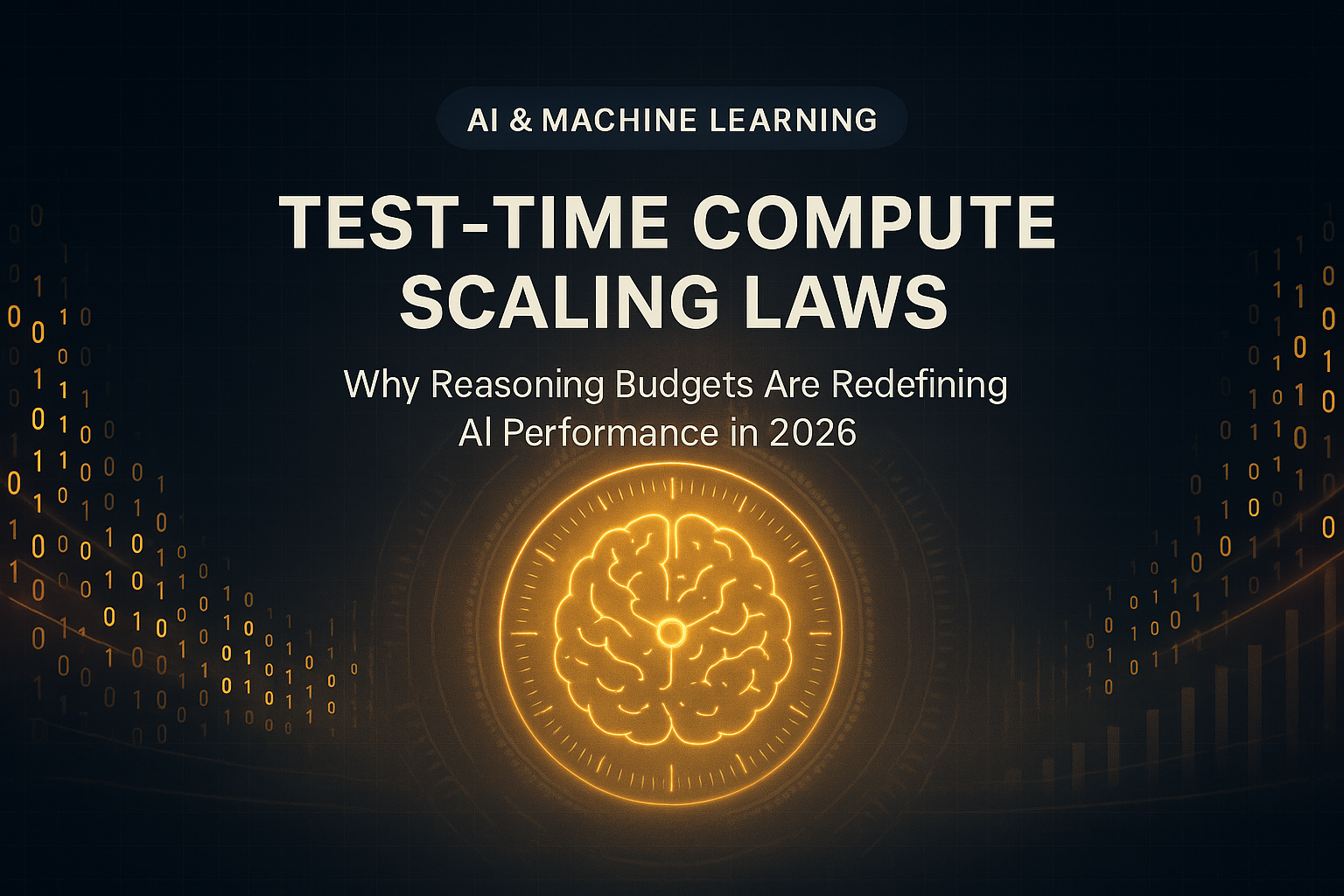
AI labs have quietly stopped asking “how big can we make the model?” and started asking “how long should we let it think?” That shift is rewriting the rules of AI performance — and the economics behind it.
For years, progress in artificial intelligence followed a familiar script: bigger models, more training data, more pretraining compute. But as of October 2026, the frontier of AI research has moved to a different lever entirely — test-time compute (TTC), the computation a model spends after a prompt arrives, while it reasons, searches, verifies, and revises its own answer. The question driving labs like OpenAI, Google DeepMind, and Anthropic is no longer just “which model is smartest,” but “how much thinking can we afford to buy, and where does it pay off?”
The Myth of a Single Scaling Law
Early intuition held that test-time compute scaling followed a clean pattern — accuracy climbing predictably as a power of inference tokens, mirroring the pretraining scaling laws popularized years earlier. 2026 research has dismantled that assumption.
New studies on inference scaling show that simple resampling strategies — generating many candidate answers and picking the best — tend to saturate: beyond a certain point, additional samples mostly produce redundant attempts rather than new insight. Instead of one universal curve, researchers now describe performance as a function of several interacting variables: base-model capability, reasoning budget, search strategy, verifier quality, and task difficulty. The practical takeaway is blunt — inference FLOPs are not interchangeable. A token spent on independent sampling behaves very differently from a token spent on structured revision or recurrent computation.
Discovery vs. Execution: A New Framework for Reasoning
One of the more influential 2026 contributions is a Discovery–Execution framework for mathematical reasoning, which separates two distinct phases of problem-solving: discovering a useful strategy, and successfully executing it once found. Researchers found that short-budget performance doesn’t reliably predict how a model will perform with a much larger reasoning budget — a model that struggles early may still scale well if it has strong “strategy-discovery” potential, while another may plateau quickly.
This matters enormously for benchmarking. A leaderboard score achieved with a small reasoning budget can be misleading about how a model will behave in production, where users may tolerate (and pay for) much longer thinking times.
Loop Scaling and the Verifier Bottleneck
A second major development, sometimes called Loop Scaling Laws, jointly models model size, training data, mixture-of-experts sparsity, and recurrent — or “looped” — computation. Early results suggest sparsity can deliver roughly threefold gains in active-parameter efficiency, while recurrence can deliver roughly twofold gains in total-parameter efficiency on reasoning tasks. In practice, a looped mixture-of-experts model reportedly matched a non-looped model roughly twice its size at the same training compute, while still allowing additional inference-time scaling simply by increasing loop iterations.
But none of this works without reliable verification. Microsoft’s research into verifier-guided inference for vision-language-action tasks highlights the core bottleneck: generating more candidate solutions only helps if the system can accurately judge which ones are correct. Verifier quality, not raw sampling volume, increasingly determines whether extra compute translates into better outcomes.
Real-World Signals: OpenAI, Google DeepMind, and Anthropic
The theory is already playing out commercially. OpenAI recently disclosed results from an unreleased reasoning system that produced 722 accepted mathematical research manuscripts, with each result reportedly consuming compute equivalent to roughly three hours of extended “thinking” time — a demonstration of long-horizon inference rather than instant response generation.
Reports also point to Google DeepMind pursuing extremely long-running reasoning capabilities, while Anthropic has taken a different commercial tack with adjustable reasoning effort in its Claude lineup, including a faster, lower-cost Haiku tier that lets developers dial reasoning depth up or down per request. Together, these moves suggest the competitive battleground has shifted from static benchmark leadership to who can deliver the right amount of reasoning at an acceptable cost and latency.
Why This Matters for Business
For enterprises and developers, test-time compute scaling has concrete financial consequences:
- Pricing is becoming multidimensional — tied to reasoning effort, tool calls, and time spent, not just token counts
- Inference infrastructure demand is rising — sustained reasoning workloads require persistent, distributed compute rather than occasional massive training runs
- Benchmark comparisons need new context — a model’s score is only meaningful alongside its compute budget, verifier method, and cost per solved task
This is especially consequential for applications in software engineering, scientific research, legal analysis, and agentic automation, where an incorrect answer is costly enough to justify substantially more inference spend.
Looking Ahead
Expect the next wave of research to focus on difficulty-aware compute allocation — systems that automatically estimate how hard a query is and assign reasoning budget accordingly, rather than applying a fixed inference recipe to every request. Recurrence-based architectures and smarter verifiers are likely to keep pushing parameter efficiency upward, while pricing models shift toward “compute-metered AI” that treats a quick chat reply and an hours-long research task as fundamentally different products.
Test-time compute scaling laws are still being written in real time, and the labs that master the trade-off between reasoning depth and cost efficiency will define the next phase of the AI race. As this shift accelerates, one question is worth sitting with: is your organization ready to pay for AI that thinks longer — and is it ready to decide when that’s actually worth it?
📖 Recommended Sources:
• OpenAI – “Sharing AI Progress in Mathematics” official announcement on the 722 math manuscripts and reasoning compute usage
• arXiv preprints (2026) – Discovery-Execution framework for reasoning budgets and Loop Scaling Laws research
• Microsoft Research – DiVeR: Decision-Critical Verifier Learning for test-time scaling in vision-language-action tasks
• Industry reporting on Google DeepMind’s Gemini 4 Argon and Anthropic’s Claude Haiku 5.5 adjustable reasoning tier
ⓘ This content is AI-generated based on training data through January 2026, supplemented with live research. Please verify specific claims independently, as some 2026 developments referenced are based on preprint and early-stage reporting.