The era of “retrieve a few text chunks and hope for the best” is ending. In its place, a new generation of retrieval-augmented generation (RAG) systems is emerging—one built on structured evidence, adaptive reasoning, and budget-aware agents rather than static document lookups.
Retrieval-augmented generation has been a cornerstone of enterprise AI since large language models first proved unreliable at recalling fresh or proprietary information. But as of October 2026, researchers and enterprise AI teams are converging on a clear verdict: naive chunk-based RAG has hit a ceiling. The next wave of innovation is about making retrieval smarter, more structured, and more accountable—turning RAG from a bolt-on feature into a genuine reasoning infrastructure for production AI systems.
From Chunks to Structured Evidence
Early RAG architectures split documents into arbitrary text chunks, embedded them, and retrieved the “closest” matches to a query. That approach often failed on complex, multi-part questions—especially ones requiring data spread across tables, graphs, or multi-step logic.
Newer research is addressing this head-on. Systems like DBRAG now retrieve candidate database tables, enrich them with relevant rows, and use an LLM to rerank and execute program-aided reasoning across full tables rather than fragments—a significant leap for enterprise analytics use cases. Similarly, document-retrieval work in technical domains like semiconductor design (EDA) is replacing isolated chunks with typed “functional units” linked as hyperedges to source passages, reportedly delivering substantially higher retrieval accuracy than both traditional chunking and earlier graph-based baselines.
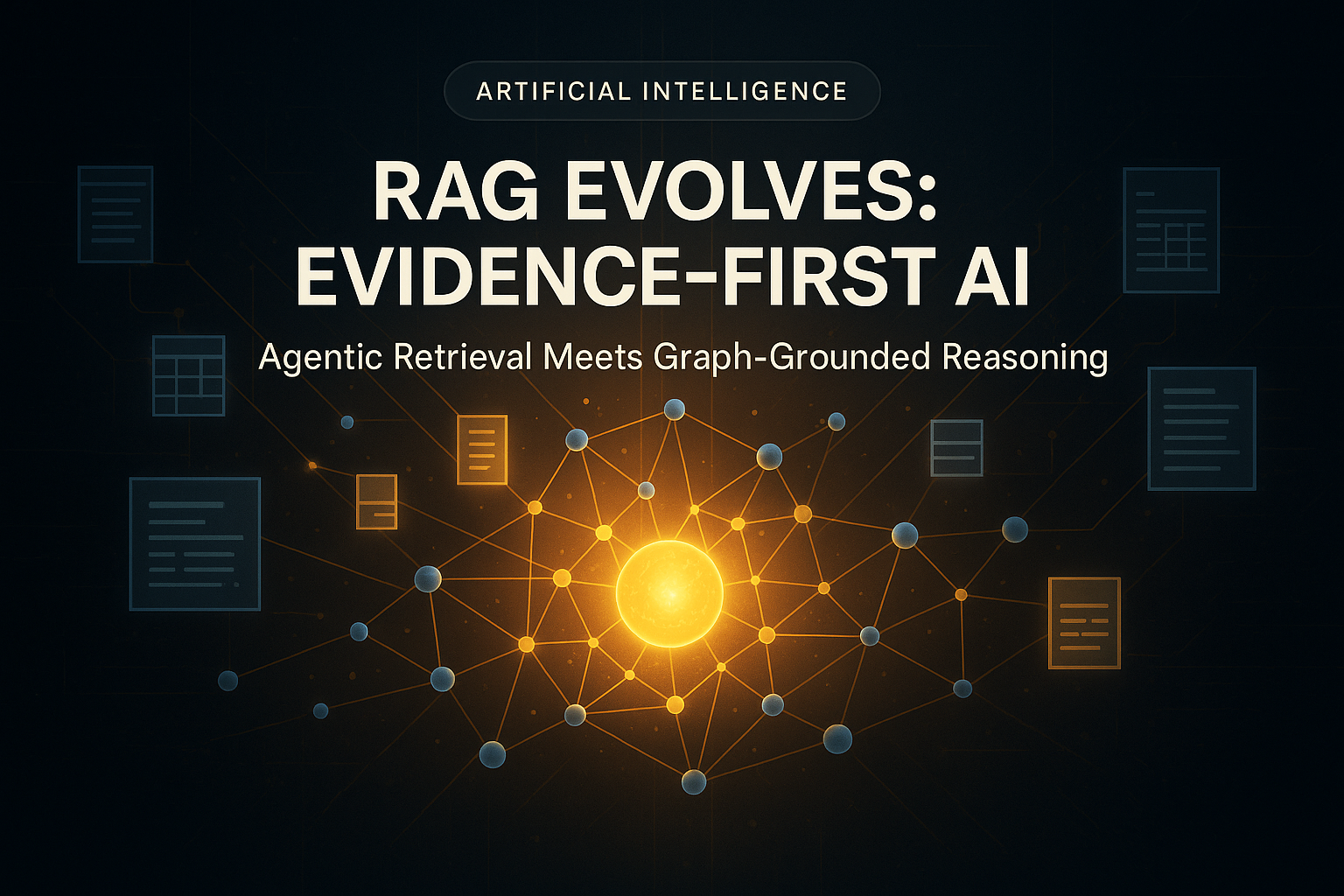
This mirrors a broader industry trend toward GraphRAG, where retrieval is powered by a semantic knowledge graph rather than a flat vector index. By deriving entity-relationship graphs from source documents—indexing spans, nodes, and edges—GraphRAG enables AI systems to reason across connected facts instead of isolated passages, a capability increasingly seen as essential for enterprise automation heading into 2026.
Retrieval and Long-Context Are Converging
For years, the AI field debated whether expanding context windows would eventually make RAG unnecessary. The emerging consensus: it’s not either/or. Frameworks such as UNREAL propose a unified, model-native evidence-selection approach that spans both corpus retrieval and long-context inference, directly tackling the classic trade-off between retrieving too little information and overwhelming the model with excessive context.
This convergence matters for businesses balancing cost and accuracy. Long-context models are powerful but computationally expensive and, as one industry commentator put it, “mentally exhausting” for the model—akin to re-reading an entire textbook for every question. Hybrid retrieval-plus-context strategies promise the precision of RAG with the depth of long-context reasoning, without the full computational overhead.
Agentic RAG Gets Budget-Aware
Perhaps the most consequential shift is the rise of agentic RAG—systems where an AI agent dynamically decides how much retrieval, reasoning, and verification a question actually requires. Rather than running a fixed retrieval pipeline for every query, agentic systems allocate computation adaptively across question types, retrieval trajectories, and repeated document reads.
Recent evaluations on benchmark datasets like HotpotQA and MuSiQue found that spreading compute budget across broader question coverage reduced error more effectively than pouring the same resources into deeper multi-step retrieval on fewer questions. This has real implications for enterprises deploying AI at scale: smarter budget allocation means lower inference costs without sacrificing accuracy—a critical consideration as organizations scale from pilot projects to production.
Industry adoption data backs up this shift. Reports indicate a majority of enterprises are now running agentic AI in some production capacity, though most deployments remain in early or limited-scope stages rather than full-scale rollout—underscoring both the momentum and the maturity gap still facing agentic RAG systems.
Multimodal RAG and High-Stakes Grounding
RAG’s evolution isn’t limited to text. Multimodal RAG systems are now emphasizing complementary evidence selection and confidence estimation rather than simply retrieving the “most similar” image or passage. Frameworks like CLIMB build compact evidence pools that balance relevance against redundancy, then apply critic-based refinement across relevance, specificity, cross-modal alignment, and confidence—showing measurable gains on multimodal benchmarks such as Encyclopedic-VQA and InfoSeek.
Domain-specific, ontology-grounded RAG is also gaining traction in high-stakes fields. In clinical settings, systems like BEACON-SP apply ontology-grounded graph structures to integrate clinical, behavioral, social, and temporal evidence for sensitive use cases such as suicide-risk assessment—reporting improved completeness and clinical relevance over standard vector-based RAG, alongside security research examining how adversaries might attempt to extract private data from multimodal retrieval stores.
Future Outlook
Looking ahead, expect RAG to keep blurring the line between retrieval and reasoning. Surveys of the field now organize advances around four pillars—efficiency, security, interactivity, and complex reasoning—suggesting that future systems will be judged not just on answer accuracy but on auditability, cost-efficiency, and resistance to adversarial extraction. As enterprises push toward fully agentic AI platforms, RAG is quietly becoming the trust layer that keeps generative AI grounded, verifiable, and enterprise-ready.
Conclusion
Far from being rendered obsolete by long-context models, retrieval-augmented generation is maturing into something more sophisticated: a structured, agentic, and evidence-first discipline at the core of reliable enterprise AI. As organizations weigh GraphRAG, multimodal retrieval, and budget-aware agents against their own data and compliance needs, one question becomes unavoidable—how is your organization preparing its data infrastructure for this next generation of retrieval-driven AI?
📖 Recommended Sources:
• arXiv.org – Recent preprints on DBRAG, UNREAL, CLIMB, BEACON-SP, and agentic RAG budget allocation research (October 2026)
• Hugging Face Papers – Curated tracking of emerging RAG and multimodal retrieval research
• Industry analysis on GraphRAG adoption and agentic AI enterprise deployment trends (2026)
ⓘ This content is AI-generated based on training data through January 2026 and supplemented with live research. Please verify specific claims independently.