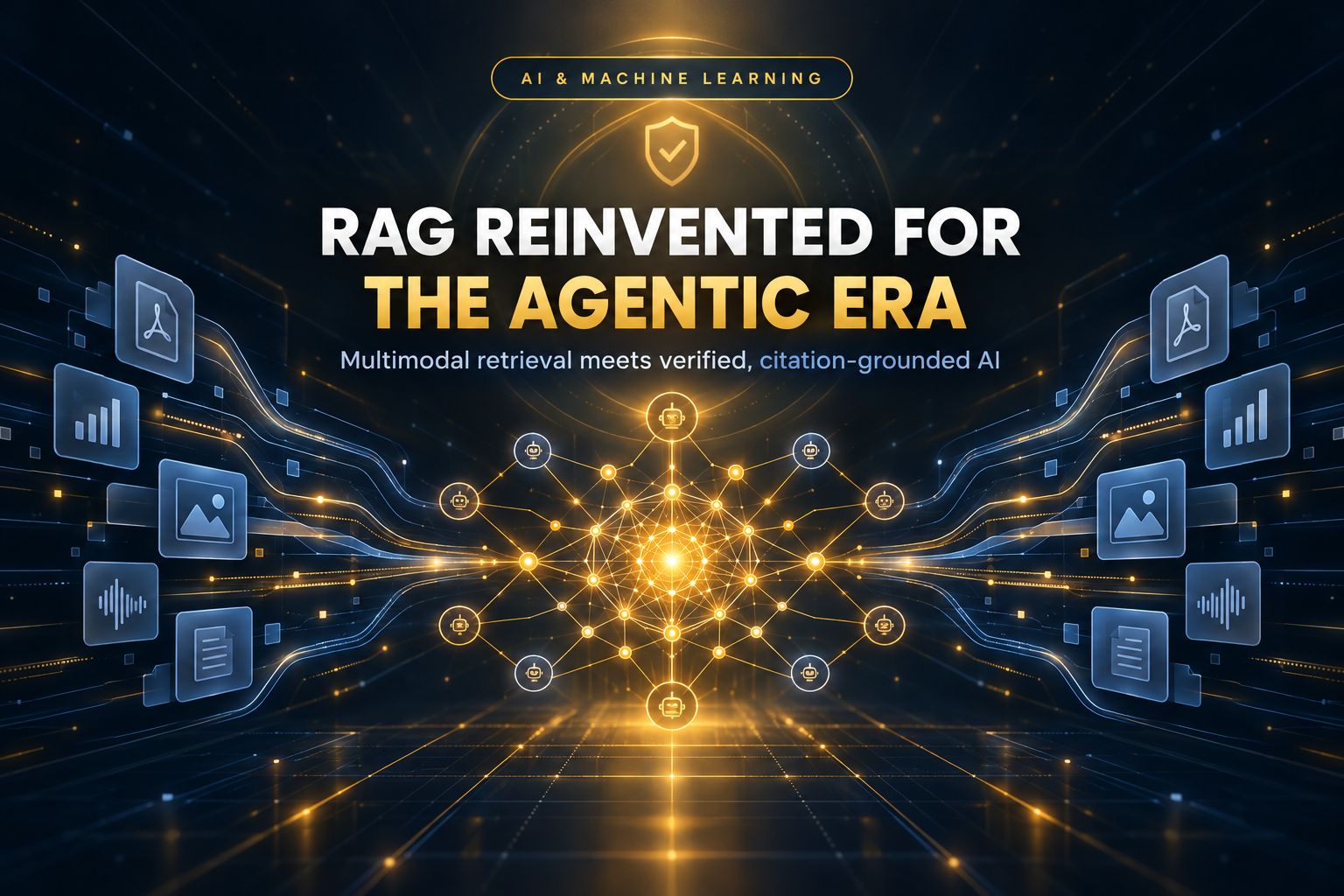
The era of “embed-and-search” RAG is over. In 2026, enterprise retrieval systems are learning to think, verify, and see.
Retrieval Augmented Generation has been a cornerstone of enterprise AI since large language models first proved unreliable at recalling proprietary or fast-changing information. But the simple architecture many teams built in 2023 and 2024—chunk documents, embed them, retrieve the top matches, stuff them into a prompt—is rapidly becoming obsolete. As of late October 2026, the technology is undergoing its most significant transformation yet, shifting from basic vector search toward agentic, multimodal, and evidence-verified retrieval systems that enterprises can actually trust in regulated, high-stakes environments.
From Vector Search to Agentic Retrieval
The biggest architectural shift this year is the move toward agentic retrieval, where systems no longer execute a single static search but instead plan, iterate, and reason about what information they actually need. AWS’s managed Amazon Bedrock Knowledge Base now treats retrieval as a multi-turn process: the system decides whether retrieval is even necessary, selects the appropriate knowledge source, performs multiple retrieval passes if needed, and produces cited, traceable answers.
This matters because real enterprise questions rarely map cleanly to a single search query. A compliance analyst asking about contract obligations across multiple jurisdictions needs a system that can decompose the question, search several repositories, and synthesize an answer—not just return the five nearest vector matches. Industry platforms are increasingly connecting governed enterprise repositories, operational systems, and external tools through agent frameworks and protocols like MCP (Model Context Protocol), reducing the custom engineering required for every new data source.
Multimodal Retrieval Moves to Index Time
Enterprise knowledge doesn’t live in clean text files—it’s locked in PDFs, scanned forms, slide decks, charts, audio recordings, and video. A major research breakthrough addressing this came from Bloomberg’s AI research team, presented at EMNLP 2026. Their system, called MIDR (Multimodal Index-time Document Retrieval), tackles a core inefficiency in visual document search: rather than running expensive visual reasoning on every single query, MIDR performs that analysis once, at indexing time.
A multimodal large language model analyzes each document page and converts its visual and textual content into text-centric representations—keyphrases, table summaries, and anticipated questions the page can answer. According to Bloomberg, this approach delivered 23% better retrieval quality than standard BM25, performed competitively against ColQwen2.5 (a state-of-the-art visual retriever) on the ViDoRe V3 benchmark, and did so with an index roughly 9 times smaller and query response roughly 2 times faster. For enterprises managing massive archives of visually rich documents—financial filings, engineering drawings, medical records—this is a meaningful efficiency gain without sacrificing accuracy.
Separately, Google Cloud’s distributed enterprise search offerings now support multimodal retrieval across text, images, audio, and video while keeping indexing and embeddings inside an organization’s sovereign environment—a critical requirement for regulated industries and government deployments.
Solving RAG’s Trust Problem
Perhaps the most consequential advance isn’t about finding information faster—it’s about proving the answer is actually true. Hallucinated citations and unsupported claims have been a persistent weakness of RAG systems, even when retrieval itself works well. Bloomberg’s second EMNLP 2026 contribution, EvidenT, directly targets this problem by separating evidence extraction from answer generation.
Here’s how it works: the system first extracts relevant passages from retrieved documents, then deterministically verifies those passages against the original source text before any passage is allowed to inform the final answer. Only verified evidence reaches the generation step. According to Bloomberg, EvidenT achieved 93% groundedness and a 29% improvement in expert-verified citation quality compared to standard prompting baselines, while eliminating citations to documents that were never actually retrieved. Notably, the approach requires no retraining of the underlying language model, making it practical to layer onto existing enterprise deployments.
This evidence-first design philosophy signals a broader industry maturation: enterprise buyers are no longer satisfied with RAG systems that merely sound confident—they demand systems that can show their work.
Open Models and Sovereign Deployment
Infrastructure flexibility is also advancing. NVIDIA recently released its Nemotron retrieval model family—covering embeddings, reranking, and document parsing, including multimodal and multilingual support—giving enterprises the option to run retrieval infrastructure on their own hardware rather than depending entirely on hosted APIs. This push aligns with growing demand for sovereign AI deployments, particularly in Europe, where NVIDIA has positioned open-weight retrieval models for regulated and defense-adjacent use cases. Google’s air-gapped enterprise search offerings serve a similar purpose, keeping sensitive data processing entirely within an organization’s own security boundary.
On the adoption side, concrete RAG-specific penetration figures remain hard to pin down with full rigor, but related signals point clearly in one direction: an IDC-sponsored survey of 763 IT and business decision-makers found that 96% expected to need faster archive retrieval capabilities for inference or RAG workloads, with nearly 95% reporting rapidly rising data volumes driven by generative AI. The infrastructure demand is unambiguous, even where precise adoption percentages require caution.
What Comes Next
Looking ahead, expect the line between “retrieval” and “reasoning” to keep blurring. As agentic retrieval systems mature, enterprises will increasingly deploy RAG not as a bolt-on feature but as a governed, auditable knowledge layer spanning structured databases, unstructured documents, and multimodal content—with built-in provenance tracking and access controls baked in from the start. Gartner has separately cautioned that a significant share of agentic AI projects may stall due to unclear ROI, underscoring that technical sophistication alone won’t guarantee adoption; enterprises will need clear governance and measurable business value to justify the investment.
The RAG systems of 2026 look less like search engines and more like accountable knowledge partners—ones that plan their searches, understand images and tables as fluently as text, and can prove exactly where every claim in their answer came from. For technology leaders evaluating AI investments, the question is no longer whether to adopt retrieval-augmented systems, but how quickly they can move to this more rigorous, verifiable architecture. What would it take for your organization to trust an AI-generated answer enough to act on it without double-checking the source?
📖 Recommended Sources:
• Bloomberg EMNLP 2026 Research (EvidenT & MIDR) – Peer-reviewed enterprise RAG advances in groundedness verification and multimodal document retrieval
• AWS Machine Learning Blog – Agentic retrieval architecture on Amazon Bedrock Knowledge Base
• NVIDIA / The Register (GTC Berlin 2026) – Open-weight Nemotron retrieval models for sovereign AI deployment
• IDC-sponsored WD survey (763 IT/business decision-makers) – Enterprise data retrieval and infrastructure demand for RAG/inference workloads
ⓘ This content is AI-generated based on training data through January 2026, supplemented by live research. Please verify specific claims independently.