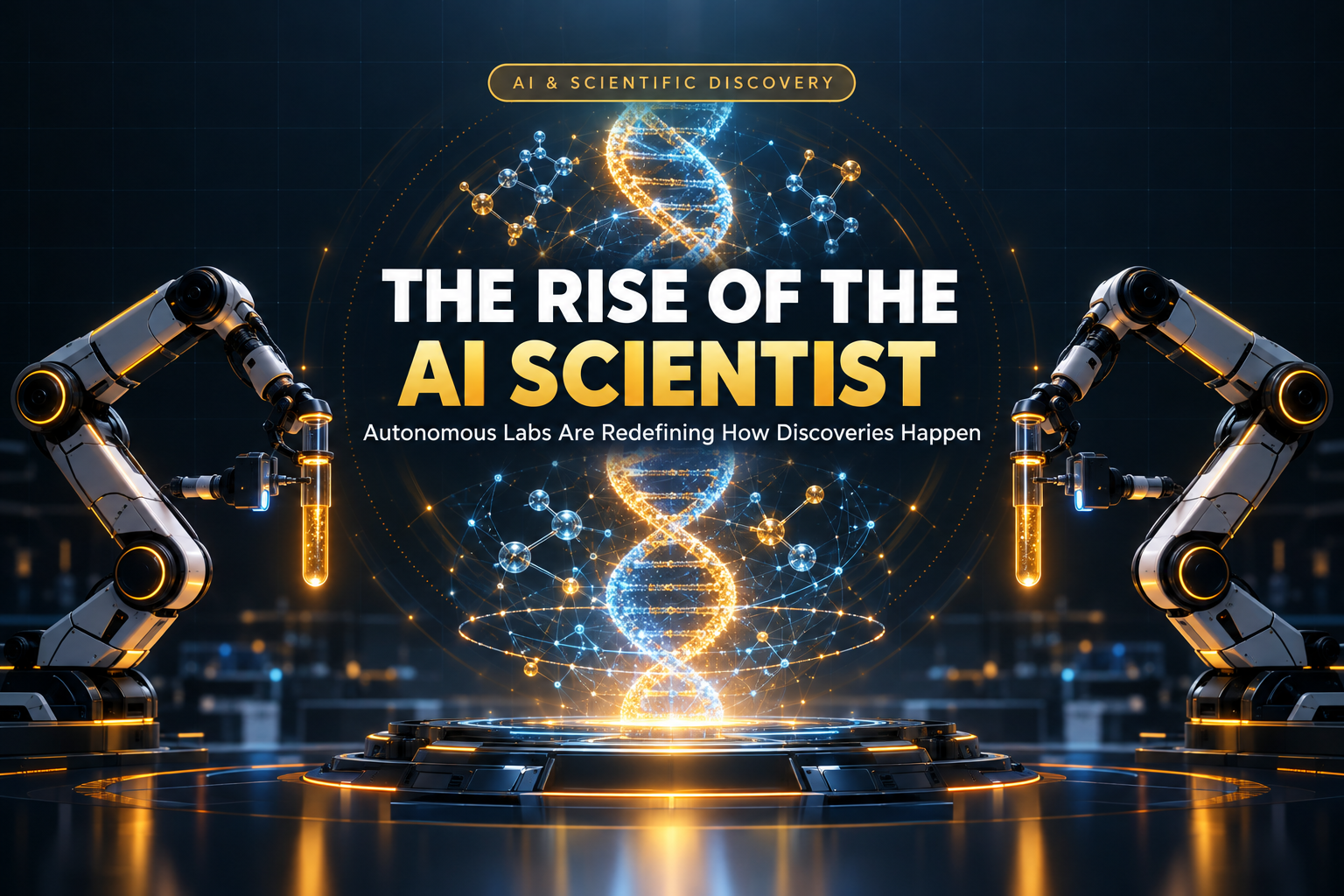
Science is getting a new kind of colleague — one that doesn’t sleep, doesn’t forget a single data point, and can run thousands of parallel experiments before lunch. In 2026, artificial intelligence has moved decisively from assisting researchers to actively driving the discovery process itself.
For years, AI in science meant faster literature reviews, better pattern recognition, or predictive models like AlphaFold. That era is giving way to something more ambitious: autonomous, closed-loop research systems that generate hypotheses, design experiments, operate laboratory equipment, interpret results, and decide what to try next — often with minimal human intervention. This shift matters because the pace of scientific discovery has historically been bottlenecked by human bandwidth. Now, that bottleneck is being systematically dismantled.
From Copilots to Co-Scientists
The defining trend of 2026 is the transition from AI as a copilot to AI as a genuine co-scientist. Google DeepMind’s AI co-scientist, built on its Gemini model family, exemplifies this shift — moving beyond summarizing papers to proposing novel research hypotheses and experimental directions for human scientists to evaluate.
Complementing this, agentic research frameworks like Agent Laboratory now automate entire workflows: taking a human-generated research idea and carrying it through literature review, experimental design, code generation, and report writing, with human feedback incorporated at key checkpoints. These systems represent multi-step reasoning rather than single-task automation — defining questions, combining disparate datasets, proposing mechanisms, and prioritizing which experiments are worth running at all.
Closed-Loop Labs: Where AI Meets Robotics
Perhaps the most consequential development is the integration of AI reasoning with physical experimentation. Self-driving laboratories are no longer a futuristic concept — they’re operational. Berkeley Lab’s A-Lab combines AI-guided compound selection with robotic synthesis to discover new materials, building on DeepMind’s GNoME project, which has already contributed nearly 400,000 predicted stable crystal structures to the Materials Project database.
This closed-loop model — propose, synthesize, test, learn, repeat — turns experimentation into a continuous optimization process rather than a series of disconnected trials. In chemistry, electrochemistry, and materials science, interpretable AI paired with automated lab equipment is being used to hunt for earth-abundant catalysts that could replace expensive platinum in hydrogen production, a critical step for scalable clean energy.
Causal Biology and the GPT-Rosalind Breakthrough
Biology has seen one of the year’s most striking demonstrations of agentic AI at scale. According to recent reporting, OpenAI, PerturbAI, and Scripps Research deployed thousands of specialized GPT-Rosalind agents to analyze millions of mouse-brain-cell measurements in roughly 32 minutes — linking gene disruptions to existing literature and surfacing testable disease hypotheses that would have taken human teams far longer to identify.
This reflects a broader move beyond correlation toward causal, mechanistic biology. Researchers are increasingly feeding AI systems perturbation data — gene knockouts, CRISPR screens, controlled interventions — rather than purely observational datasets, allowing models to reason about why something happens, not just predict what will happen next. On the therapeutic side, AI-discovered drug candidates are advancing through clinical pipelines; rentosertib, a molecule whose target and structure were both identified with AI assistance, has reportedly reached Phase III trials for idiopathic pulmonary fibrosis.
The Validation Bottleneck
Speed, however, has introduced a new and arguably more difficult challenge: validation. AI systems can now generate plausible hypotheses, candidate molecules, and experimental designs far faster than laboratories, peer reviewers, or regulatory bodies can confirm them. A compelling AI-generated result isn’t a discovery until it’s independently reproduced.
This has pushed the field toward urgent questions around reproducibility, data provenance, and interpretability. Scientific teams now need to preserve not just final outputs but entire agent workflows — prompts, model versions, code, datasets, and even failed experiments — to maintain scientific rigor. Governments are responding at an infrastructure level; Europe’s RAISE initiative, for example, is pooling compute, curated datasets, and funding specifically to support AI-enabled research across institutions. The consensus emerging from recent discussions, including at international science summits, is clear: the credibility of AI-driven discovery will depend on validation discipline, not just generation speed.
The Road Ahead
Looking forward, expect the line between “AI tool” and “AI collaborator” to blur further as foundation models trained specifically on molecular, materials, and experimental data mature alongside robotic lab infrastructure. The organizations that win in this new landscape won’t simply be the ones with the biggest models — they’ll be the ones who build rigorous validation pipelines, transparent provenance tracking, and cross-institutional data sharing to keep pace with AI’s generative speed. Expect national labs, biotech firms, and materials science companies to increasingly compete not on raw discovery volume, but on how reliably they can convert AI-generated hypotheses into confirmed, reproducible science.
AI’s role in science has shifted from answering questions to asking better ones — and running the experiments to test them. As autonomous labs and agentic reasoning systems mature, the real competitive advantage will belong to teams that pair AI’s speed with rigorous human oversight. What do you think: will 2026 be remembered as the year AI became a genuine scientific collaborator, or merely a faster assistant? Share your take in the comments.
📖 Recommended Sources:
• OpenAI / Scripps Research / PerturbAI – GPT-Rosalind agentic biology research on gene-disruption analysis
• Google DeepMind – AI co-scientist (Gemini-based) and GNoME materials discovery project
• Berkeley Lab A-Lab – Autonomous robotic materials synthesis research
• Europe’s RAISE initiative – Cross-institutional AI-for-science infrastructure coordination
ⓘ This content is AI-generated based on training data through January 2026 and supplementary live research. Please verify specific claims independently.