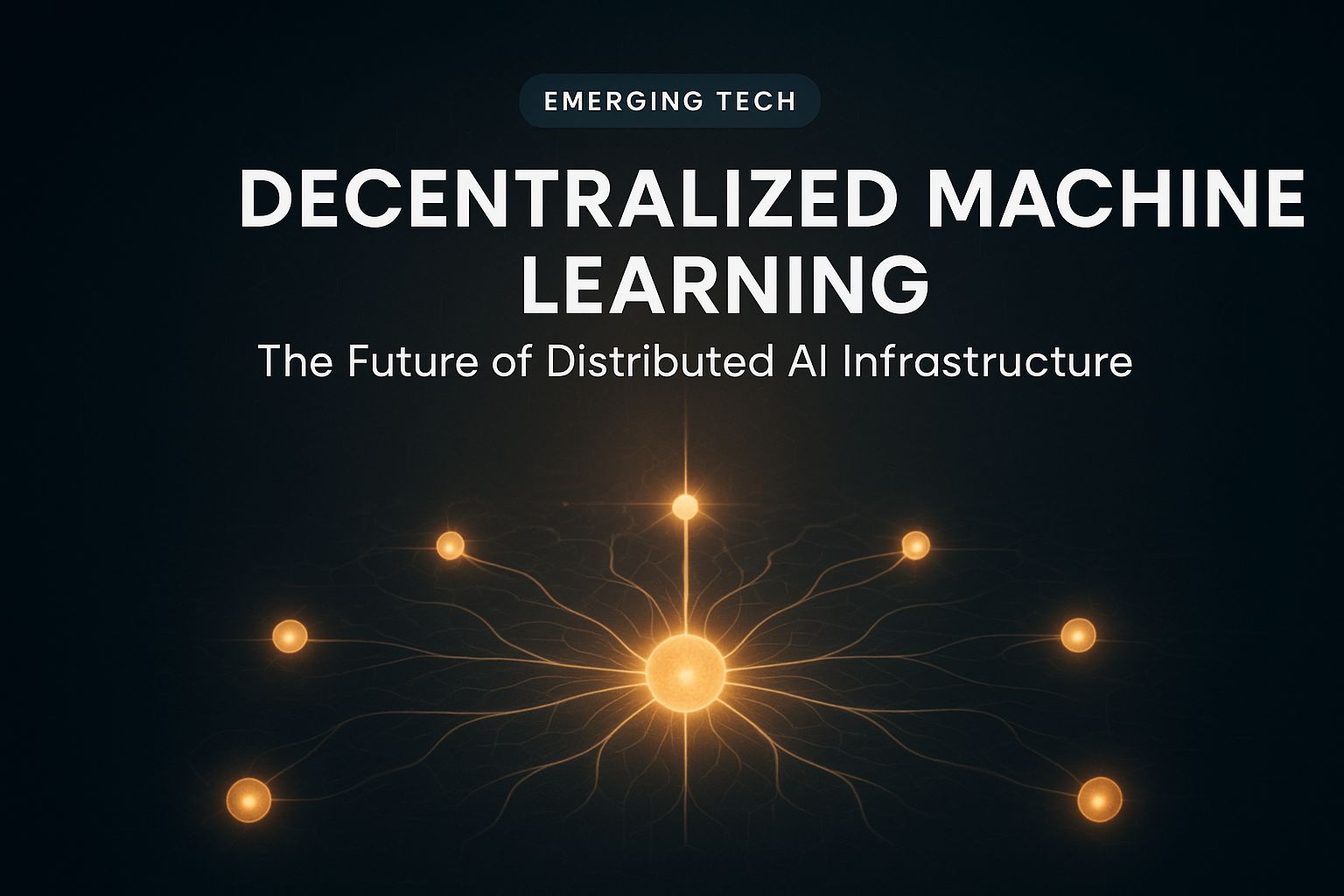
Decentralized Machine Learning: The Future of Distributed AI Infrastructure in 2026
The centralized AI model is breaking down. As enterprises grapple with data privacy regulations, latency concerns, and the computational bottlenecks of training massive models in single locations, decentralized machine learning has emerged as a transformative alternative that distributes intelligence across networks while maintaining data sovereignty and improving model performance.
What Is Decentralized Machine Learning?
Decentralized machine learning represents a fundamental shift in how artificial intelligence systems are trained and deployed. Rather than concentrating data and computational resources in centralized data centers, decentralized approaches distribute model training across multiple nodes—whether edge devices, enterprise servers, or blockchain-based networks—while keeping sensitive data local and secure.
The most prominent implementation is federated learning, a technique pioneered by major tech companies where individual devices or organizations train models locally on their own data, then share only the model updates (not raw data) with a central aggregator. This approach preserves privacy while enabling collaborative intelligence. According to research from leading AI institutions, federated learning reduces data exposure risk by up to 95% compared to traditional centralized training, making it essential for regulated industries like healthcare, finance, and government.
The Blockchain-AI Convergence
A critical development in 2025-2026 has been the integration of blockchain technology with decentralized machine learning. Projects like Ocean Protocol, Fetch.ai, and Akash Network have built infrastructure that combines decentralized data marketplaces with distributed AI training, creating trustless environments where data scientists, model developers, and compute providers can collaborate without intermediaries.
These platforms use smart contracts to automate reward distribution, ensuring contributors are compensated fairly for their data or computational resources. Blockchain’s immutability also creates an auditable record of model training provenance—critical for regulated industries requiring transparency about how AI systems were built and what data influenced their decisions.
The economic model is compelling: enterprises can access high-quality training data from decentralized networks without negotiating individual data-sharing agreements, while data owners retain control and earn passive income from their information assets.
Enterprise Adoption and Real-World Applications
Major organizations have begun deploying decentralized ML systems across industries. In healthcare, federated learning enables hospitals to collaboratively train diagnostic models without sharing patient data across institutions. Financial institutions use distributed AI to detect fraud patterns across networks while maintaining competitive data separation. Supply chain networks leverage decentralized learning to optimize logistics without revealing proprietary operational details to competitors.
According to industry analysis from McKinsey and Gartner, approximately 35-40% of enterprises are piloting federated or distributed learning initiatives, with adoption accelerating in regulated sectors where data privacy and governance are non-negotiable. The market for decentralized AI infrastructure is projected to reach $2.5-3.2 billion by 2027, driven by regulatory pressure (GDPR, CCPA), edge computing expansion, and demand for privacy-preserving AI.
Technical Challenges and Emerging Solutions
Despite its promise, decentralized machine learning faces significant technical hurdles. Model convergence across heterogeneous devices with varying data distributions remains computationally expensive. Communication overhead between nodes can exceed the cost of centralized training. Ensuring consistency and security across distributed systems requires sophisticated cryptographic protocols and Byzantine fault tolerance mechanisms.
Emerging solutions address these challenges. Differential privacy techniques add mathematical noise to model updates, preventing adversaries from reverse-engineering training data. Secure multi-party computation allows collaborative training without any party revealing their raw data. Quantum-resistant encryption ensures long-term security of distributed AI systems.
Companies like Openmined, Sherpa.ai, and academic institutions are developing open-source frameworks that abstract these complexities, making decentralized ML accessible to organizations without deep expertise in distributed systems.
The Edge Computing Catalyst
The explosive growth of edge computing—processing data closer to its source rather than sending it to centralized cloud—has become a primary driver of decentralized ML adoption. Edge devices (IoT sensors, smartphones, autonomous vehicles, industrial equipment) generate massive volumes of sensitive data unsuitable for transmission to remote servers.
Decentralized machine learning allows these devices to collaboratively train models while data remains on-device. A fleet of autonomous vehicles, for example, can improve object detection and navigation models by sharing training insights without exposing raw sensor feeds to a central authority. This reduces latency, improves privacy, and creates more robust AI systems trained on diverse real-world conditions.
Future Outlook
By 2027-2028, decentralized machine learning is expected to transition from experimental to mainstream infrastructure. We’ll likely see standardized protocols emerge (similar to how HTTP unified web communication), making it easier to integrate decentralized AI into existing enterprise systems. Regulatory bodies will increasingly mandate decentralized approaches for sensitive applications, accelerating adoption.
The convergence of federated learning, blockchain incentive mechanisms, and edge computing will create a new ecosystem where AI development is truly distributed—with intelligence, data, and value flowing across networks rather than concentrating in the hands of a few tech giants.
Conclusion
Decentralized machine learning represents a necessary evolution in AI infrastructure, addressing privacy, scalability, and governance challenges that centralized approaches cannot solve. Organizations that begin experimenting with federated learning and distributed AI frameworks today will gain competitive advantages in a landscape where data sovereignty and regulatory compliance are paramount.
What aspects of decentralized ML are most relevant to your organization—privacy preservation, edge deployment, or collaborative data ecosystems? Share your insights in the comments below.
—
### 📖 Recommended Sources:
• **Gartner & McKinsey AI Reports (2025-2026)** – Enterprise adoption trends and market sizing for decentralized AI
• **Ocean Protocol & Fetch.ai Documentation** – Real-world blockchain-based decentralized learning implementations
• **OpenMined Research** – Federated learning frameworks and differential privacy techniques
• **IEEE & ACM Distributed Systems Conferences** – Technical deep-dives on Byzantine fault tolerance and secure multi-party computation in ML
ⓘ This content is AI-generated based on training data through January 2026. Please verify specific market figures and latest product announcements independently with current sources.