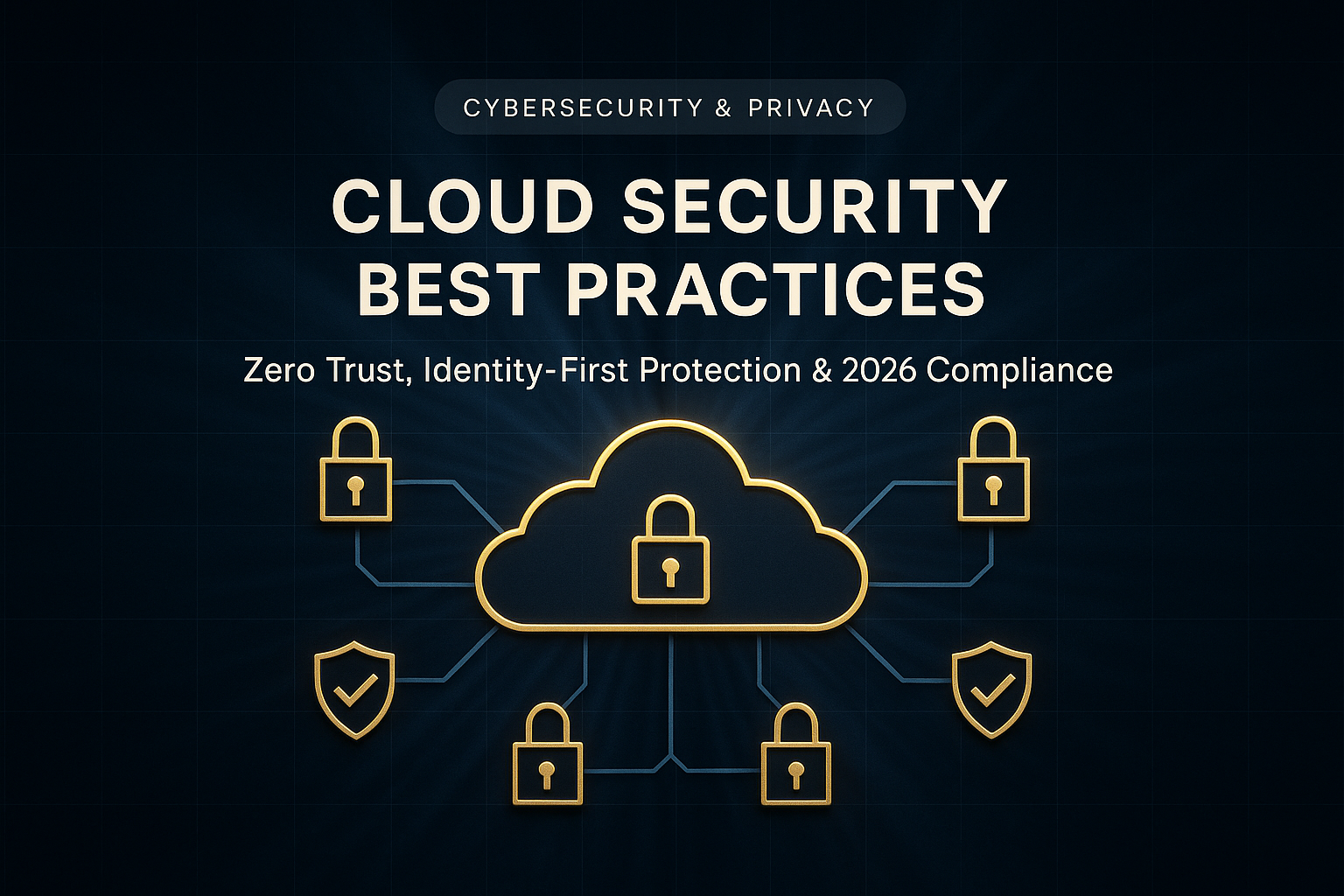
# Cloud Security Best Practices 2026: Zero Trust, Identity-First Protection & Compliance
The cloud has become mission-critical infrastructure for organizations worldwide, but with unprecedented adoption comes unprecedented risk. As cloud environments grow more complex and distributed, traditional perimeter-based security models are no longer sufficient—organizations must embrace zero trust architecture and identity-first security strategies to protect their most sensitive assets.
The Evolution of Cloud Security: From Perimeter Defense to Zero Trust
For decades, cybersecurity relied on a “castle and moat” mentality: build strong perimeter defenses and assume everything inside is trustworthy. Cloud computing has shattered this model. According to the NIST Cybersecurity Framework and industry leaders like Gartner, zero trust architecture—which operates on the principle of “never trust, always verify”—has become the gold standard for cloud security.
Zero trust requires continuous verification of every user, device, and application accessing cloud resources, regardless of location or network. This shift represents a fundamental change in how organizations approach cloud security, moving from implicit trust to explicit verification at every layer.
Identity and Access Management: The New Security Perimeter
Identity has become the new security perimeter. In cloud environments, identity and access management (IAM) is no longer a supporting function—it’s foundational to security posture. Organizations must implement:
- Multi-factor authentication (MFA) across all cloud services and administrative access
- Passwordless authentication using biometric and hardware-based methods
- Privileged access management (PAM) to control and monitor administrative accounts
- Conditional access policies that enforce security requirements based on risk signals
Leading cloud providers like AWS, Microsoft Azure, and Google Cloud have made identity-first security central to their platforms. According to industry security reports, organizations implementing robust IAM controls significantly reduce their breach risk, as identity compromise remains one of the most common attack vectors.
Data Encryption: Protecting Sensitive Assets in Transit and at Rest
Encryption remains non-negotiable in cloud security strategy. Organizations must implement:
- Encryption at rest for all sensitive data stored in cloud databases, storage buckets, and backup systems
- Encryption in transit using TLS 1.2 or higher for all data moving between cloud services and endpoints
- Customer-managed encryption keys (CMEK) to maintain control over encryption key management
- Transparent data encryption (TDE) for database-level protection
The NIST SP 800-175B guidelines and HIPAA, PCI-DSS, and SOC 2 compliance frameworks all mandate strong encryption standards. Organizations handling regulated data—healthcare, financial services, personally identifiable information—must ensure encryption implementations meet or exceed these standards.
Continuous Monitoring, Logging, and Threat Detection
Static security configurations are vulnerable to evolving threats. Organizations must implement continuous monitoring through:
- Cloud Access Security Brokers (CASB) to monitor and control cloud application usage
- Security Information and Event Management (SIEM) systems that aggregate and analyze logs across cloud infrastructure
- Cloud workload protection platforms (CWPP) for real-time threat detection and response
- Automated threat hunting and behavioral analytics to identify anomalies and suspicious patterns
According to Gartner’s latest cloud security research, organizations with mature logging and monitoring practices detect threats an average of 60% faster than those without, significantly reducing dwell time and damage from breaches.
Compliance and Governance: Meeting Regulatory Requirements
Cloud security isn’t just about preventing attacks—it’s also about meeting regulatory obligations. Organizations must:
- Map cloud resources to compliance frameworks (SOC 2, ISO 27001, HIPAA, GDPR, CCPA)
- Implement cloud security posture management (CSPM) tools to identify misconfigurations and compliance gaps
- Maintain audit trails and evidence for regulatory audits and incident investigations
- Establish incident response procedures specific to cloud environments
Cloud providers offer compliance certifications and shared responsibility models, but organizations remain responsible for their configurations and data protection. Regular compliance audits and security assessments are essential.
The Future of Cloud Security: AI-Driven Protection and Autonomous Response
Looking ahead, artificial intelligence and machine learning are transforming cloud security. Predictive threat detection, anomaly detection, and automated response capabilities are becoming standard features in enterprise cloud security platforms. Organizations investing in AI-driven security tools today will have significant advantages in detecting and responding to sophisticated threats in 2026 and beyond.
Conclusion: Building a Resilient Cloud Security Foundation
Cloud security in 2026 requires a multi-layered approach: zero trust architecture, identity-first strategies, strong encryption, continuous monitoring, and compliance-aware governance. Organizations that implement these best practices systematically will significantly reduce their risk profile and build resilient cloud infrastructure.
The question isn’t whether to adopt these practices—it’s how quickly you can implement them across your entire cloud environment. What’s your organization’s biggest cloud security challenge, and how are you addressing it?
—