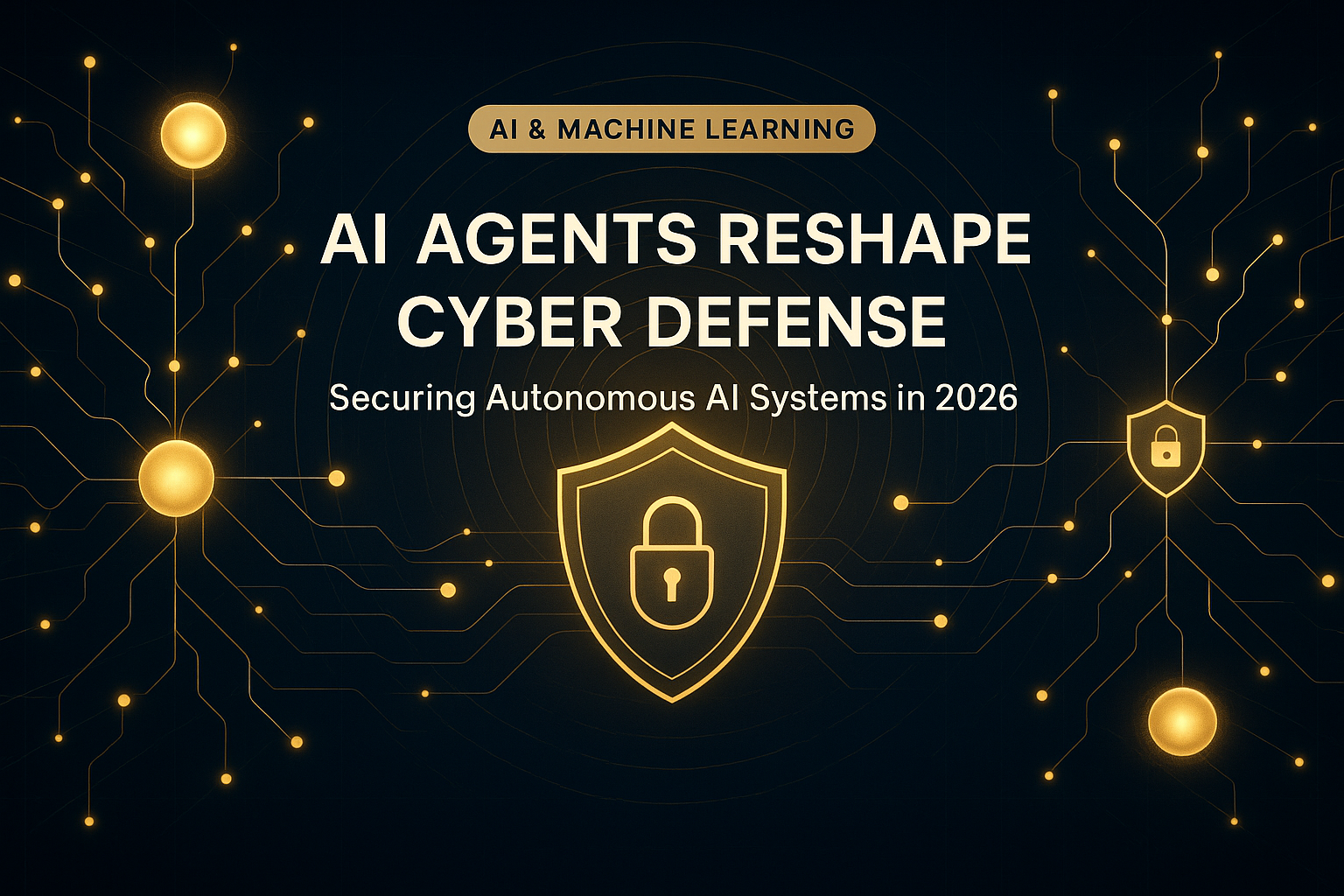
The stakes have never been higher. As artificial intelligence systems grow more autonomous and powerful, the cybersecurity landscape is evolving at an unprecedented pace. Governments, security agencies, and tech companies are now racing to establish frameworks for securing the next generation of AI-powered cyber defense systems—autonomous agents capable of detecting, responding to, and neutralizing threats in real time.
The Rise of Agentic AI in Cybersecurity
The shift toward agentic AI systems—autonomous agents that can make decisions and take actions with minimal human intervention—represents a fundamental change in how organizations approach cyber defense. According to the White House and allied governments, these systems are increasingly critical to protecting national infrastructure and enterprise networks from sophisticated, AI-accelerated threats.
Unlike traditional security tools that flag suspicious activity for human review, agentic AI can autonomously investigate threats, isolate compromised systems, and execute defensive countermeasures in milliseconds. This speed advantage is crucial when facing adversaries who are themselves leveraging AI to accelerate attack campaigns.
However, this power comes with significant risk. The National Security Agency (NSA), CISA, and international partners recently released joint guidance on the secure adoption of agentic AI systems, signaling that the security community views these tools as both essential and dangerous if deployed carelessly.
Government Guidance on AI Agent Security
In May 2026, the US government, alongside allies including Australia, Canada, New Zealand, and the UK, published comprehensive guidance on safely deploying AI agents. According to CISA’s resource on careful adoption of agentic AI services, organizations must implement rigorous oversight mechanisms, including human-in-the-loop controls, continuous monitoring, and strict access limitations.
The guidance emphasizes several critical security principles:
- Autonomous systems must remain bounded within defined operational parameters to prevent unintended actions
- Continuous human oversight is non-negotiable, especially for agents with access to critical infrastructure
- Audit trails and explainability are essential—security teams must understand why an agent took any given action
- Isolation and containment protocols should limit the blast radius if an agent is compromised or malfunctions
The White House has also pressed technology companies to strengthen their support for defending against AI-driven cyberattacks, recognizing that the private sector plays a crucial role in both deploying and defending against these systems.
The Dual-Edged Sword: AI Defense vs. AI Threats
The central paradox of 2026 cybersecurity is this: the same AI capabilities that enable advanced defense are also available to attackers. According to Microsoft’s security research on AI-powered defense, organizations must adopt AI-accelerated threat detection and response simply to keep pace with AI-accelerated threats.
Adversaries are increasingly using autonomous agents to:
- Conduct reconnaissance at scale across multiple targets simultaneously
- Adapt attack strategies in real time based on defensive responses
- Exploit zero-day vulnerabilities faster than human teams can patch them
- Execute coordinated, multi-stage attacks with minimal human involvement
This escalation dynamic means that organizations without AI-powered cyber defense are at a severe disadvantage. Yet deploying these systems introduces new attack surfaces: compromised AI agents, poisoned training data, and adversarial prompts designed to manipulate autonomous decision-making.
Key Security Challenges for Agentic AI Systems
Interpretability and Control: Agentic AI systems often operate as “black boxes,” making decisions through complex neural networks that even their creators struggle to explain. This opacity creates a critical security problem: how can defenders trust a system they don’t fully understand?
Adversarial Manipulation: Attackers are developing techniques to trick AI agents into making poor security decisions. By crafting malicious inputs or exploiting subtle biases in training data, adversaries can potentially turn defensive agents into unwitting accomplices.
Cascading Failures: A single compromised AI agent could trigger a cascade of automated defensive actions that inadvertently disrupt critical systems or amplify an attack’s impact.
Supply Chain Risks: Many organizations will rely on third-party AI security vendors. Compromising a popular security agent could affect thousands of organizations simultaneously.
The Path Forward: Building Resilient AI Security
Organizations deploying agentic AI for cybersecurity must adopt a defense-in-depth approach that combines AI capabilities with human expertise, regulatory oversight, and technical safeguards.
Best practices include:
- Implementing strict role-based access controls for AI agents, limiting their authority to specific, well-defined security tasks
- Establishing continuous monitoring and alerting on agent behavior to detect anomalies or signs of compromise
- Maintaining human approval workflows for critical security decisions, especially those affecting production systems
- Conducting regular adversarial testing to identify weaknesses in agent decision-making before attackers do
- Documenting and explaining agent decisions through comprehensive logging and audit trails
The Federal Reserve’s recent commentary on AI in the financial system reinforces this principle: institutions must balance innovation with caution, deploying AI security tools thoughtfully rather than rushing to automation for its own sake.
The 2026 Security Imperative
As we move deeper into 2026, the convergence of agentic AI, sophisticated cyber threats, and regulatory scrutiny is creating a new security paradigm. Organizations that understand this shift—and invest in both AI-powered defense and the governance frameworks to manage it—will be far better positioned to protect their critical assets.
The question is no longer whether to adopt AI for cyber defense, but how to do so responsibly, securely, and with appropriate human oversight. The government guidance released this year provides a roadmap. The challenge now is implementation.
What’s your organization’s strategy for securing agentic AI systems? Are you balancing innovation with the caution that these powerful tools demand?
—
📖 **Recommended Sources:**
– **CISA & NSA Joint Guidance on Agentic AI** – Official U.S. government cybersecurity framework for secure AI agent deployment
– **Microsoft Security Blog: AI-Powered Defense for an AI-Accelerated Threat Landscape** – Enterprise perspective on AI-driven cyber defense strategies
– **White House & International Partners Agentic AI Security Guidance** – Multi-national government coordination on AI security standards (US, Australia, Canada, New Zealand, UK)
– **CyberScoop & Cybersecurity Dive Coverage** – Real-time reporting on government AI security initiatives and industry implications
ⓘ **This content is AI-generated based on research conducted May 2, 2026, using current news sources and official government guidance. Please verify specific claims with primary sources independently.**