# AI Agents Transform Workplace Automation in 2026: The $4.4 Trillion Opportunity
The workplace is undergoing a fundamental shift. Rather than simply augmenting human workers with AI tools, autonomous AI agents are now taking on end-to-end business processes, making independent decisions, and driving measurable productivity gains across enterprises. This marks a critical inflection point in how organizations approach digital transformation.
The Rise of Agentic AI in Enterprise
AI agents are fundamentally different from traditional AI applications. Unlike chatbots or predictive models that require human oversight at each step, autonomous agents operate continuously, making decisions, executing tasks, and adapting to changing conditions without constant human intervention. In 2026, enterprise adoption of agentic AI has accelerated dramatically as organizations recognize the potential to reshape entire workflows.
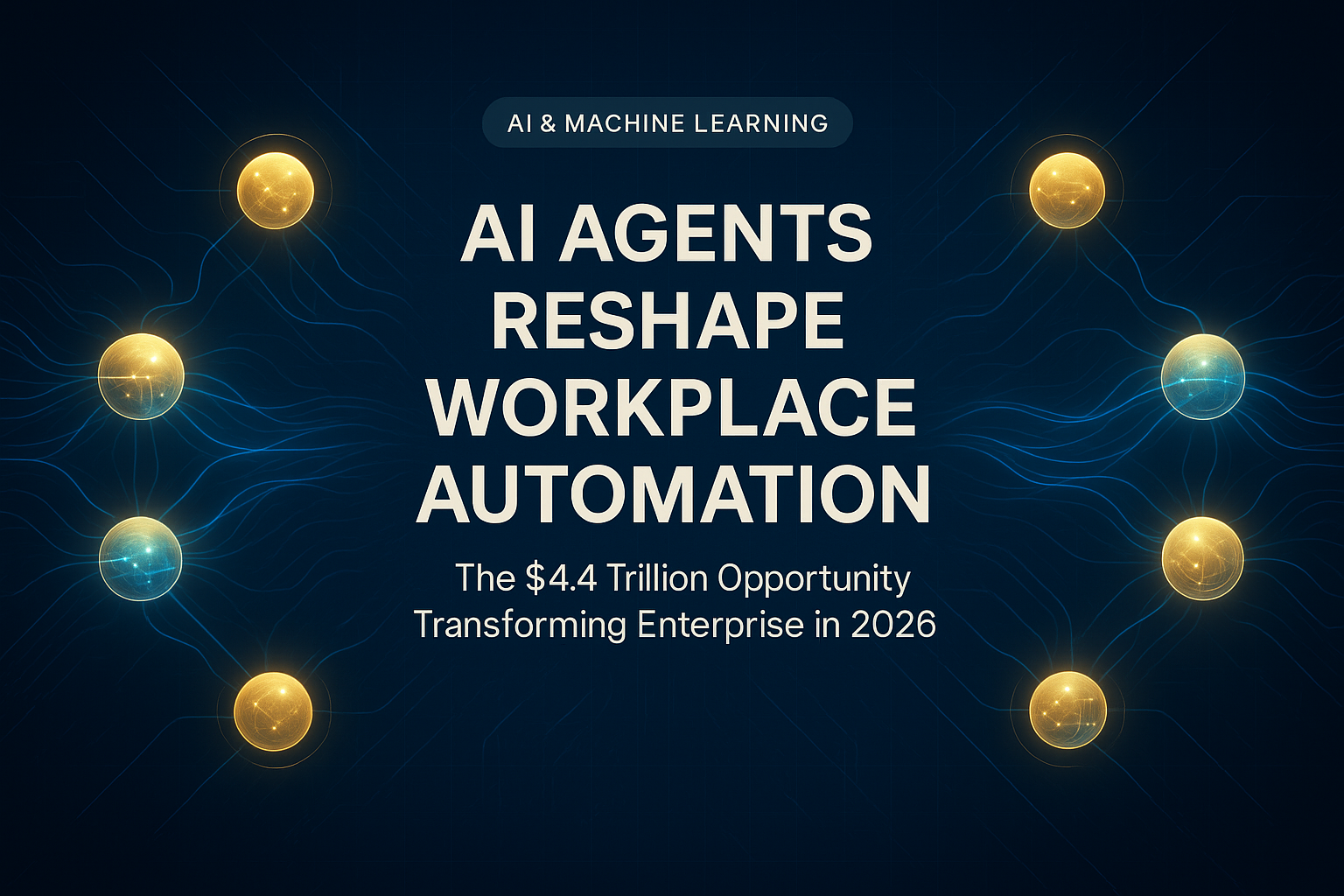
According to McKinsey, AI agents could add $2.6 to $4.4 trillion in value annually across various business use cases. This staggering projection reflects the magnitude of transformation happening across industries—from customer service and finance to supply chain management and human resources. The key difference from previous AI implementations is that agents are designed to own outcomes, not just assist with isolated tasks.
Organizational Redesign: The New Imperative
The most successful enterprises deploying AI agents in 2026 aren’t simply layering automation on top of existing processes. Instead, they’re fundamentally redesigning their organizations to work alongside autonomous systems. This approach mirrors the industrial revolution, when factories had to rethink entire production systems rather than merely replacing manual labor with machines.
Organizations are discovering that effective agent deployment requires:
- Process restructuring: Defining clear decision boundaries and autonomy levels for agents
- Data architecture modernization: Ensuring agents have access to clean, real-time information
- Skills realignment: Training teams to manage, monitor, and optimize agent performance rather than perform routine tasks
- Governance frameworks: Establishing accountability and oversight mechanisms for autonomous systems
Companies that treat agent implementation as a technical checkbox—simply adding AI to human-centered systems—are seeing limited returns. Those investing in organizational redesign are unlocking exponential productivity gains.
Real-World Agent Applications Driving Impact
Enterprise teams are deploying AI agents across multiple domains with measurable success. Customer service agents now handle complex inquiries, escalate intelligently, and resolve issues without human intervention in many cases. Financial operations agents process invoices, reconcile accounts, and flag anomalies continuously, reducing processing time from days to minutes.
In supply chain management, autonomous agents monitor inventory levels, predict demand shifts, and coordinate logistics across multiple suppliers in real time. Human resources agents screen candidates, schedule interviews, and manage onboarding workflows, freeing HR professionals to focus on strategic talent development.
The common thread: agents are handling high-volume, rule-based, and partially structured tasks that previously consumed significant human effort. This liberation of human attention allows teams to focus on strategic, creative, and relationship-driven work—the areas where human judgment remains irreplaceable.
The 2026 Inflection Point: Why Now?
Several converging factors have made 2026 the breakthrough year for workplace automation through AI agents:
Advanced language models now possess reasoning capabilities sophisticated enough to handle multi-step processes and ambiguous situations. Enterprise AI infrastructure has matured, making it feasible to deploy agents at scale. Regulatory clarity is emerging around AI governance, reducing deployment uncertainty. And critically, organizational leadership has shifted from skepticism to active investment in agentic AI strategies.
The competitive pressure is intensifying. Organizations that master agent deployment in 2026 will establish significant productivity advantages, making adoption a strategic imperative rather than an optional enhancement.
Future Outlook: The Agent-Powered Enterprise
Looking ahead, the trajectory is clear: AI agents will become the default operational layer for routine business processes by 2027–2028. The question for enterprises today isn’t whether to adopt agentic AI, but how quickly they can redesign their organizations to maximize agent effectiveness.
The most forward-thinking companies are already moving beyond single-agent deployments toward multi-agent systems—networks of specialized agents collaborating to solve complex business challenges. These systems will operate with increasing autonomy, learning from outcomes and continuously optimizing performance.
However, the human element remains central. The organizations that thrive in this era will be those that view AI agents as partners in transformation, not replacements for human expertise. The $4.4 trillion opportunity belongs to those who can architect the symbiosis between autonomous systems and human creativity.
The Transformation Begins Now
The data is compelling, the technology is ready, and enterprise adoption is accelerating. AI agents aren’t a future possibility—they’re reshaping workplace automation today. Organizations that begin redesigning their processes and governance frameworks now will capture disproportionate value in the coming years.
The question for your organization: Are you treating AI agents as a tactical tool, or as a catalyst for fundamental operational transformation?
—
📖 **Recommended Sources:**
• **McKinsey** – Research on AI agents’ economic impact and business use cases; projects $2.6–$4.4 trillion annual value potential
• **Enterprise AI Adoption Reports** – Real-world case studies on autonomous agent deployment across customer service, finance, and operations
• **Technology Thought Leadership** – Analysis of organizational redesign requirements for effective agentic AI implementation
ⓘ This content is AI-generated based on research through May 2026. Please verify specific McKinsey projections and enterprise case studies independently with primary sources.