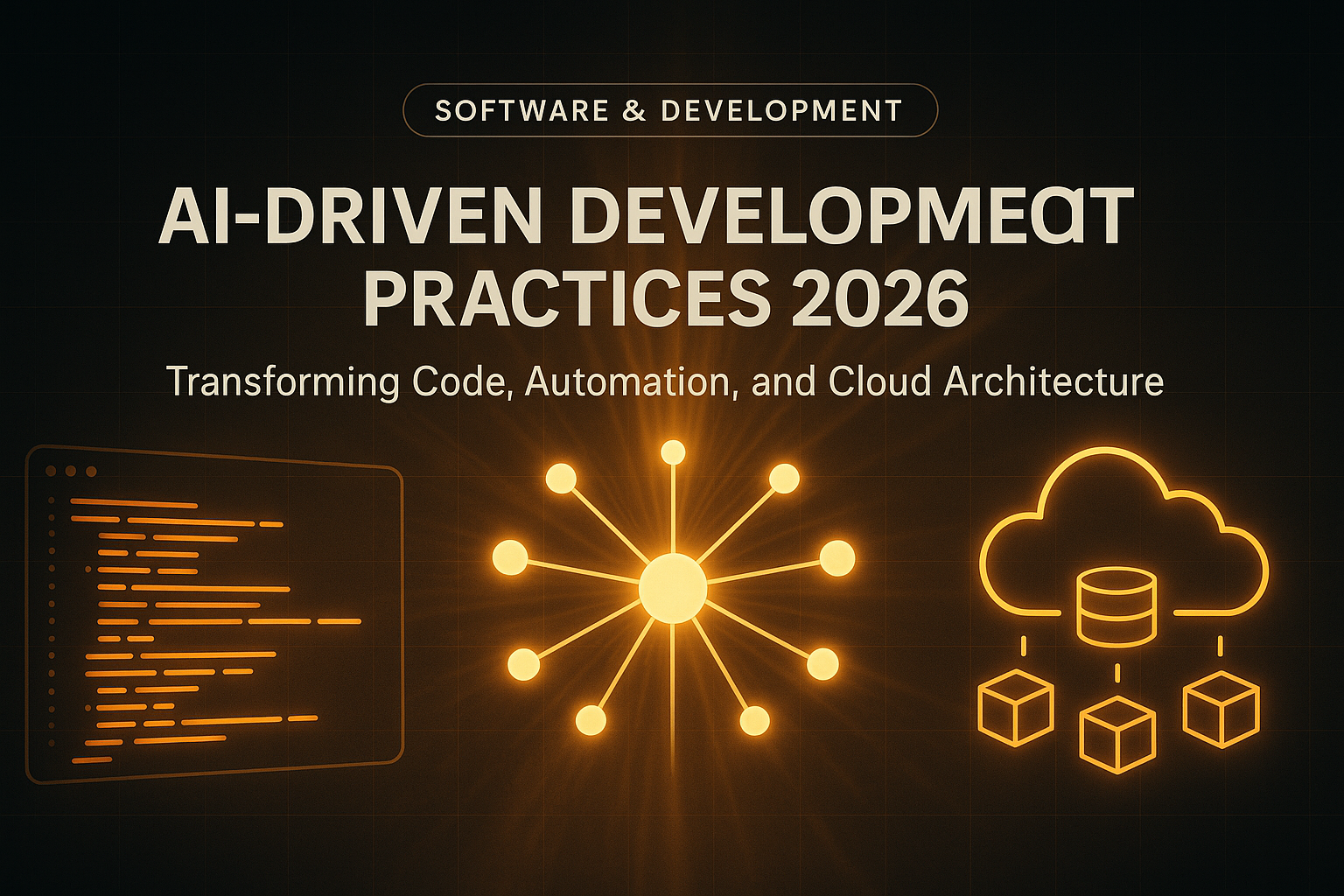
# AI-Driven Development & DevOps Transformation: Software Development Practices in 2026
The software development landscape of 2026 stands at an inflection point. Artificial intelligence is no longer an optional enhancement—it’s becoming foundational to how teams write, test, and deploy code. Combined with mature DevOps practices and cloud-native architecture, modern development has fundamentally shifted from manual workflows to intelligent, automated pipelines that accelerate time-to-market while maintaining code quality.
The Rise of AI-Assisted Code Generation
The most visible transformation in 2026 is the widespread adoption of AI-powered code generation tools that have moved beyond novelty into essential developer infrastructure. These tools—powered by large language models trained on millions of open-source repositories—now handle routine coding tasks, accelerate prototyping, and reduce boilerplate code generation by up to 40% in many organizations.
Developers are no longer spending hours writing repetitive code; instead, they’re focusing on architecture, logic, and problem-solving while AI handles the mechanical aspects. Tools like GitHub Copilot, Tabnine, and proprietary enterprise solutions have matured significantly, with improved context awareness and fewer hallucinations. According to industry adoption trends, approximately 60% of enterprise development teams now integrate AI coding assistants into their standard workflows, up from just 25% in 2024.
The key benefit isn’t just speed—it’s consistency and accessibility. Junior developers can produce code quality comparable to senior engineers, while experienced teams focus on complex architectural decisions. Security scanning is integrated directly into these AI tools, flagging vulnerable patterns in real-time before code is committed.
DevOps Maturity and Continuous Everything
By 2026, DevOps has evolved from a cultural movement into a technical standard. The industry has moved beyond “continuous integration and deployment” into “continuous everything”—continuous testing, continuous security (DevSecOps), continuous monitoring, and continuous optimization.
Infrastructure-as-Code (IaC) has become non-negotiable. Teams using Terraform, CloudFormation, and Pulumi can now provision entire environments in minutes, with full auditability and version control. This shift eliminates the “works on my machine” problem that plagued development for decades.
More importantly, observability has replaced monitoring as the industry standard. Rather than setting up alerts for known failure modes, modern teams instrument their applications with comprehensive logging, distributed tracing, and metrics collection. Platforms like Datadog, New Relic, and open-source solutions (Prometheus, Grafana, Jaeger) provide real-time visibility into system behavior, enabling teams to detect and resolve issues before customers notice them.
Cloud-Native Architecture as Default
Cloud-native development—building applications specifically for cloud environments using containers, microservices, and serverless computing—is now the default approach rather than an alternative. Kubernetes has won the container orchestration battle, and most enterprise teams are running containerized workloads at scale.
The maturation of serverless platforms (AWS Lambda, Google Cloud Functions, Azure Functions) has also changed how teams think about infrastructure. For many workloads, developers no longer need to think about servers, scaling, or capacity planning—they write functions and the cloud platform handles the rest.
This shift has profound implications: development teams can move faster, infrastructure costs are more predictable, and applications are inherently more scalable. Organizations that haven’t migrated to cloud-native architectures by 2026 are experiencing significant competitive disadvantages in time-to-market and operational efficiency.
Security-First Development (DevSecOps)
The integration of security into the development pipeline—not as an afterthought, but as a core practice—has become mandatory in 2026. DevSecOps is no longer optional; it’s a business requirement.
This means:
- Static Application Security Testing (SAST) integrated into CI/CD pipelines, scanning code for vulnerabilities before it’s merged
- Software Composition Analysis (SCA) automatically detecting vulnerable dependencies
- Dynamic testing in staging environments that simulate real-world attack patterns
- Container scanning ensuring images are free of known CVEs before deployment
- Secrets management using tools like HashiCorp Vault, ensuring API keys and credentials are never exposed in code repositories
Organizations that embed security checks into their development workflows report 50% fewer security incidents in production and significantly faster remediation times when issues do occur.
The Shift Toward Platform Engineering
A new discipline—Platform Engineering—has emerged as a critical practice in 2026. Rather than leaving infrastructure concerns to individual teams, organizations are building internal developer platforms (IDPs) that provide self-service capabilities, standardized deployment patterns, and golden paths for common use cases.
Platform teams create abstractions that allow application developers to deploy code without deep Kubernetes, networking, or cloud infrastructure expertise. This separation of concerns allows specialization: platform engineers focus on reliability and scalability, while application developers focus on business logic.
Companies like Spotify, Netflix, and Shopify pioneered this approach, and it’s now spreading across enterprise organizations. The result: faster deployments, more consistent infrastructure, and fewer operational bottlenecks.
Looking Ahead: 2026 and Beyond
The convergence of AI-assisted development, mature DevOps practices, cloud-native architectures, and security-first mindsets is creating a new era of software development. Teams that embrace these practices are shipping features 3-5x faster than those using legacy approaches, while maintaining comparable or better quality and security.
The competitive advantage in 2026 doesn’t come from working harder—it comes from working smarter, leveraging intelligent tools and proven practices to amplify human capability. The developers and organizations that thrive will be those who view these practices not as technical checkboxes, but as strategic enablers of business agility.
The question for your organization isn’t whether to adopt these practices, but how quickly you can integrate them into your development culture. What’s holding your team back from AI-assisted development, mature DevOps, and cloud-native architecture?
—
📖 **Recommended Sources:**
– **GitHub Copilot & Tabnine Reports** – Industry adoption metrics for AI code generation tools
– **Cloud Native Computing Foundation (CNCF)** – Kubernetes adoption surveys and cloud-native best practices
– **Gartner DevOps & Platform Engineering Research** – Market trends and organizational adoption patterns
– **HashiCorp & Atlassian** – Infrastructure-as-Code and DevOps tooling best practices
– **OWASP & DevSecOps Community** – Security-first development practices and vulnerability scanning
ⓘ *This content is AI-generated based on training data through January 2026. Please verify specific claims and current adoption statistics independently with recent industry reports.*