The Convergence That Changes Everything: AI Meets Crypto in 2026
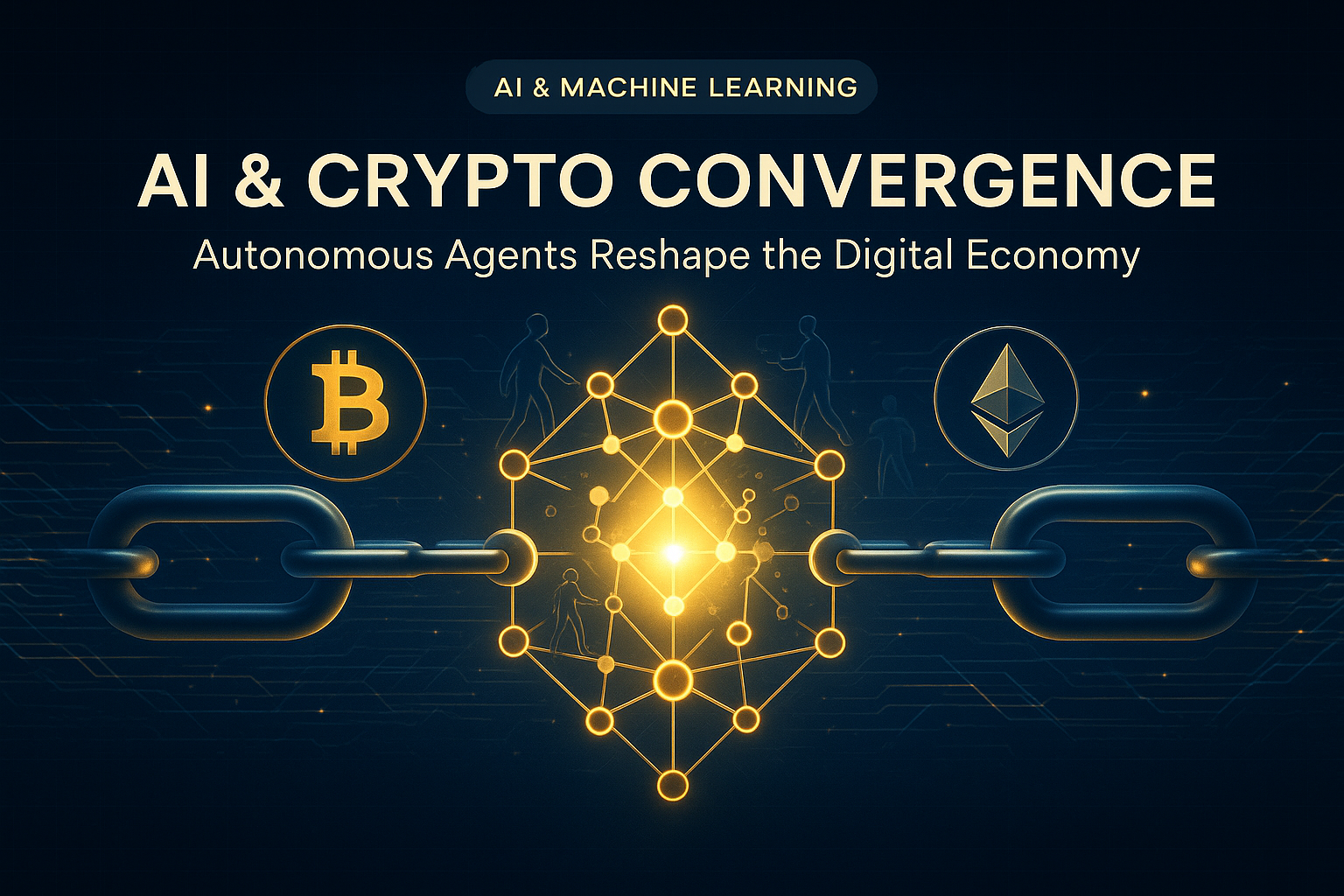
We’re witnessing a fundamental shift in how digital systems operate. The convergence of artificial intelligence and blockchain technology isn’t just creating new tools—it’s birthing an entirely new economic model powered by autonomous agents that operate independently across decentralized networks. This isn’t science fiction; it’s reshaping markets, finance, and infrastructure right now.
The AI-Crypto Infrastructure Revolution
For years, AI and cryptocurrency developed on parallel tracks. But in 2026, the intersection has become the most critical innovation frontier. AI agents require infrastructure that can handle scale, speed, and trustless coordination—and blockchain-native systems provide exactly that.
The key insight: autonomous AI agents need smart contracts to execute transactions, manage budgets, and enforce agreements without human intervention. They need decentralized networks to operate globally without geographic restrictions. They need cryptocurrency to transact value instantly and transparently. This convergence creates a new class of entity—the autonomous, globally-distributed, always-on company.
According to emerging industry analysis, AI agents will execute over 80% of DeFi transactions by 2030, moving from simple automation to genuine autonomous decision-making. This represents a fundamental shift in how financial markets will operate, with machines making complex trading, lending, and yield optimization decisions in real-time.
Agent Wallets and Autonomous Financial Autonomy
One of the most transformative applications emerging is the agent wallet—a crypto address controlled entirely by an AI system rather than a human. These agents manage budgets, execute transactions, and participate in DeFi protocols with complete autonomy.
Imagine an AI agent that:
- Monitors market conditions across multiple blockchain networks
- Executes trades based on programmed strategies without human approval
- Manages collateral in lending protocols automatically
- Optimizes yield by moving capital between different DeFi opportunities
- Settles transactions in milliseconds using smart contracts
This capability fundamentally changes how capital allocation works. Rather than humans making decisions and submitting transactions, AI agents become the operational layer of finance itself. Smart contracts replace legal and operational workflows, reducing friction and enabling new business models that were previously impossible.
DePAI: Bringing Agent Economies to the Physical World
While financial applications capture headlines, the real transformation extends beyond digital assets. Decentralized Physical AI (DePAI) brings autonomous agents into factories, warehouses, roads, and logistics networks.
This model evolves from DePIN (Decentralized Physical Infrastructure Networks) by adding intelligent autonomous agents to the equation. Imagine:
- Autonomous robots in warehouses coordinated by AI agents that negotiate tasks and compensation via blockchain
- Fleet management systems where vehicles autonomously coordinate routes, tolls, and fuel optimization
- Manufacturing systems where AI agents optimize production, quality control, and supply chain logistics
The infrastructure challenge is immense. These physical AI systems require massive computational resources. This is where decentralized GPU computing networks like Aethir become critical—providing distributed computing power that AI agents can access via crypto-native payment systems. The result is a truly decentralized, scalable infrastructure for autonomous physical systems.
Smart Contracts as the Operating System of Agent Economy
Smart contracts serve a dual purpose in the emerging agent economy. First, they enforce agreements between multiple AI agents without requiring trusted intermediaries. Second, they encode business logic directly into the protocol layer, making transactions immutable and verifiable.
Consider a supply chain scenario: An AI agent managing inventory automatically triggers a purchase order through a smart contract when stock reaches a threshold. The smart contract verifies the price, executes payment, and triggers logistics coordination—all without human involvement. If disputes arise, the blockchain provides an immutable record of every transaction and decision.
This shifts the paradigm from permission-based systems (where humans approve actions) to trustless systems (where cryptographic proofs and smart contracts guarantee compliance). It’s a fundamental architectural change in how organizations operate.
The Business Implications: Autonomous, Global, Always-On
The convergence creates a new organizational model: companies that are autonomous, global, and always-on. These aren’t companies with AI tools—they’re companies run by AI agents with crypto infrastructure as their backbone.
The advantages are stark:
- Zero geographic restrictions: AI agents operate across borders without regulatory friction
- 24/7 operations: No human working hours; markets never sleep
- Instant settlement: Cryptocurrency enables real-time value transfer without banking delays
- Programmable incentives: Smart contracts align agent behavior with organizational goals
- Transparent accountability: Blockchain records every decision and transaction
For investors and technologists, this creates unprecedented opportunities—but also challenges. How do you regulate autonomous agents? How do you ensure they act in the broader interest? How do you prevent malicious agents from exploiting the system?
The Road Ahead: 2026 and Beyond
We’re still in the early innings of this convergence. Most AI agents today are relatively simple—executing predetermined strategies in controlled environments. But the trajectory is clear: as AI models become more capable and blockchain infrastructure matures, we’ll see increasingly sophisticated autonomous agents managing larger portions of economic activity.
The next frontier isn’t just financial automation—it’s physical world automation. AI agents controlling robots, logistics, and manufacturing. Decentralized GPU networks powering the computation. Cryptocurrency enabling trustless value transfer. This convergence represents one of the most significant technological and economic shifts of the decade.
Conclusion: The Question Isn’t If, But How
The convergence of AI and crypto into an agent economy is no longer a theoretical discussion—it’s operational reality in 2026. The question isn’t whether autonomous agents will reshape our economy, but how quickly we adapt to this new paradigm.
What’s your view on autonomous agent economies? Are you preparing your organization for a future where AI agents handle the majority of transactions and decisions? The conversation has only just begun.
—
📖 **Recommended Sources:**
• **DePAI & Decentralized Physical AI** – Emerging framework integrating physical robotics with blockchain-based coordination and decentralized GPU computing (Aethir infrastructure)
• **AI Agent DeFi Forecasts** – Industry analysis projecting 80%+ of DeFi transactions executed by AI agents by 2030
• **Smart Contracts & Agent Wallets** – Research on crypto-native infrastructure enabling autonomous financial management and trustless execution
• **Decentralized Physical Infrastructure Networks (DePIN)** – Foundation for understanding how decentralized systems extend beyond digital assets into physical world coordination
ⓘ **Content Verification Note:** This content synthesizes emerging industry trends and research from April 2026. Specific numerical projections (e.g., 80% of DeFi transactions by 2030) reflect current industry forecasts. Please verify specific claims and latest developments independently before making investment or operational decisions.