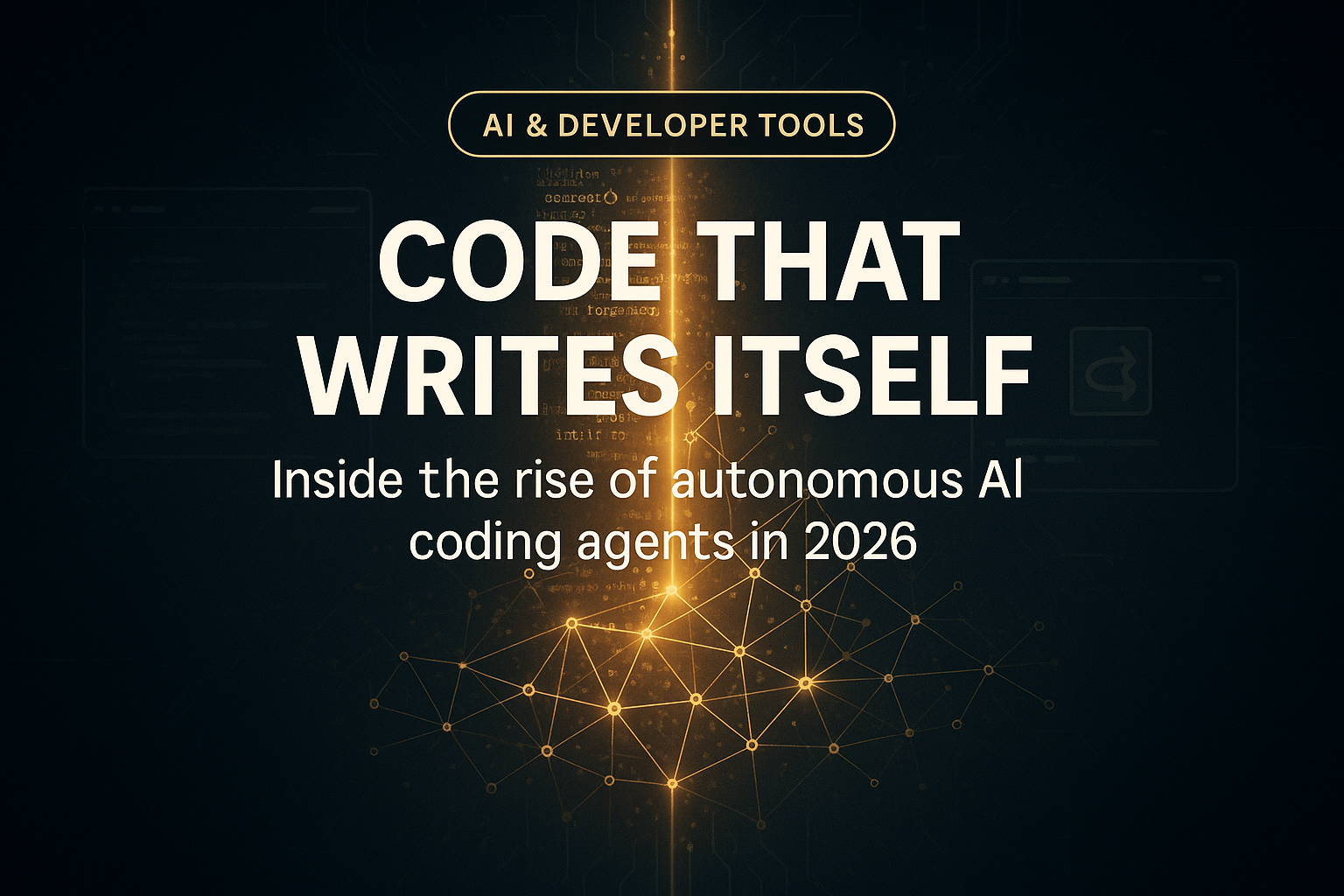
The gap between AI coding tools just widened sharply — and it’s not about who writes the best autocomplete anymore. It’s about who can be trusted to run unsupervised in your codebase.
As of October 2026, the conversation around AI code generation has moved decisively past “smart suggestions” and into the territory of autonomous software engineering agents. These systems no longer just finish your sentence in an IDE — they inspect repositories, implement multi-file changes, run tests, review pull requests, and even remediate security vulnerabilities on their own. For engineering leaders and investors alike, understanding this shift is no longer optional; it’s becoming core to how software gets built.
From Autocomplete to Autonomous Agents
The defining trend of 2026 is the rise of agentic workflows as the new baseline for professional development. According to JetBrains’ 2026 developer survey data, roughly 90% of professional developers now use an AI coding agent at work at least weekly — a dramatic jump from simple code-completion adoption just a couple of years ago.
What’s striking is how quickly the competitive order has shifted within that same survey window. Claude Code usage reportedly rose from 18% to 39% among developers, while GitHub Copilot usage fell from 29% to 21%, and Cursor dropped from 18% to 12%. OpenAI Codex, meanwhile, climbed from 3% to 16%. These are survey-specific signals rather than definitive market share, but they point to a market in active flux, where terminal-first, repository-scale agents are gaining ground against editor-native assistants.
Enterprise Adoption Is Accelerating Fast
This isn’t a niche developer trend — it’s becoming enterprise standard practice. Gartner forecasts that AI-augmented software development will be standard in 75% of technology organizations by the end of 2026, and that 40% of enterprise applications will include task-specific AI agents by year-end, up from less than 5% in 2025.
Real-world adoption at the highest end is already visible: Google has reported that roughly 75% of its new code is now AI-generated and engineer-approved, according to company statements made earlier in 2026. While this single-company figure shouldn’t be generalized across the industry, it illustrates where frontier adopters are heading — and it puts pressure on enterprise engineering leaders to define their own AI-code governance before the practice outpaces policy.
Security and Governance Take Center Stage
As agents gain the ability to touch production code, security has become the dominant theme of recent product announcements. Microsoft’s security team recently warned, in a blog post titled “Agents are your newest insiders,” that AI coding agents must be treated with the same identity, permission, and audit rigor as human employees — because they now operate with comparable access to sensitive systems.
The major vendors are responding in kind. GitHub Copilot’s agentic autofix feature reached general availability for eligible GitHub Enterprise Cloud customers, allowing Copilot to investigate security alerts, propose fixes, rerun CodeQL scans, and open a single draft pull request addressing up to 25 alerts at once. Anthropic’s Claude Code Review became generally available for Team and Enterprise plans, offering administrators a choice of Quick, Standard, or Deep review modes per repository, alongside a new Claude Security beta that runs continuous repository scanning and tracks vulnerability remediation over time.
Cursor, meanwhile, is investing in orchestration rather than pure security tooling — introducing remote control for cloud agents, an Environments API supporting workspaces of up to 300 repositories, and an integration marketplace exceeding 20 connected tools. This reflects a broader industry pattern: competition is shifting from “whose model writes better code” to “whose platform can be trusted to operate autonomously, safely, and auditably at scale.”
The Real Cost of Autonomous Coding
None of this capability comes free. Enterprise deployments of Claude Code reportedly average roughly $150–$250 per developer monthly, according to industry cost analyses, while Copilot and Cursor increasingly blend traditional seat pricing with usage-based consumption models. This marks a meaningful shift for procurement teams accustomed to flat SaaS licensing — budgeting for AI developer tools now resembles budgeting for cloud compute, with variable costs tied directly to how aggressively teams delegate work to agents.
Forward-thinking organizations are responding by evaluating these tools less on code-acceptance rates and more on holistic metrics: cycle time, review burden, defect-escape rate, security findings resolved, and cost per completed engineering task. This measurement shift signals a maturing market — one where ROI, not novelty, determines which tools survive enterprise procurement cycles.
What Comes Next
Looking ahead, the trajectory is clear: repositories themselves are becoming the primary unit of automation, with agents receiving issues, implementing changes, and submitting reviewable pull requests largely unattended. Human oversight won’t disappear, but it will concentrate at approval checkpoints rather than line-by-line code review. Expect governance, identity management, and integration depth to matter as much as raw model quality when enterprises choose their next-generation tooling — a dynamic already playing out in adjacent discussions around AI agent security and enterprise AI governance frameworks.
The era of AI as a coding assistant is giving way to AI as a coding colleague — one that writes, reviews, tests, and secures its own output, under increasingly formalized human supervision. The question every engineering leader should be asking isn’t whether to adopt these agents, but how quickly their governance, security, and budgeting practices can keep pace with what these tools are already capable of doing today. Is your organization ready to manage AI agents as infrastructure, not just software?
📖 Recommended Sources:
• JetBrains 2026 Developer Survey – agent adoption and tool usage share data
• Gartner – enterprise AI agent adoption forecasts for 2026
• GitHub Blog / Anthropic Product Announcements – Copilot autofix GA and Claude Code Review GA details
• Microsoft Security Blog – “Agents are your newest insiders” governance perspective
ⓘ This content is AI-generated based on training data through January 2026, supplemented with live research. Please verify specific claims independently.