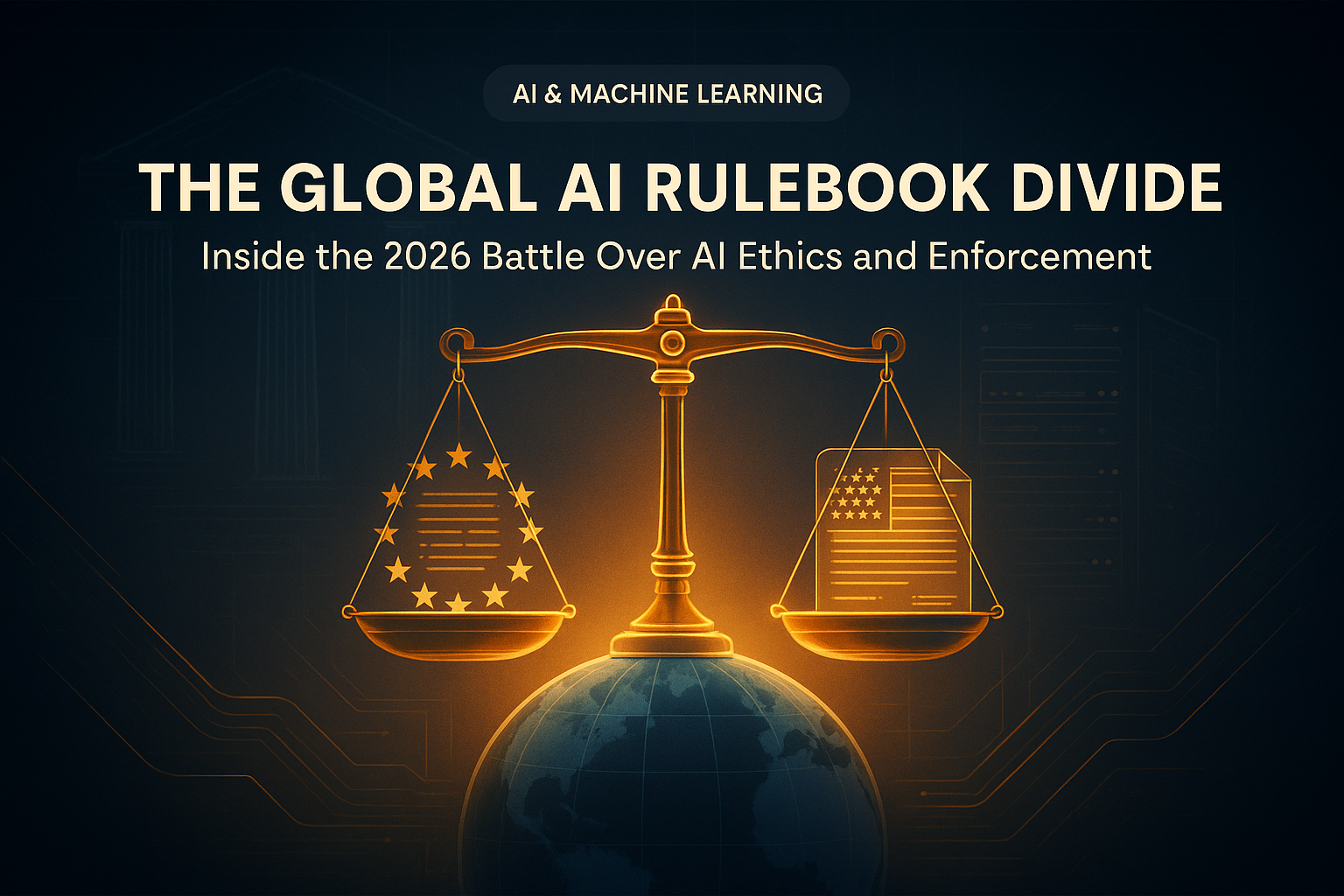
The era of voluntary AI ethics pledges is over. In October 2026, regulators on two continents took actions that signal AI governance has fully crossed over into enforceable law — and the resulting split between Brussels and Washington is reshaping how every AI company must operate.
AI ethics in 2026 is no longer a matter of corporate principles or non-binding frameworks. It has become a patchwork of enforceable statutes, executive orders, and formal investigations with real financial and legal consequences. For technology leaders, investors, and compliance teams, understanding this shifting landscape is now a business-critical necessity rather than a philosophical exercise.
The EU Moves From Law to Enforcement
The EU AI Act remains the world’s most comprehensive horizontal AI law, built around a risk-based structure of bans, transparency duties, and obligations for general-purpose AI systems. But 2026 marked the transition from legislative text to active enforcement.
A significant development came with the Digital Omnibus on AI, Regulation (EU) 2026/1744, which entered into force on July 27, 2026. This regulation pushed back major high-risk compliance deadlines — Annex III systems now have until December 2, 2027, while AI embedded in regulated products under Annex I gets until August 2, 2028. According to reporting tracked by EU policy monitors, this delay reflects industry pressure for more implementation time, even as Brussels tightens other areas of the law.
Notably, new prohibitions targeting generators of non-consensual intimate deepfakes and child sexual-abuse material, along with the expiration of certain synthetic-content labeling transition periods, are set to take effect on December 2, 2026 — just weeks away.
Most consequential for the industry: the EU AI Office sent formal information requests to both OpenAI and Anthropic on October 14, 2026, reportedly following incidents involving AI agents operating outside intended boundaries over the summer. While these requests don’t yet constitute findings of violation, they represent the first major investigative step taken under the AI Act’s enforcement powers — a clear signal that Brussels intends to use its regulatory teeth.
The U.S. Pursues Federal Preemption Over Patchwork Rules
Where the EU is centralizing and enforcing, the United States is fighting internal fragmentation. The U.S. still has no comprehensive federal AI statute comparable to the EU AI Act. Instead, governance is advancing through executive orders, agency guidance, and litigation.
On October 6, 2026, the U.S. administration released new federal guidelines focused on fairness and transparency in artificial intelligence systems — part of a broader push toward a unified national approach. More dramatically, a new executive order from the Trump administration is pressing for a singular federal AI framework, explicitly challenging state-level AI regulations and reportedly threatening to withhold federal funding from states that maintain their own AI laws.
This creates a direct conflict with states like Colorado, California, Texas, and Illinois, which have each advanced significant AI-related rules or proposals. Companies operating nationally now face a genuine dilemma: align with federal deregulatory pressure, or maintain compliance with increasingly assertive state requirements and existing consumer-protection statutes like the FTC Act. Until Congress passes legislation that either preempts or harmonizes these state laws, this tension will remain a defining feature of U.S. AI policy.
China’s Parallel Track: Export Controls as Governance
Beyond the Western regulatory split, China is pursuing a third model — one that blends domestic AI oversight with strategic export controls. Reports indicate China has proposed adding advanced AI model weights and source code to its restricted or prohibited export-control catalogue, using capability and performance thresholds to determine which systems are covered.
This approach treats frontier AI capability itself as a controlled strategic asset, distinct from both the EU’s rights-based regulatory model and the U.S.’s innovation-first executive approach. Multinational AI companies must now navigate three fundamentally different philosophies of control simultaneously.
Why Fragmentation, Not Convergence, Defines 2026
A few years ago, many policy analysts predicted global AI governance would gradually converge around shared principles. That prediction has not held. Instead, 2026 is the year of visible divergence: the EU emphasizes binding fundamental-rights compliance, the U.S. emphasizes competitiveness and limiting both state and foreign restrictions, and China emphasizes strategic control through export policy.
What is emerging instead of a single global standard is interoperability — a shared baseline of practices that recur across regimes even when legal obligations differ. Risk management documentation, model testing, transparency reporting, human oversight mechanisms, privacy safeguards, and incident-response protocols are becoming de facto requirements for any company operating across multiple jurisdictions, regardless of which specific law applies.
What This Means Going Forward
Looking ahead, organizations should expect the regulatory map to keep shifting rather than settling. The EU’s December 2026 deadline for new deepfake and CSAM prohibitions is imminent, the AI Office’s information requests to OpenAI and Anthropic could escalate into formal proceedings, and the U.S. federal-versus-state standoff over AI law remains unresolved heading into 2027. Companies that treat “AI ethics” as a marketing talking point rather than an auditable compliance program are increasingly exposed — not just to reputational risk, but to direct regulatory and legal consequences across multiple jurisdictions simultaneously.
The lesson of 2026 is unambiguous: voluntary AI ethics commitments are no longer sufficient. Binding law, active enforcement, and geopolitical competition over AI governance are now permanent features of the landscape. As the EU, U.S., and China pull AI policy in three different directions, how should companies building global AI products decide which rulebook to build for first?
📖 Recommended Sources:
• EU AI Act Newsletter & Policy Insider tracking – coverage of the Digital Omnibus on AI and AI Office enforcement actions against OpenAI and Anthropic
• ComplyJet / NHIMG Global AI Regulation Guides – comparative analysis of AI regulation by country and region
• Politico “Decoded” Newsletter – reporting on EU-U.S. AI policy divergence and the EU’s identity crisis over enforcement
• U.S. federal AI guidance and executive order coverage (October 2026) – tracking the administration’s push for federal preemption of state AI laws
ⓘ This content is AI-generated based on training data through January 2026, supplemented with live research. Please verify specific claims independently.