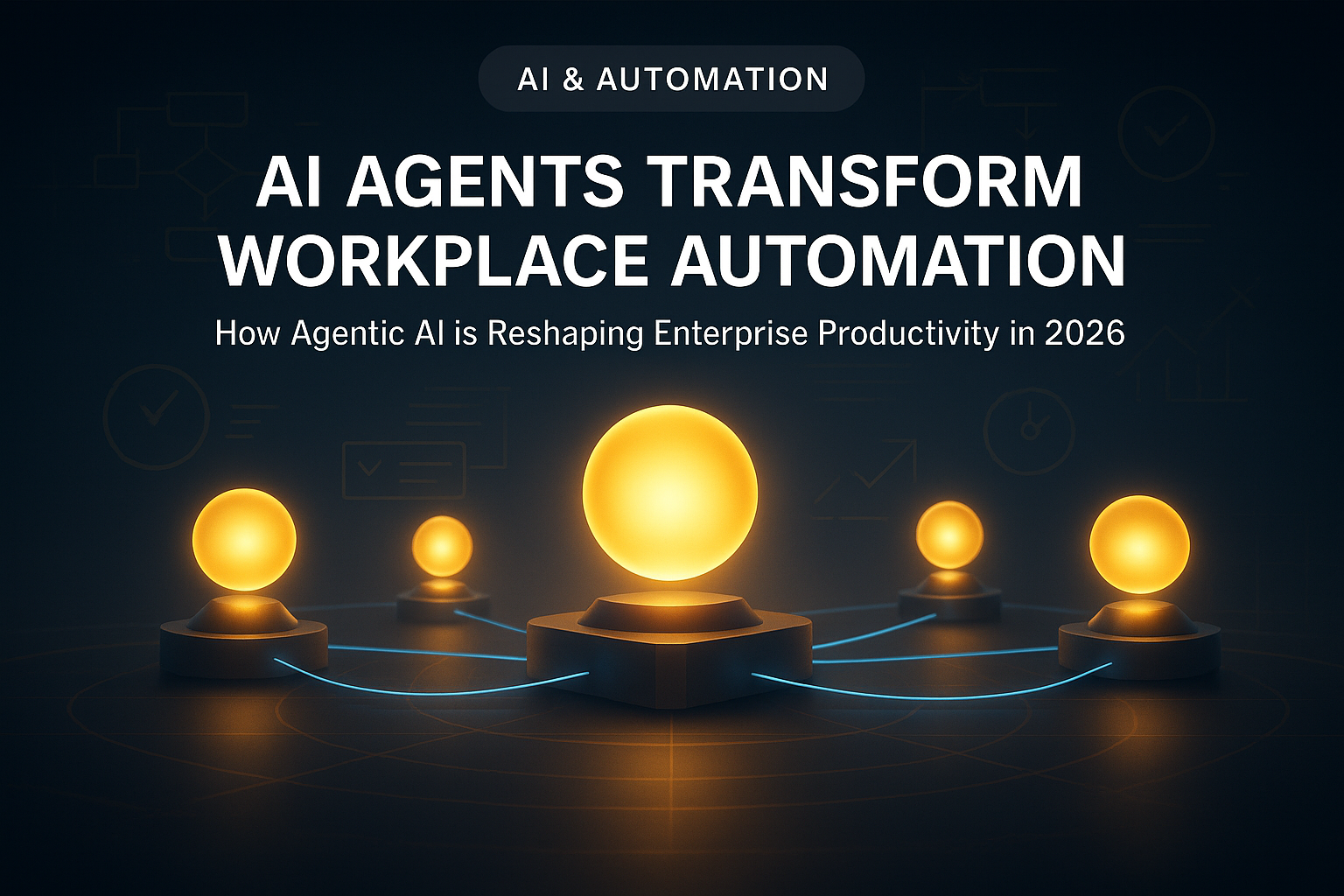
# AI Agents Transform Workplace Automation: The 2026 Enterprise Shift to Agentic AI
The workplace is fundamentally changing. AI agents are no longer a futuristic concept—they’re now embedded in enterprise systems, autonomously handling tasks that once consumed hours of human effort every week.
The Rapid Rise of Agentic AI in Enterprise
According to Gartner, 40% of enterprise applications will embed task-specific AI agents by the end of 2026, up dramatically from less than 5% in 2025. This explosive growth signals a decisive shift in how organizations approach automation and workforce productivity.
Unlike traditional automation tools that follow rigid, pre-programmed workflows, AI agents are autonomous systems capable of reasoning, adapting, and making decisions in real-time. They can connect across multiple business systems, understand context, and execute complex tasks with minimal human oversight. This represents a qualitative leap beyond robotic process automation (RPA) and basic workflow tools.
The momentum is undeniable. Organizations across finance, healthcare, customer service, and operations are deploying agentic AI to reclaim lost productivity and redirect human talent toward higher-value work.
Quantified Productivity Gains: The 6.4-Hour Weekly Impact
The business case for AI agents is backed by concrete data. Knowledge workers using production AI agents recover a median of 6.4 hours per week per seat across deployments, according to recent enterprise adoption metrics. For a team of 100 knowledge workers, this translates to approximately 640 hours of recovered productivity weekly—equivalent to adding 16 full-time employees without hiring costs.
These gains span across multiple dimensions:
- Administrative task automation: Email management, scheduling, document processing, and routine data entry
- Decision support: AI agents synthesizing information from multiple sources to provide actionable insights
- Cross-system orchestration: Seamlessly moving data and executing processes across disconnected enterprise platforms
- Continuous monitoring: Agents running 24/7 to flag anomalies, escalate issues, and maintain operational health
The impact extends beyond time savings. Organizations report improved accuracy, faster decision cycles, and reduced human error in repetitive processes—all critical for competitive advantage in fast-moving industries.
Why 2026 Is the Inflection Point
Several factors converge to make 2026 the definitive year of AI agent adoption:
Mature AI Model Infrastructure: Large language models (LLMs) and specialized reasoning models have reached production-grade reliability. They can now handle nuanced business logic, multi-step reasoning, and error recovery—capabilities essential for autonomous workplace agents.
Enterprise Integration Frameworks: Vendors and open-source communities have developed robust integration patterns, governance frameworks, and security controls that allow enterprises to deploy agents at scale without compromising compliance or data protection.
Proven ROI and Use Cases: Early adopters have published case studies demonstrating measurable returns. This reduces perceived risk for enterprises still evaluating agentic AI, accelerating mainstream adoption.
Workforce Expectations: Employees increasingly expect AI-powered tools to handle routine work. The talent market rewards organizations that free workers from tedious tasks, enabling recruitment and retention advantages.
From Human + AI Harmony to Competitive Necessity
The narrative around AI in the workplace has evolved. The 2026 workforce will see growing harmony between humans and their AI assistants, moving beyond fears of replacement toward a collaborative model where agents handle execution and humans focus on strategy, creativity, and complex decision-making.
This shift requires organizational readiness:
- Reskilling programs: Employees must learn to collaborate with agents, interpret their outputs, and oversee autonomous workflows
- Governance and transparency: Clear policies around agent decision-making, escalation protocols, and human oversight
- Change management: Cultural shifts to embrace AI as a productivity multiplier rather than a threat
Organizations that successfully navigate this transition will unlock substantial competitive advantages. Those that delay face the risk of falling behind peers who’ve already captured efficiency gains and redeployed talent to innovation.
The Road Ahead: Agentic AI as Standard Infrastructure
Looking forward, AI agents will transition from differentiator to baseline expectation. By 2027 and beyond, enterprises without embedded agentic AI will face pressure to catch up. The question is no longer “if” but “how quickly” and “how comprehensively” organizations can deploy these systems.
The most forward-thinking enterprises are already moving beyond single-purpose agents toward multi-agent systems—networks of specialized agents that collaborate to solve complex, cross-functional problems. This represents the next frontier of workplace automation.
Conclusion: The Autonomous Workplace Is Here
The convergence of mature AI technology, proven business cases, and enterprise readiness makes 2026 the pivotal year for AI agent adoption in the workplace. With 40% of enterprise applications embedding task-specific agents and knowledge workers recovering 6.4 hours weekly, the productivity gains are measurable and immediate.
The question for your organization is no longer whether to adopt AI agents, but how to do so strategically—ensuring governance, security, and alignment with business objectives. Are you prepared to lead the shift to an agentic workforce, or will you play catch-up as competitors pull ahead?
📖 **Recommended Sources:**
– **Gartner Enterprise Application Forecasts 2026** – Provides the 40% embedding forecast and market trend analysis for task-specific AI agents
– **Enterprise AI Agent Productivity Studies** – Data on 6.4-hour weekly time savings for knowledge workers using production AI agents
– **McKinsey & BCG Reports on AI Workplace Transformation** – Strategic insights on organizational readiness and change management for agentic AI
ⓘ *This content is AI-generated based on research data current through September 2026. Please verify specific claims and statistics with primary sources independently.*