# AI Agents Meet Crypto: How Agentic Commerce Is Reshaping Autonomous Payments in 2026
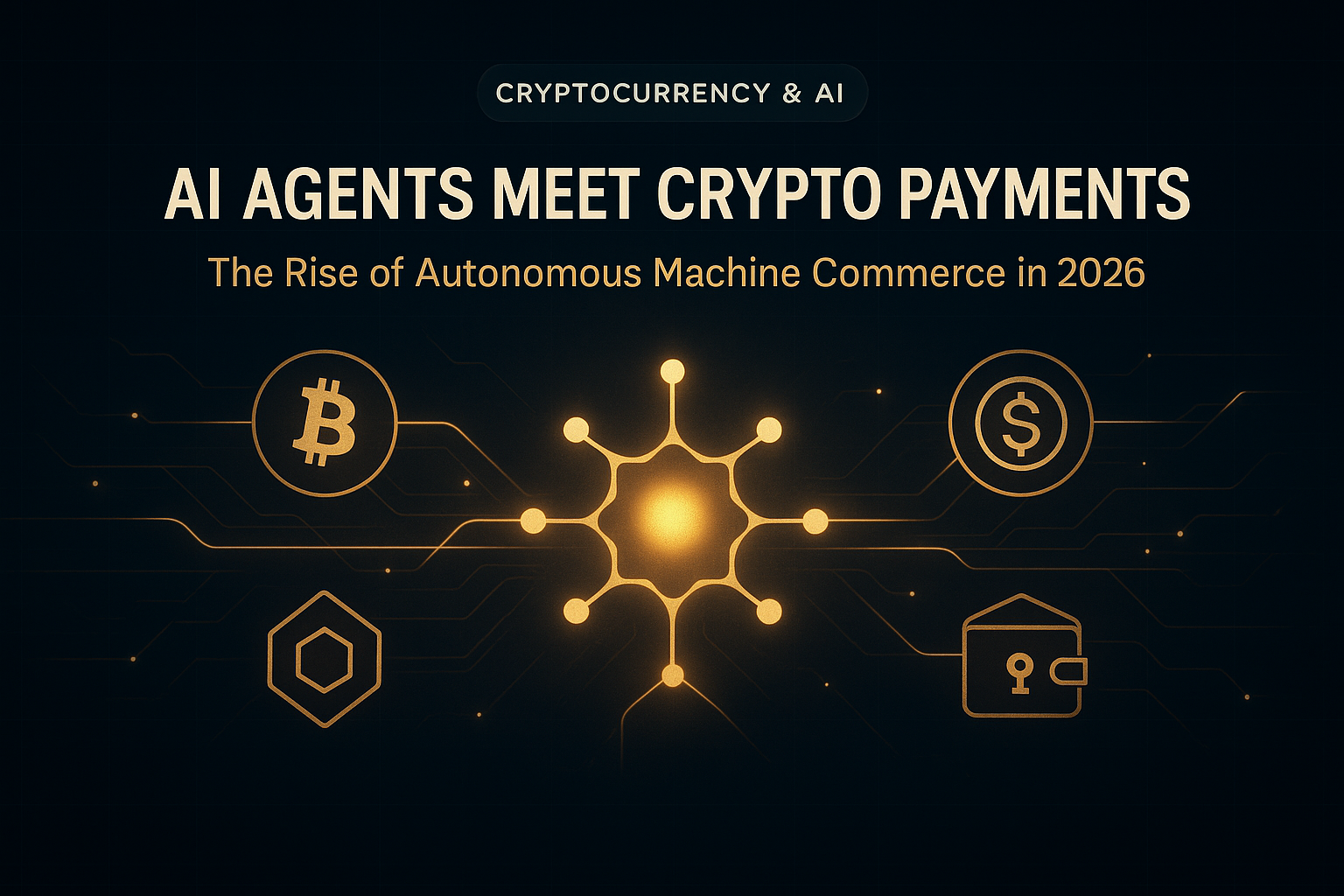
The age of AI agents as mere assistants is over. In 2026, autonomous software is no longer just recommending actions—it’s executing transactions, making purchases, and moving value across blockchain networks at machine speed. This convergence of artificial intelligence and cryptocurrency is creating a new economic layer: agentic commerce, where machines transact with other machines using stablecoins and novel payment protocols.
The Shift from Assistants to Autonomous Economic Actors
For years, AI agents played a supporting role—they analyzed data, generated recommendations, and waited for human approval. That dynamic has fundamentally changed. According to recent industry analysis, AI agents are increasingly completing purchases, executing trades, and buying digital services directly without human intervention at each step. The technology is maturing, and the infrastructure to support autonomous machine-to-machine commerce is being built in real time.
This shift has profound implications. If AI agents can safely hold and move value, they become first-class participants in the economy. They can pay for API calls, purchase data, hire other agents for specialized tasks, and settle transactions in milliseconds. The question is no longer “Can agents transact?” but rather “How do we build the trust, identity, and payment infrastructure to let them do so safely at scale?”
Stablecoins as the Default Settlement Layer
The answer, surprisingly, is not a specialized “agent token.” It’s stablecoins—particularly USDC. According to Coinbase’s Q2 2026 reporting and analysis from TRM Labs, over 90% of agentic commerce is settling in USDC, with the vast majority occurring on Base via the x402 protocol. This reveals a crucial insight: agentic commerce is fundamentally a payments and infrastructure problem, not a speculative asset play.
Stablecoins offer agents several advantages:
- Predictable value – No price volatility means agents can reliably budget and settle transactions without slippage.
- Fast finality – Settlement occurs in seconds, enabling high-frequency, micropayment-based commerce.
- Programmable money – USDC and similar stablecoins integrate directly into APIs and smart contracts, making payments inseparable from service execution.
- Existing liquidity and off-ramps – Merchants can accept USDC and convert to fiat without touching crypto infrastructure.
Circle’s recent announcements highlight this trend. The company’s Discovery API enables agents to autonomously locate and pay for services that accept USDC across multiple chains. Agents can query the API, retrieve structured payment details, and execute transactions—all without human guidance. This is the beginning of a programmable marketplace where autonomous software can discover, evaluate, and transact in real time.
The x402 Protocol and Per-Request Payments
At the heart of emerging agentic commerce infrastructure sits x402, a protocol that ties stablecoin payments to individual API requests. Each web call triggers an on-chain USDC transfer, creating an auditable record of every transaction. This is revolutionary for several reasons:
Micropayments become economically viable. With sub-cent gas fees on Base and x402’s efficiency, agents can pay fractions of a cent per API call. The Monad API Hub exemplifies this: developers and agents pay $0.01 to $7.50 per data endpoint request, settling in USDC instantly. This pricing model was impossible under traditional payment rails.
Receipts are cryptographic and final. Once a transaction confirms on-chain, it cannot be disputed or reversed without a counter-transfer. For agents, this means no chargebacks, no fraud claims—just settled transactions. This requires robust controls, which we’ll address below.
Payment and service delivery are coupled. x402 embeds payment logic directly into HTTP-like request flows. An agent calls an API, the request is authenticated, the payment is processed, and the service is delivered—all atomically. This tight coupling reduces counterparty risk and enables true pay-per-use economics.
Nanopayments and the Circle Gateway Stack
For ultra-high-frequency agent activity, even x402 fees can add up. Enter Circle Gateway Nanopayments, a gas-free settlement primitive that allows agents to make payments as small as $0.000001 without hitting the blockchain for every transaction. Instead, payments are batched and settled off-chain, with periodic reconciliation to the ledger.
This is critical for agents making thousands of inferences, log entries, or computational steps per second. A machine learning agent evaluating data might make millions of micro-decisions, each potentially compensating a data provider or service. Nanopayments make this economically feasible.
Circle’s broader Arc mainnet—launching September 16, 2026—positions itself as an economic operating system for agents. Arc combines x402, Nanopayments, and StableFX (24/7 on-chain foreign exchange using vetted stablecoins) into a unified stack. The vision is clear: agents should be able to hold, move, and exchange stablecoins as easily as humans exchange fiat.
Identity, Trust, and the “Know Your Agent” Framework
Stablecoins and protocols are only half the story. The other half is trust and identity—arguably the harder problem. If an agent can irreversibly move funds, how do we ensure it’s authorized to do so? How do we prevent misconfigured or malicious agents from draining accounts?
The answer is a new class of standards called Know Your Agent (KYA), jointly developed by Visa, Mastercard, and Ant International and announced in September 2026. KYA is essentially KYC/AML for AI agents—a framework to:
- Establish agent identity and link it to a human operator or organization
- Certify the agent’s mandate – what it can do, with which payment instruments, under what limits
- Monitor behavior continuously and adjust trust and autonomy dynamically based on transaction patterns
Visa’s Trusted Agent Protocol (TAP) and Mastercard’s Verifiable Intent framework both feed into this ecosystem. The goal is to create cross-network interoperability so that a “trusted agent” certified by one payment network can operate across multiple ecosystems without full re-onboarding.
In the crypto context, platforms like Binance are deploying agentic wallets that allow users to create isolated, keyless wallets for AI agents. These wallets enforce user-defined permissions, including transaction types, asset limits, and whitelists. The agent operates within these preset boundaries, and all activity is auditable and reversible by the human operator.
Verifiable Credentials and Decentralized Identity
Trust frameworks are being further strengthened by verifiable credentials (VCs) and decentralized identity infrastructure. The EU’s eIDAS 2.0 and European Digital Identity (EUDI) Wallet introduce a model where individuals and organizations hold cryptographically signed credentials in digital wallets. By December 2027, EU financial institutions will be required to accept wallet-based credentials from customers.
This model maps naturally to agentic commerce. An AI agent’s authority and scope could be represented as a VC—a cryptographically signed credential stating “Agent X is authorized to spend up to $Y per transaction on behalf of Organization Z.” Relying parties (merchants, payment networks) can verify these credentials against a shared trust framework, rather than relying on opaque, proprietary systems.
The concept of a neutral “Trust Bureau” has also been proposed—a shared infrastructure that verifies agents and credentials once, allowing those confirmations to be reused across platforms and wallets. This avoids forcing relying parties to surrender strategic control to a competitor’s identity system and creates a foundation for true interoperability.
Market Size and Future Outlook
The economic opportunity is immense. According to industry projections cited by Ant International and other payment networks, AI agents could orchestrate $3–5 trillion in global consumer commerce by 2030. That’s a strong secular tailwind for agentic infrastructure.
However, it’s important to note that agentic commerce is still in its infancy. TRM Labs’ analysis of x402 settlement volume suggests that AI agents currently account for only 0.6–7.5% of total x402 volume—roughly $150K–$1.92M. The infrastructure is sophisticated and ready, but adoption is still ramping.
The most credible opportunities in this space are not speculative agent tokens, but rather infrastructure plays: wallets, payment rails, identity verification systems, and escrow mechanisms that enable autonomous software to transact safely. Companies building stablecoin settlement layers, agentic wallet controls, and trust frameworks are positioned to capture value as this market scales.
Conclusion: The Plumbing Matters More Than the Hype
Agentic commerce in crypto is ultimately about plumbing, not hype. It’s about building the boring-but-critical infrastructure—payment rails, identity frameworks, wallet controls, and governance mechanisms—that let autonomous software move value safely.
The winners in 2026 and beyond won’t be flashy “agent tokens” with speculative narratives. They’ll be the builders of stablecoin infrastructure, verifiable identity systems, and transaction controls that make agentic commerce possible. Stablecoins like USDC, protocols like x402, platforms like Circle Arc, and frameworks like KYA are the real innovations.
As an investor, builder, or technologist, the question to ask is: Which infrastructure will become the standard for agent-to-agent and agent-to-merchant settlement? The answer will likely determine which platforms, protocols, and companies capture disproportionate value in the coming decade.
What’s your view—will agents primarily transact on-chain via stablecoins, or will hybrid models combining fiat rails and crypto settle at scale? Share your thoughts in the comments below.
—
### 📖 Recommended Sources:
• **Perplexity Research on AI Agents & Crypto (September 2026)** – Comprehensive analysis of agentic commerce trends, stablecoin settlement rails, and infrastructure maturity across Base, Solana, and Polygon networks.
• **Coinbase Q2 2026 Filing & TRM Labs x402 Analysis** – Real transaction data showing USDC dominance (99.6% of settlement value) and early-stage agent volume (0.6–7.5% of x402 activity).
• **Circle Arc & Discovery API Documentation** – Technical specifications for programmable agent payment infrastructure, including Nanopayments, StableFX, and service discovery mechanisms.
• **Ant International, Visa, Mastercard KYA Framework (September 2026)** – Joint announcement on Know Your Agent standards, Trusted Agent Protocol (TAP), and cross-network interoperability for autonomous payment actors.
• **EU eIDAS 2.0 & EUDI Wallet Specifications** – Regulatory framework for verifiable credentials, selective disclosure, and decentralized identity integration in financial services (deadline December 2027).
────────────────────
ⓘ This content is AI-generated based on research through September 2026. Please verify specific claims, transaction volumes, and regulatory timelines independently, as agentic commerce infrastructure is evolving rapidly.