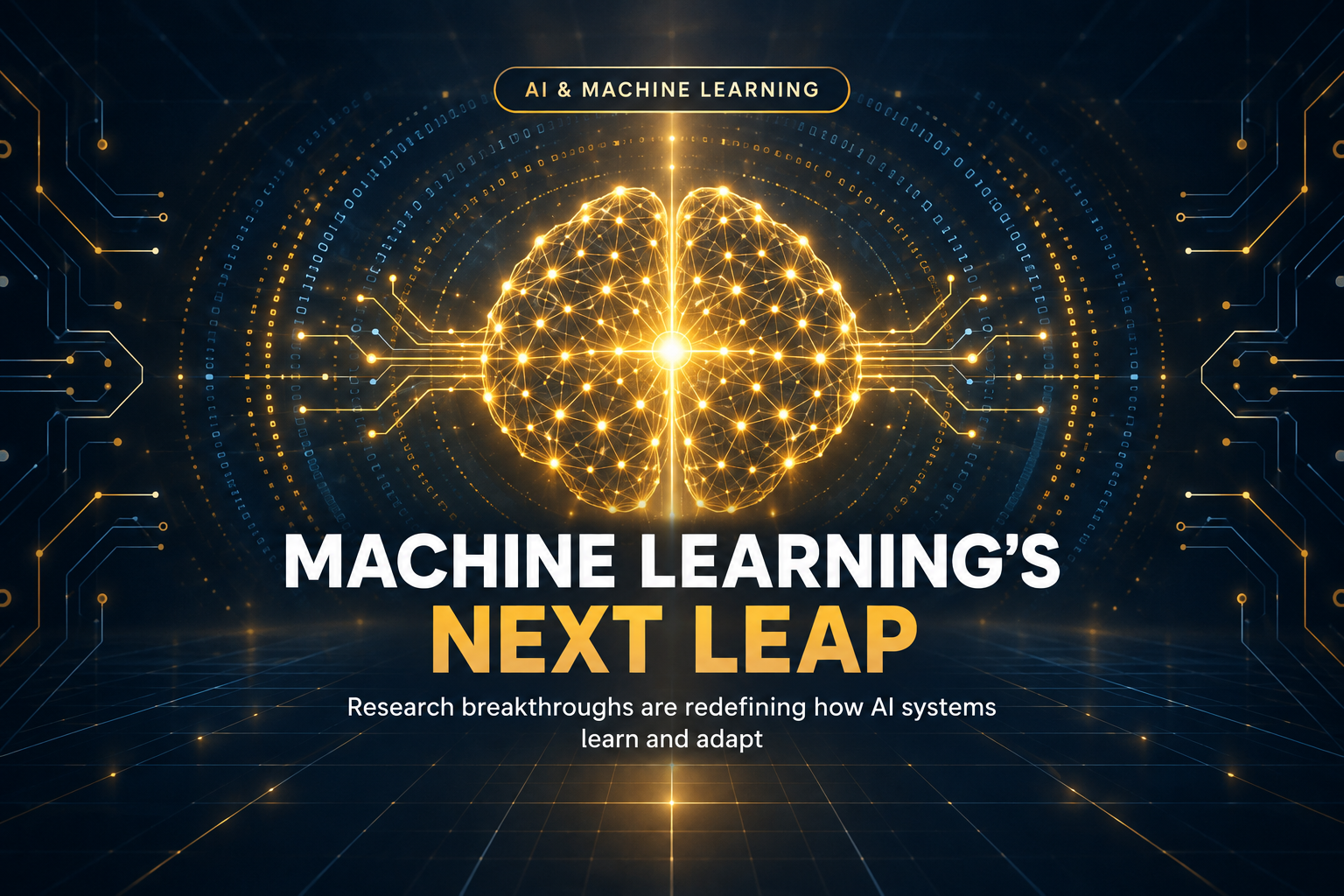
Machine learning research just crossed a threshold that few predicted even a year ago: AI systems are beginning to edit, adapt, and reason about themselves. As of early November 2026, a wave of breakthroughs is redirecting the field’s energy away from simply building bigger models and toward making existing models smarter, more efficient, and capable of continuous improvement without starting from scratch.
This shift matters because the “just add more parameters and data” era of AI progress is showing diminishing returns on cost and energy. The latest research signals that the next competitive advantage in machine learning won’t come from scale alone—it will come from precision, adaptability, and efficiency. For technology leaders and investors, understanding these developments is essential to separating genuine innovation from hype.
The Rise of Weight-Space Programming
One of the most striking developments comes from MIT CSAIL, where researchers published findings on what they call “weight-space programming.” In the experiment, a frontier language model—reportedly OpenAI’s GPT-6 Astra—was given direct access to inspect and modify the internal parameters of a smaller open model, Alibaba’s Qwen3.5-0.8B, without any gradient-based training or fine-tuning loop.
The results were dramatic on paper: by altering just 0.016% of the model’s weights (131,072 parameters out of roughly 800 million), the editing process raised Qwen’s MATH-500 benchmark score from 7.9% to 48.1%, and its GSM8K score from 13.8% to 67.1%. According to the research team’s published report, the intervention largely eliminated repetitive reasoning loops that had been causing the smaller model to run out of tokens before completing its answers.
It’s important to read this result carefully. Critics have noted that the technique resembles targeted behavioral repair rather than a model learning new mathematical reasoning from scratch, and that the process still required dozens of iterative evaluation passes. Still, the implications for AI model maintenance and interpretability are significant—imagine debugging a deployed model’s flaws the way engineers patch software bugs, instead of retraining it entirely.
Solving the Continual Learning Problem
A second major research thread tackles one of machine learning’s oldest challenges: catastrophic forgetting, where models lose previously learned skills as they absorb new information. Sandia National Laboratories recently reported progress with a system called AIGM Lite, which improved incremental-learning accuracy from roughly 70% to above 90% in controlled testing.
This matters enormously for real-world deployment. Enterprise AI systems operating in dynamic environments—fraud detection, manufacturing quality control, supply chain forecasting—need to adapt to shifting conditions without being retrained from zero every time the data changes. Continual learning research like this points toward a future where models update themselves incrementally and reliably, reducing both computational cost and downtime.
Long-Context Efficiency and Embodied AI
Efficiency gains are also reshaping how models handle enormous amounts of information. New research into Latent Sparse Attention architectures has reportedly achieved up to 72.4x faster attention-layer processing at context lengths of 10 million tokens, while preserving comparable accuracy to standard approaches. For industries working with massive documents, codebases, or genomic datasets, this kind of efficiency breakthrough could make previously impractical applications commercially viable.
Meanwhile, embodied AI research is bridging the gap between digital intelligence and physical action. The RISE vision-language-action framework connected independently learned walking and manipulation skills in robots, achieving an 87.3% simulated task success rate compared to 73.6% for a comparable baseline model—and notably, it also showed real-world gains on physical humanoid robots. This convergence of perception, language, and motor control suggests robotics is catching up to the pace of progress seen in large language models.
Enterprise Adoption Is Accelerating—But ROI Lags
These research advances are landing in an enterprise environment that’s scaling AI faster than ever. According to McKinsey’s 2026 findings, approximately 89% of organizations now use AI regularly in at least one business function, and 44% report AI scaling across the enterprise—up from 38% the previous year. Agentic AI adoption among large enterprises has also surged, with 40% of companies generating over $1 billion in revenue now scaling AI agents, compared to 27% a year earlier.
Yet Gartner’s latest outlook strikes a more cautious note, emphasizing that governance, security, and cost accounting remain unresolved challenges. Only about 37% of organizations attribute measurable profit impact to their AI investments so far. This gap between rapid technical progress and slower enterprise value realization is likely to define the industry conversation well into 2027.
What Comes Next
Looking ahead, the research trends converging in late 2026—targeted model editing, continual learning, long-context efficiency, and embodied intelligence—suggest the field is maturing beyond raw scale into something more surgical and sustainable. Expect increased investment in interpretability tools, model repair techniques, and hybrid architectures that combine the reasoning power of large models with the efficiency of smaller, specialized ones.
The message from the research community is clear: the next era of machine learning won’t be won by the biggest model, but by the smartest, most adaptable, and most efficient one. As these techniques move from research labs into production systems, which breakthrough do you think will have the biggest impact on your industry first—self-editing models, continual learning, or embodied AI?
📖 Recommended Sources:
• MIT CSAIL “Sparks of Weight-Space Programming” report (November 2026) – details on weight-space editing experiments with GPT-6 Astra and Qwen3.5
• Sandia National Laboratories Lab News (November 2026) – AIGM Lite continual learning research
• McKinsey “The State of AI” 2026 report – enterprise AI adoption and ROI data
• Gartner 2026 AI Hype Cycle outlook – governance and scaling challenges
ⓘ This content is AI-generated based on training data through January 2026, supplemented with live research. Please verify specific claims independently.