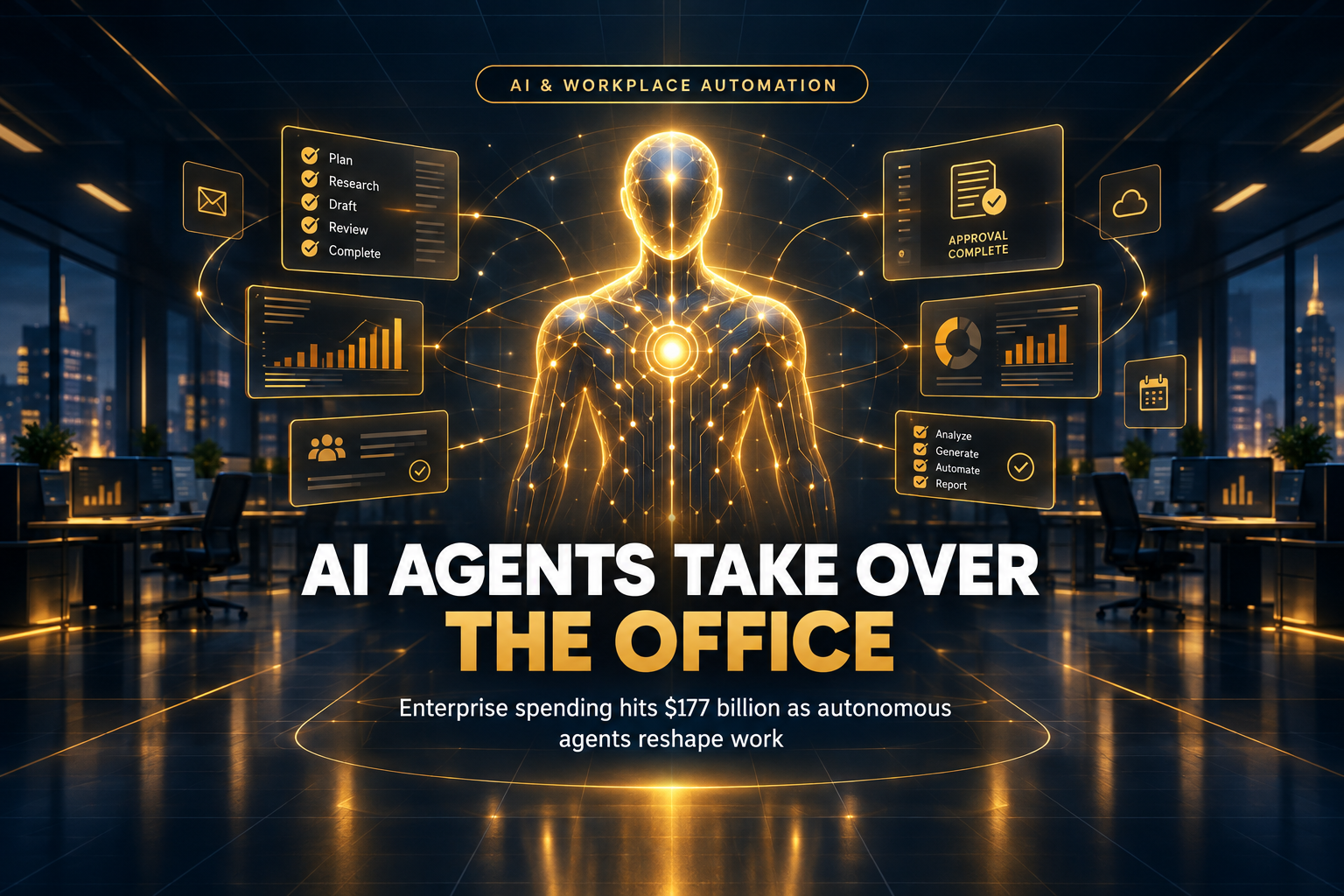
Enterprise AI spending on autonomous agents just rocketed to $176.8 billion in 2026 — a staggering 5.4x jump from $33 billion the year before. The age of AI agents quietly observing workflows is over. They’re now executing them.
As of November 2026, the shift from AI as a drafting assistant to AI as an active workforce participant has become one of the defining stories in enterprise technology. According to the Menlo Ventures 2026 State of Enterprise AI report, agents are no longer confined to chatbots answering questions — they’re planning multi-step tasks, coordinating across software applications, and only escalating to human employees when something falls outside their defined boundaries. This matters now because the gap between companies racing to deploy agentic automation and those still governing it responsibly is widening fast, creating both enormous opportunity and real operational risk.
The Scale of Enterprise Adoption
The numbers tell a story of uneven but accelerating momentum. 62% of large U.S. companies are now building, deploying, or actively developing AI agents, up from 53% just one quarter earlier. Zoom out to the broader economy, though, and adoption looks very different: only 24.6% of all U.S. employer businesses had integrated AI into at least one business function as of mid-October 2026.
This divide is largely about company size and resources. 40% of organizations with over $1 billion in revenue are scaling agents across at least one function, compared to just 22% of smaller organizations. Gartner data suggests this gap will narrow dramatically, projecting agent deployment to climb from 17% in 2026 to more than 60% within two years — but the trajectory clearly favors enterprises with the budget and technical infrastructure to move first.
Where Agents Are Actually Working
Customer service has emerged as the clear frontrunner for agentic deployment, accounting for 26.5% of primary use cases, followed closely by research and data analysis at 24.4%, and internal workflow automation at roughly 18%. These are bounded, measurable workflows — exactly the kind of environment where agentic AI performs reliably without excessive risk.
Major vendors are racing to capture this shift. Microsoft, AWS, Accenture, ServiceNow, and Salesforce are all embedding agentic capabilities directly into their existing productivity and enterprise software suites rather than selling standalone agent products. This matters strategically: 55% of incremental enterprise AI spending came from new budgets, while 22% was redirected from existing software spend, signaling that agents are increasingly viewed as infrastructure rather than experimental tooling. Perplexity’s own “Teammates” product — positioned as a 24/7 AI agent for work — reflects this broader industry push toward persistent, task-executing agents embedded in daily operations.
The Governance Gap Nobody’s Solved
Here’s where the enthusiasm meets reality. Despite rapid deployment, only 10% of enterprises currently allow agents to make decisions across multiple business functions without human approval. Even fewer — just 9% — report that their agents can securely coordinate workflows across different enterprise applications.
The security picture is more concerning. One industry survey found that while 82% of organizations are already using AI agents in some capacity, only 44% have formal security policies governing their behavior. A recent TCS study echoed this disconnect, finding that most enterprises remain deeply cautious about granting agents autonomous decision-making power — even as they expand deployment. According to Littler’s 2026 Agentic AI Workplace Report, 74% of organizations expect moderate AI use over the next two years, yet only 13% believe they have adequate governance frameworks in place today. That’s a governance gap that will likely define the next phase of enterprise AI risk management, alongside related conversations around AI compliance and data privacy in automated systems.
Productivity Gains and the Looming Correction
Despite the caution, the business case remains compelling. 84% of executives identify productivity improvement as the primary value driver behind their AI agent investments, and agent-generated activity now dominates usage metrics — agents accounted for 80% of tokens processed on OpenRouter, with agent-driven consumption growing 37-fold after surpassing human usage back in February 2026.
But not every bet will pay off. Industry analysts, including Gartner, forecast that more than 40% of agentic AI projects will be canceled by the end of 2027, citing unclear ROI, escalating costs, and inadequate risk controls. This suggests the current enthusiasm wave will likely be followed by a necessary market correction — separating genuinely valuable agentic deployments from hastily implemented pilots.
What Comes Next
The near-term future of workplace automation looks like supervised autonomy rather than unrestricted agent independence. Enterprises will keep scaling agents in bounded, measurable workflows — customer support, coding, IT operations, research — while maintaining human oversight for high-stakes decisions. Expect governance frameworks, security policies, and agent-specific compliance tools to become as critical to enterprise AI strategy as the agents themselves, particularly as regulators begin paying closer attention to autonomous decision-making in sensitive sectors like finance and healthcare.
The data makes one thing clear: AI agents aren’t a future workplace trend — they’re already reshaping how work gets done today. The real question facing business leaders isn’t whether to adopt agentic automation, but how quickly they can build the governance infrastructure to deploy it responsibly. Is your organization investing more in agent capability or agent oversight — and which one do you think will determine who wins this race?
📖 Recommended Sources:
• Menlo Ventures 2026 State of Enterprise AI Report – comprehensive data on enterprise AI spending and agent adoption rates
• Littler 2026 Agentic AI Workplace Report – analysis of governance frameworks and workplace AI policy gaps
• TCS Enterprise AI Study – research on autonomous decision-making limits in enterprise agent deployment
• GlobeNewswire AI Automation Market Coverage – industry reporting on vendor competition in agentic automation (Microsoft, AWS, Accenture, ServiceNow, Salesforce)
ⓘ This content is AI-generated based on training data through January 2026, supplemented with live research. Please verify specific claims independently.