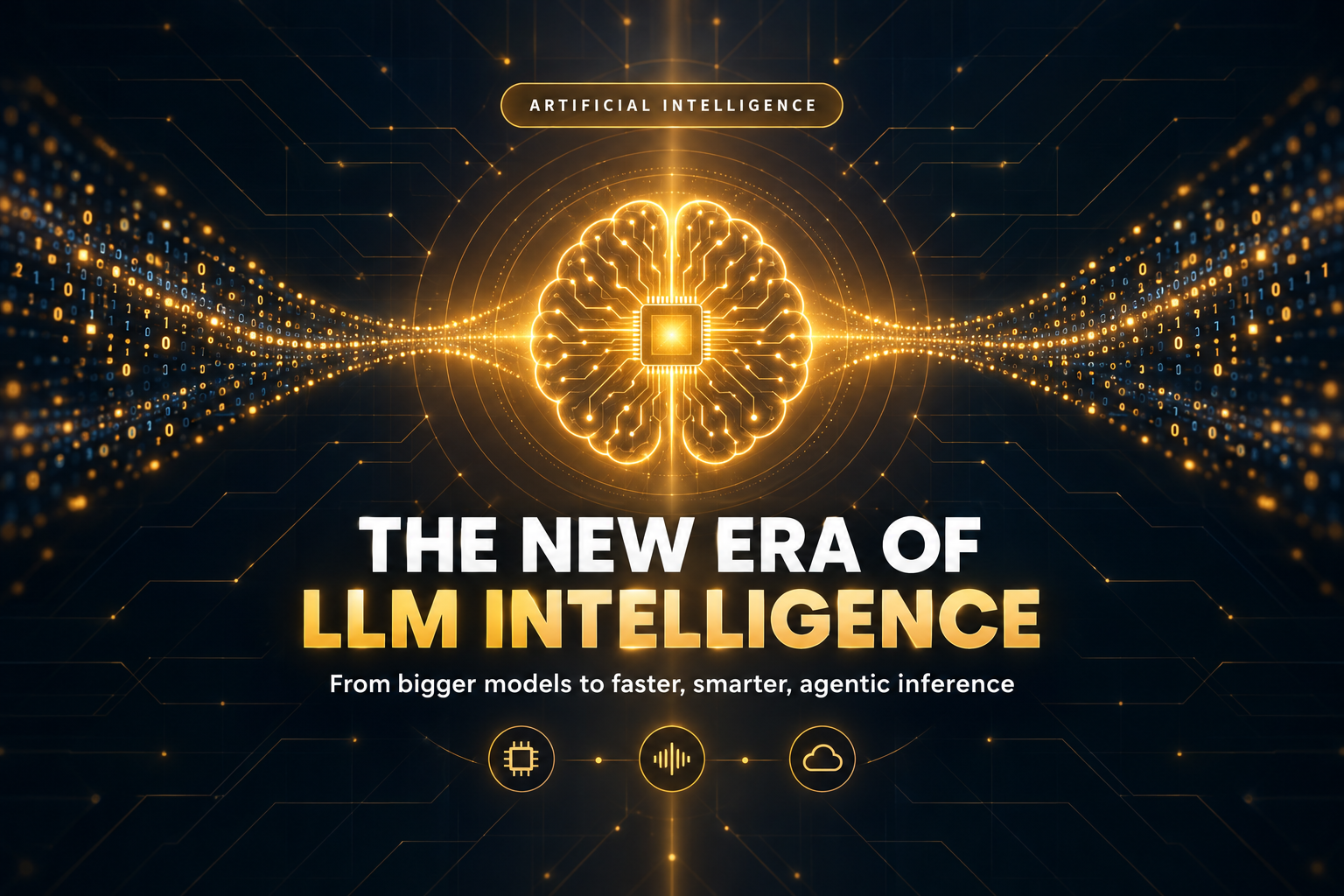
The era of “bigger is better” in artificial intelligence is quietly ending — and what’s replacing it may matter more for business than any single parameter count ever did.
Large language models have spent the last three years chasing scale: more parameters, more training data, more compute. But as of October 2026, the innovation frontier has shifted decisively toward efficiency, open deployment, long-context reasoning, and autonomous action. This pivot isn’t just a technical curiosity — it’s reshaping how enterprises budget for AI, which vendors they trust, and what kinds of tasks they’re willing to hand over to a model. For CTOs, investors, and builders, understanding this shift is now essential to staying competitive.
Inference Efficiency Becomes the New Battleground
For years, the AI conversation centered on training breakthroughs. Now, the spotlight has moved to inference — the cost and speed of actually running these models in production. The open-source llm-d 1.0 release, highlighted in IBM’s newsroom, targets distributed inference at production scale and has demonstrated dramatically lower costs for context-heavy agent workloads alongside significantly higher output throughput.
This matters because inference costs, not training costs, dominate the long-term economics of deploying AI at scale. A model that’s marginally smarter but prohibitively expensive to run loses to a leaner, faster alternative every time a business scales from pilot to production. New architectures are reinforcing this trend: Inception Labs’ Mercury 3, a diffusion-based language model, has reportedly generated over 1,000 tokens per second in testing, while MiniMax M3.1 Flash has focused on improving inference speed while cutting usage costs. Diffusion-style generation, rather than purely sequential token prediction, represents a genuinely novel architectural direction worth watching closely.
Open-Weight Models Are Winning Enterprise Trust
Perhaps the most consequential shift this quarter is the growing enterprise embrace of open-weight models. According to Constellation Research, technology executives report that open models are increasingly handling the majority of enterprise AI workloads, with several 2026-era open releases approaching the capability of leading proprietary systems — at a fraction of the infrastructure cost.
This is a meaningful departure from the earlier assumption that only closed, frontier-lab models could deliver enterprise-grade reliability. For businesses evaluating AI infrastructure strategy, this trend has direct implications: lower vendor lock-in risk, more flexibility to fine-tune models on proprietary data, and reduced dependency on a handful of API providers. Expect procurement teams to increasingly demand open-weight options as a standard line item in AI vendor evaluations, not an exotic alternative.
Frontier Models Push Long-Context and Real-Time Capabilities
October also saw a wave of frontier releases that pushed technical boundaries in specific, practical directions. Google’s newly announced Gemini 4 Argon is positioned as a frontier model built explicitly for real-world coding, enterprise knowledge work, and cyber defense — a signal that labs are optimizing for concrete enterprise use cases rather than general benchmark dominance alone.
Elsewhere, xAI’s Grok 5 reportedly introduced an expanded context window approaching 450,000 tokens, enabling models to reason over entire codebases, lengthy legal documents, or multi-day conversation histories without losing coherence. Gemini 4 Argon also reportedly posted strong results on voice-dictation benchmarks, underscoring how real-time, voice-native interaction is becoming table stakes rather than a novelty feature. Meta’s Muse models, DeepSeek V4.1, and NVIDIA’s Nemotron 3.5 family rounded out a particularly dense month of releases — a pace that suggests competitive intensity among labs has, if anything, accelerated rather than plateaued.
Agentic LLMs Are Learning to Act, Not Just Answer
The most transformative trend may be the movement of LLMs from passive question-answering tools into autonomous agents capable of taking action inside software. OpenAI’s GPT-6 Astra, reported for browser-agent applications, was cited in connection with an Asana deployment test that claimed dramatic reductions in model operating costs alongside substantial speed improvements over prior-generation agents.
This agentic shift is reinforced by the emergence of what industry observers are calling “decision models” — a category OpenAI and Microsoft have both begun pursuing, according to IBM’s reporting. Unlike conversational chatbots, decision models are engineered to make rapid, confident choices that downstream software can execute directly, without a human reviewing every output. Combined with OpenAI’s announced plan to distribute GPT-6 Astra, GPT-6.1 Sol, and GPT-6 Luna through Google Cloud’s Model Garden, the infrastructure for enterprise-grade autonomous AI agents is maturing faster than many predicted even a year ago.
What This Means Going Forward
Looking ahead, the convergence of cheaper inference, open-weight competitiveness, longer context windows, and action-capable agents points toward an AI landscape where differentiation shifts from raw model capability to deployment sophistication. The winners won’t necessarily be the labs with the single smartest model — they’ll be the organizations and vendors that can deploy capable models most cost-effectively, securely, and in ways that integrate directly into business workflows. Expect continued consolidation around hybrid strategies that blend open-weight models for routine workloads with premium frontier models reserved for the most complex reasoning tasks.
The large language model race has entered a more pragmatic, infrastructure-driven phase — one where efficiency, openness, and real-world agentic utility matter more than headline-grabbing parameter counts. As these systems increasingly take direct action inside enterprise software rather than merely advising humans, the real question for business leaders isn’t which model is “smartest” — it’s which one you can trust to act. Which trade-off matters more to your organization: raw capability, cost efficiency, or autonomous reliability?
📖 Recommended Sources:
• IBM Newsroom – Coverage of llm-d 1.0 open-source distributed inference release and enterprise “decision model” trend
• Constellation Research – Executive survey insights on open-weight model adoption in enterprise AI workloads
• SiliconANGLE – Reporting on OpenAI’s GPT-6 Astra expansion to Google Cloud’s Model Garden
• Google / Gemini Announcements – Official details on Gemini 4 Argon’s enterprise and coding capabilities
ⓘ This content is AI-generated based on training data through January 2026, supplemented with live research. Please verify specific claims, benchmark figures, and product names independently before publishing, as some details reflect rapidly evolving vendor announcements.