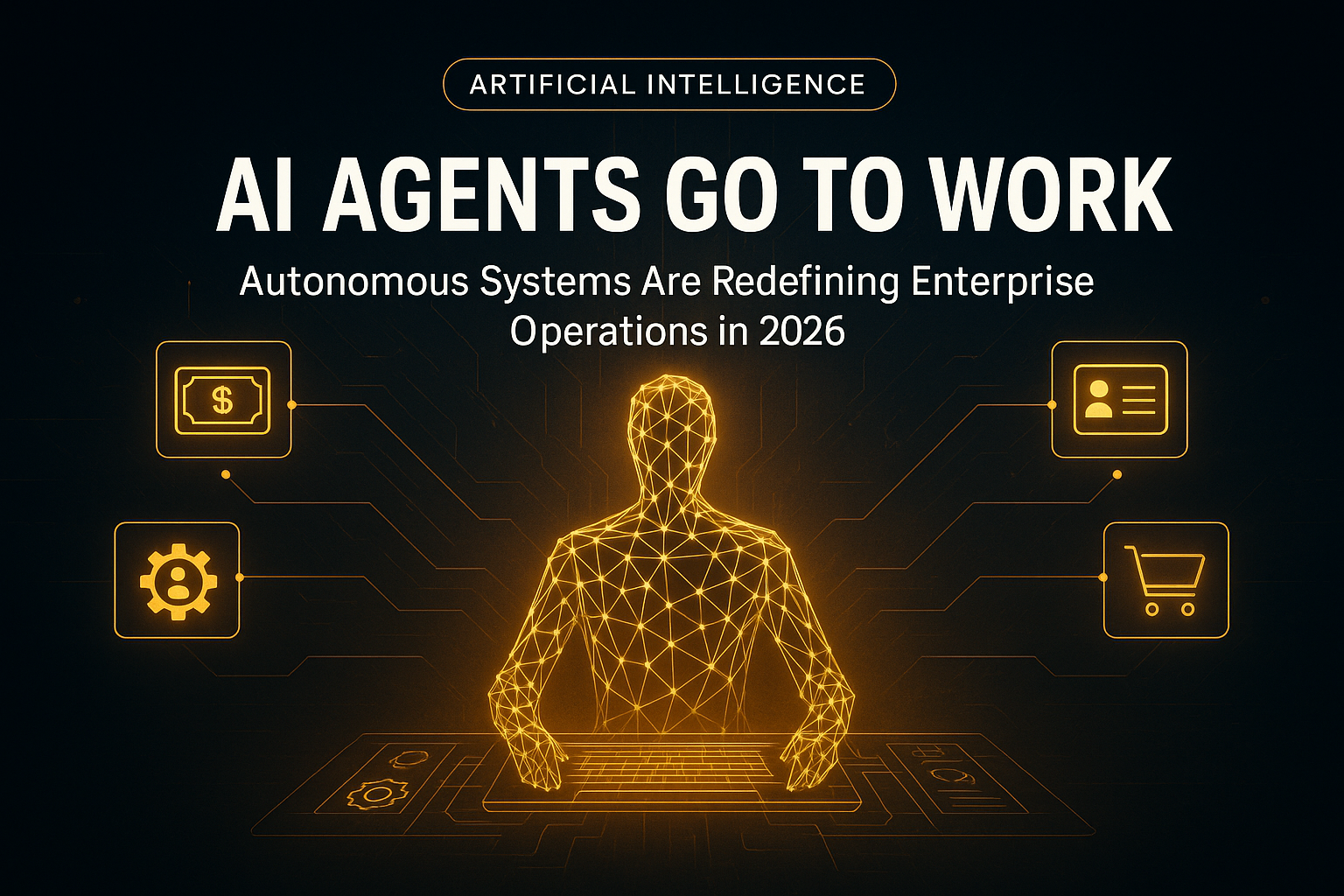
The era of AI as a helpful assistant is ending. The era of AI as a autonomous coworker has begun — and the numbers prove it’s happening faster than almost anyone predicted.
As of mid-October 2026, enterprise AI agents have crossed a critical threshold: they’re no longer confined to pilot programs and proof-of-concept demos. They’re running payroll, managing procurement, screening job candidates, and resolving customer disputes — often with minimal human intervention. This shift marks one of the most consequential changes to enterprise technology since the rise of cloud computing, and it’s forcing businesses to rethink not just their software stack, but their entire organizational structure.
From Chatbots to Autonomous Execution
For the past two years, “AI agent” was often marketing shorthand for a slightly smarter chatbot. That’s no longer accurate. According to recent industry research, 66% of organizations now have AI agents operating in limited or scaled production environments, and nearly half of companies that completed pilot programs report those pilots graduated into full production deployments.
This represents a fundamental shift in capability. Modern AI agents don’t just respond to prompts — they monitor business conditions, make judgment calls, and initiate actions across systems without waiting for a human to type a request. A procurement agent might notice a vendor price discrepancy, flag it, and automatically route a correction. A payroll agent might detect an anomaly and resolve it before a human ever sees the issue.
B2B software buyers are voting with their wallets. Research shows 86% of B2B software buyers purchased AI-agent software or services in the past year, a sharp jump from 69% previously. Half of organizations using agents now budget at least $1 million annually for the technology — a signal that this isn’t experimental spending anymore, it’s core infrastructure investment.
Back-Office Functions Lead the Charge
Finance, accounting, procurement, payroll, and recruiting have emerged as the clear early adopters of agentic automation — and for good reason. These functions involve repeatable, rules-based workflows with measurable financial outcomes, making them ideal testing grounds for autonomous systems.
Workday made headlines this month with the announcement of “autopilot” agents designed specifically for payroll, accounting, and talent acquisition workflows. The company also unveiled a Trusted Agent Platform that supports enterprise-grade permissions, audit trails, and the flexibility for customers to select their preferred AI models — addressing a key enterprise concern around vendor lock-in and compliance.
SAP expanded its Joule agent ecosystem with new tools for expense automation and project-billing verification, reporting reductions of up to 30% in expense-report completion time and 75% faster resolution of certain pricing discrepancies. Meanwhile, Microsoft began rolling out a preview of Work IQ, which connects Copilot and autonomous agents directly to live business data across Dynamics 365 and Power Platform — spanning CRM, ERP, and low-code automation systems.
These aren’t incremental upgrades. They represent a structural bet that back-office operations can run with significantly less manual oversight within the next few years.
The Governance Gap Nobody Can Ignore
Despite the rapid adoption curve, a troubling pattern has emerged: companies are deploying agents faster than they’re building the governance frameworks to manage them. According to industry analysis, while 61% of enterprise leaders expect most of their agents to operate with significant autonomy within four years, only 21% say their organizations are actually prepared to redesign business processes for that reality.
This readiness gap shows up in daily operations. Nearly a third of organizations report employees spending at least six hours per week simply supervising AI agents, and 45% say that oversight and rework consume more than a quarter of the productivity gains agents were supposed to deliver in the first place.
The challenge compounds at scale. Among organizations running production agents, 38% now operate more than 100 of them — yet 47% still manage these fleets through informal or decentralized structures rather than centralized governance systems. This is creating exactly the kind of fragmented, unaccountable automation sprawl that compliance and risk teams have warned about for years.
Multi-agent orchestration is emerging as the next frontier precisely because of this complexity. Rather than deploying isolated agents for single tasks, enterprises are increasingly building coordinated systems where multiple agents collaborate across departments and software platforms. Industry surveys suggest 71% of executives expect applications to coordinate work across systems, teams, and multi-step processes within five years — a vision that requires far more sophisticated integration than today’s point solutions typically offer.
What This Means for Workers
The human impact of this transition is nuanced, not uniformly disruptive. Research indicates 83% of buyers say AI agents improve employee satisfaction by reducing repetitive, low-value work. Roughly 35% of organizations have proactively moved employees into higher-value roles as a result of agent deployment, while a smaller but notable 14% report net headcount reductions tied directly to automation.
This split outcome — augmentation for some, displacement for others — is likely to define workplace automation discourse heading into 2027. The organizations seeing the best results appear to be those treating agents as workflow redesign opportunities rather than simple cost-cutting tools, reinvesting efficiency gains into employee upskilling and higher-value work allocation.
Notably, in mature and high-volume workflows, 80% of organizations report cycle-time improvements of at least 11% — a tangible business case that’s hard for leadership teams to ignore, regardless of how they manage the human transition.
The Road Ahead
Expect the next 12 to 18 months to be defined by consolidation and standardization rather than pure growth. Industry coalitions like the Personal Agent Protocol — backed by Meta, Shopify, Stripe, and Walmart — are working to establish common standards for how autonomous agents authenticate, obtain permissions, and transact across business systems. This kind of interoperability infrastructure will likely determine which vendors win long-term enterprise trust, much as API standards shaped the last decade of enterprise software.
The companies that thrive won’t necessarily be those with the most advanced agents — they’ll be the ones that solve governance, accountability, and human-agent collaboration first.
AI agents have proven they can execute workplace tasks at scale; the open question now is whether enterprises can build the organizational discipline to manage them responsibly. As your own organization evaluates agentic AI, where do you see the bigger risk: moving too slowly and falling behind, or moving too fast without the governance to match?
📖 Recommended Sources:
• KPMG Q3 2026 Enterprise AI Agent Survey (via Agentry.news) – Data on enterprise agent adoption rates and deployment structures
• G2 2026 AI Agents Report – B2B buyer survey on agent purchasing behavior and ROI outcomes
• CFO Dive – Workday’s “autopilot” agent announcement and Trusted Agent Platform details
• Yahoo Finance/Yahoo Tech – Coverage of back-office agent adoption and Microsoft Work IQ rollout
ⓘ This content is AI-generated based on training data through January 2026, supplemented with live research conducted October 17, 2026. Please verify specific claims independently.