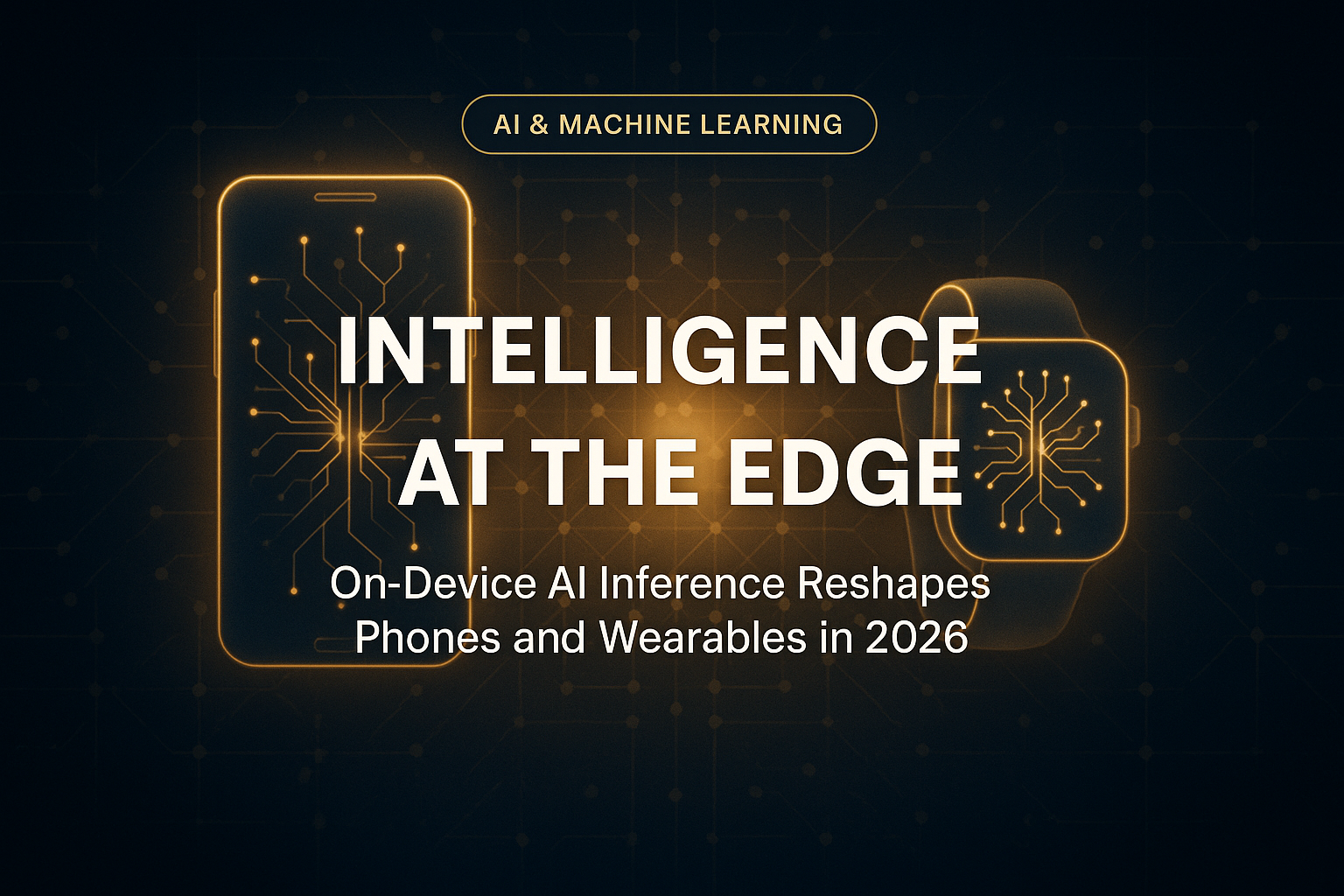
The cloud is no longer the only place where artificial intelligence thinks. As of October 2026, the smartphone in your pocket is quietly becoming a self-contained AI engine, and that shift is rewriting the rules of mobile computing.
For years, generative AI meant sending a query to a data center and waiting for a response. That model is breaking down under its own weight — rising cloud compute costs, latency concerns, and growing privacy expectations have pushed the industry toward a new architecture: edge AI inference, where models run directly on the device itself. According to market research cited across industry reports, the global edge AI market is projected to grow from roughly $46.96 billion in 2026 to $445.75 billion by 2034, reflecting a compound annual growth rate near 32.5%. That trajectory signals more than incremental progress — it points to a structural transformation in how AI gets delivered to consumers.
The NPU Becomes the New Battleground
Dedicated neural processing units (NPUs) have moved from a nice-to-have feature to the central component of modern smartphone silicon. These chips work alongside traditional CPUs and GPUs but are purpose-built for AI inference, delivering significantly better performance per watt for tasks like language processing, computer vision, speech recognition, and real-time camera enhancement.
Qualcomm and MediaTek are racing to push this further. Qualcomm’s latest smartphone NPU architecture reportedly supports mixture-of-experts models exceeding 30 billion parameters with context windows around 32,000 tokens — a staggering leap for a handheld device. Qualcomm’s CEO has gone so far as to say AI companies want phones capable of running 100-billion-parameter models continuously by 2028. MediaTek, meanwhile, unveiled plans for 2-nanometer chipsets at the IMC 2026 conference, emphasizing smaller process nodes and dual-NPU designs engineered specifically to handle sustained AI workloads without overheating.
Memory, Not Just Raw Power, Is the New Bottleneck
One of the more nuanced insights emerging from current research is that memory bandwidth matters as much as raw processing power. Running large models locally isn’t just about TOPS (trillions of operations per second) — it’s about whether a device can hold and move that model’s data fast enough without draining the battery or causing thermal throttling.
This has pushed chipmakers toward shared memory pools, aggressive model compression, quantization, and mixture-of-experts execution, where only parts of a model activate for a given task. Nexa AI, for example, released an SDK late in 2025 specifically optimized for Hexagon NPUs, enabling multiple state-of-the-art models to run efficiently on Qualcomm-powered devices — a sign that the software stack is catching up to the hardware ambition.
Google’s Coral NPU and the Wearables Frontier
Perhaps the most striking development of the past month is Google’s unveiling of an edge AI chip reportedly using 40% less power than existing comparable hardware. Branded as part of the Coral NPU platform, this open-source, full-stack solution is designed for “always-on” intelligence in wearables — smartwatches, smart glasses, and other low-power devices that need to process voice, video, motion, and contextual data continuously without being tethered to constant cloud connectivity.
This matters because wearables have historically been the most power-constrained category in consumer electronics. A chip architecture capable of real-time, local inference without blowing through a battery in hours opens the door to genuinely useful always-on AI assistants on the wrist or face — not just reactive voice commands, but ambient awareness of context, environment, and user intent.
Hybrid Edge-Cloud Orchestration Is the New Default
Rather than a binary choice between “on-device” and “in-the-cloud,” the industry is converging on a hybrid architecture. Phones and wearables handle private, latency-sensitive, or routine tasks locally — things like transcription, translation, image enhancement, and short-context conversation. More complex, multi-step reasoning or massive-context tasks still route to the cloud.
This orchestration layer is becoming a competitive differentiator in its own right. The ability to intelligently decide, in real time, which part of a request should stay local and which should be offloaded is emerging as its own software discipline — one that will likely define the next wave of AI agent development on mobile platforms. Industry analysts increasingly describe this as a “distributed AI continuum,” where the smartphone becomes one node in a broader intelligence fabric rather than a dumb terminal querying a distant server.
The Road Ahead
Looking forward, the industry’s focus is shifting from benchmark bragging rights toward sustained performance — can a phone run a capable model continuously, hour after hour, without throttling or killing the battery? Expect continued investment in quantization techniques, cross-vendor NPU software standards, and agentic on-device assistants capable of perceiving screen content, apps, and sensor data to take autonomous action. As memory architectures improve and 2nm silicon reaches mass production, the gap between “cloud-only” and “on-device” AI capability will continue to narrow, eventually becoming largely invisible to the end user.
Edge AI inference isn’t a niche technical curiosity anymore — it’s becoming the backbone of how billions of people will interact with intelligent systems daily, from their phones to their wrists to their glasses. As chipmakers, model developers, and platform companies race to put more capability directly into consumers’ hands, the real question isn’t whether on-device AI will become mainstream, but how quickly today’s cloud-dependent habits will give way to a world where your most important AI interactions never leave your pocket. What would it mean for your business or daily workflow if your most powerful AI assistant never needed an internet connection at all?
📖 Recommended Sources:
• Google / Coral NPU announcement coverage (en.sedaily.com, aiflowix.com) – details on the new low-power edge AI chip for wearables
• Qualcomm CEO statements on smartphone NPU roadmap (startupfortune.com) – insight into 100-billion-parameter model ambitions by 2028
• MediaTek IMC 2026 announcement (globalsources.com) – 2nm chipset and data-center-ambition coverage
• Edge AI market sizing reports (industry research aggregators) – $46.96B to $445.75B growth projection through 2034
ⓘ This content is AI-generated based on training data through January 2026, supplemented with live research current to October 2026. Please verify specific claims independently.