Edge computing is fundamentally reshaping how IoT systems process data, moving intelligence from distant cloud centers directly to the devices and gateways where data originates. In 2026, this architectural shift is no longer theoretical—it’s becoming the operational standard across industries that demand real-time responsiveness, bandwidth efficiency, and privacy-first data handling.
The Edge Computing Revolution in IoT Architecture
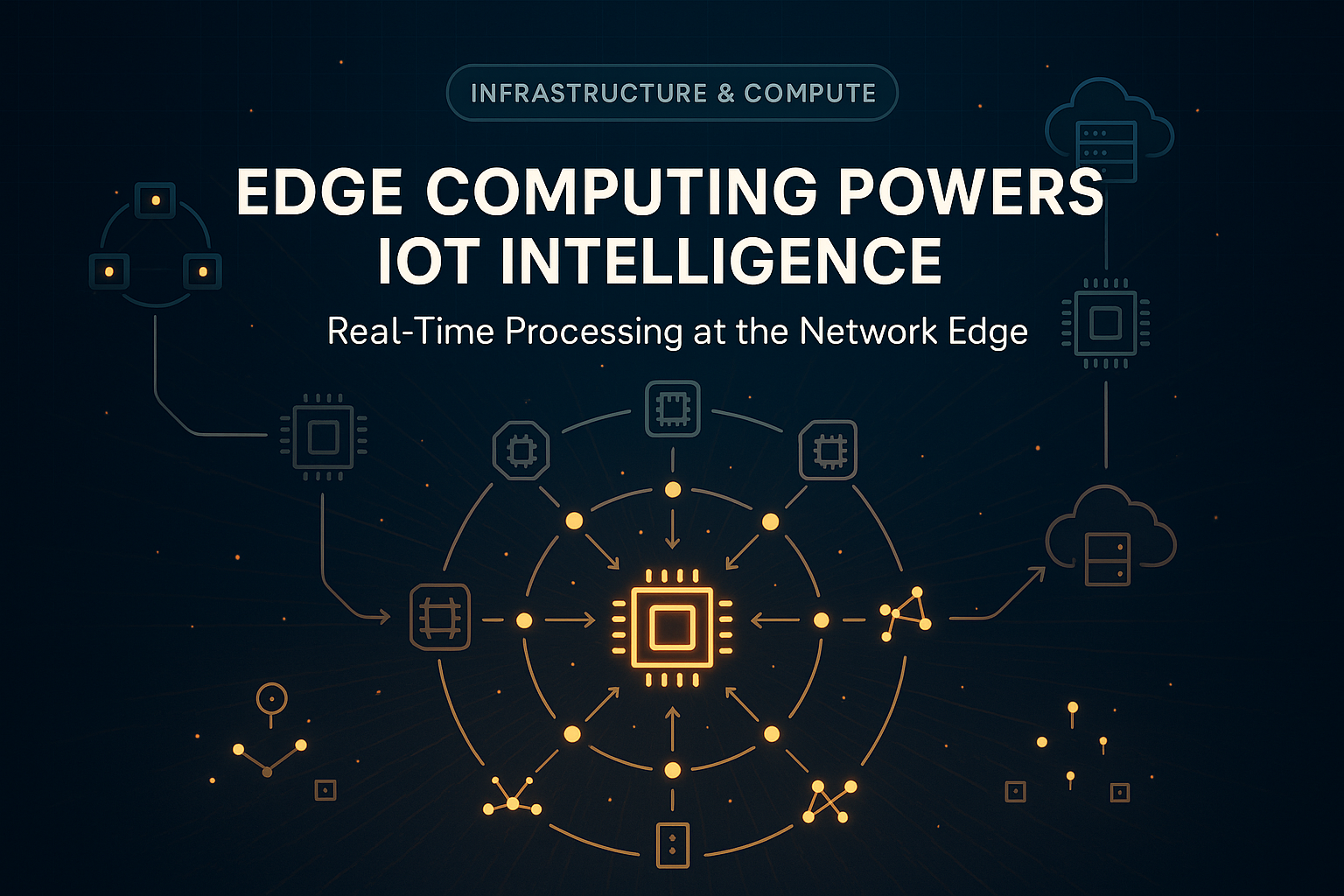
Edge computing for IoT means processing data where it matters most: at the source. Rather than streaming raw sensor feeds to centralized cloud platforms, modern IoT systems now adopt a tiered intelligence model that distributes computational responsibility across three layers.
At the foundation, on-device and sensor nodes run lightweight machine learning models and control logic on microcontrollers and low-power system-on-chips (SoCs). The middle layer consists of local gateways and edge servers that aggregate data from multiple devices, execute more sophisticated analytics, and handle real-time decision-making. Finally, the cloud layer handles long-term storage, fleet-wide model training, and global optimization—no longer burdened with processing every raw data point.
This architecture emerged from a critical technological convergence: AI-integrated embedded systems have matured to the point where meaningful machine learning inference is now routine at the device level, even on power-constrained hardware. According to recent industry analysis, the Edge Computing in IoT market is expected to grow at a CAGR of approximately 10.2% from 2026 to 2033, signaling strong enterprise and industrial adoption momentum.
Edge AI Semiconductors: The Hardware Foundation
The hardware revolution powering edge IoT innovation centers on dedicated neural processing units (NPUs) integrated directly into microcontrollers and edge processors. A breakthrough announced in early 2026 exemplifies this progress: a new MCU platform with an embedded NPU (“TinyEngine”) achieves up to 90× reduction in AI inference latency and cuts energy consumption per inference by more than 120× compared with conventional microcontrollers.
This performance leap is transformative for battery-powered IoT nodes that must run sophisticated machine learning without sacrificing weeks or months of operational lifetime. Edge AI semiconductor markets are projected to grow at around 18.3% CAGR through 2032, reflecting aggressive investment in purpose-built AI accelerators for endpoints.
Beyond microcontrollers, dedicated IoT edge AI processors now combine NPUs with low-power CPU cores and integrated wireless connectivity (Wi-Fi, BLE, cellular, LPWAN). This integrated approach eliminates the need for separate compute and connectivity modules, reducing power draw, physical footprint, and system complexity. Vendors are increasingly offering end-to-end edge AI IoT platforms that bundle low-power wireless, edge compute, cloud services, and power management as a unified stack—dramatically accelerating time-to-market for AIoT product development.
Foundation Models Meet Edge Constraints
One of 2026’s most significant innovations is the emergence of Edge Foundation Models—large but carefully optimized models designed to operate within the thermal, power, and memory constraints of consumer and industrial endpoints. These aren’t stripped-down toy models; they’re sophisticated systems capable of multi-modal understanding and complex reasoning.
A concrete example: a 3-billion-parameter vision-language model (LFM2.5-VL-3B) was released in August 2026 specifically optimized for efficient edge inference. This model provides advanced vision capabilities—object recognition, scene understanding, anomaly detection—on cameras and robots without constant cloud dependence. The availability of such capable yet efficient models fundamentally changes what’s possible at the edge.
This shift means that advanced perception and language understanding tasks that previously required cloud connectivity can now happen locally, preserving privacy, reducing latency to milliseconds, and enabling offline operation in remote or connectivity-constrained environments.
Real-World Impact: Bandwidth, Latency, and ROI
The business case for edge computing in IoT is increasingly compelling. According to 2026 industry analysis, edge AI can reduce data transmission to the cloud by up to 85% in IoT deployments, dramatically lowering both latency and bandwidth costs. Instead of streaming raw sensor feeds, edge-enabled systems send only:
- Summarized metrics and aggregated insights
- Alerts and anomalies
- Periodic snapshots rather than continuous streams
This efficiency translates directly to operational ROI. Organizations implementing edge AI in IoT systems can expect return on investment within 12–18 months, driven by reduced cloud and network costs, fewer connectivity-related outages, and faster, automated decision-making on production floors and in logistics networks.
Critical Use Cases Driving Adoption
Industrial IoT and manufacturing leads the charge. Smart factories and process plants now deploy edge analytics for predictive maintenance, throughput optimization, and safety monitoring. Edge devices on production lines run vision models for product inspection, detecting defects in real time without waiting for cloud processing.
Smart cities and public safety are equally transformative. Edge video analytics on cameras enable incident detection, crowd flow analysis, and traffic management—all without streaming full video feeds to centralized cloud infrastructure. This approach preserves citizen privacy while dramatically improving response times.
Healthcare and wearables benefit from on-device machine learning for vital sign monitoring, fall detection, and anomaly alerts. Sensitive health data never leaves the device, addressing privacy concerns while enabling instantaneous alerts for critical events.
Autonomous systems—vehicles, drones, and mobile robots—depend on edge compute for onboard vision models, navigation, obstacle detection, and local path planning. These systems cannot tolerate cloud round-trip latencies; millisecond-level responsiveness is non-negotiable.
Strategic Imperatives for Edge IoT Programs
Industry whitepapers and market analyses converge on several critical success factors. First, lead with the operational problem, not the technology. Effective edge AI programs begin with a clear operational challenge: strict latency requirements, unreliable connectivity, or strong data privacy constraints. Hardware selection and model choice follow from these constraints, not the reverse.
Second, start small with focused pilots. Begin with a single critical use case to validate edge AI technology and demonstrate value before scaling broadly across the organization.
Third, invest in secure, scalable model and device management. Treat model lifecycle management and secure over-the-air (OTA) updates as core infrastructure. Without this foundation, edge deployments become static and quickly outdated as new models and security patches emerge.
The Future: Edge as Standard Infrastructure
Edge computing is transitioning from emerging technology to expected infrastructure. The convergence of capable NPU-equipped hardware, optimized foundation models, and proven business case methodologies means that edge processing will become the default architecture choice for latency-sensitive, privacy-critical, or bandwidth-constrained IoT applications.
Organizations that build edge AI competency now—developing expertise in hardware selection, model optimization, and distributed lifecycle management—will establish competitive advantages in real-time intelligence, operational resilience, and data privacy. Those that delay risk being locked into cloud-centric architectures that struggle with latency, cost, and privacy requirements their industries increasingly demand.
As edge computing matures from innovation to infrastructure, the question is no longer “whether” to adopt edge AI for IoT, but “where” and “how quickly” your organization can implement it effectively. What critical operational challenge in your business could be solved with real-time edge intelligence?
—
📖 **Recommended Sources:**
• **Perplexity Research & Industry Reports (August 2026)** – Comprehensive analysis of edge computing architecture patterns, edge AI semiconductor market growth projections (18.3% CAGR through 2032), and emerging foundation models optimized for edge inference.
• **IoT Tech Expo North America 2026** – Industry conference highlighting real-world edge AI deployments across manufacturing, smart cities, and healthcare sectors.
• **Edge AI Technology Report 2026** – Market analysis documenting the rise of Edge Foundation Models, edge AI processor innovations (including TinyEngine NPU achieving 90× latency reduction), and ROI timelines for edge IoT implementations.
• **TCS White Paper: AI-Integrated Embedded Systems** – Strategic guidance on secure model lifecycle management, edge-cloud orchestration, and hardware co-design for edge AI programs.
ⓘ This content is AI-generated based on research through August 2026. Please verify specific claims and market projections independently with current sources.