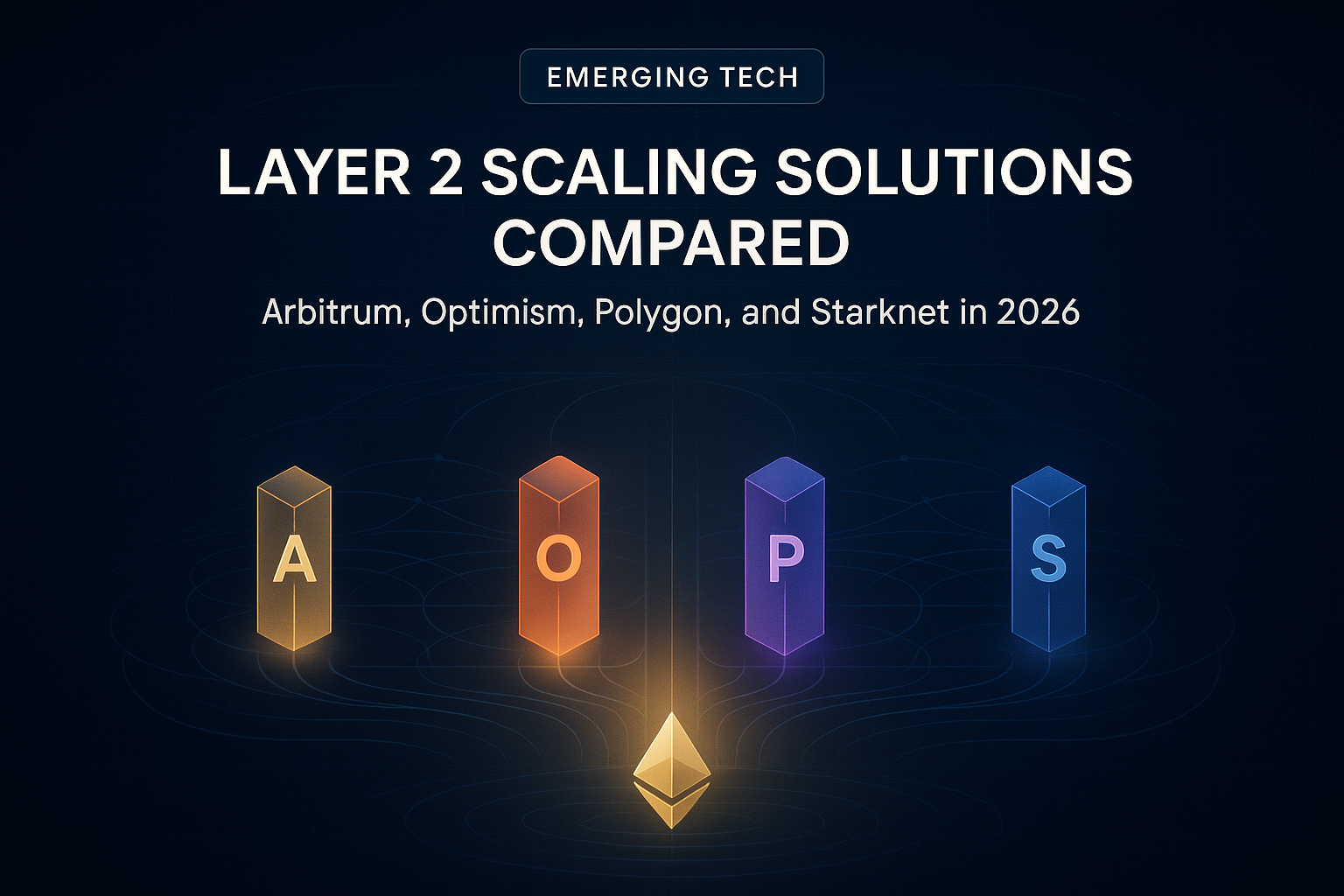
# Layer 2 Scaling Solutions Comparison: Arbitrum vs. Optimism vs. Polygon vs. Starknet in 2026
The Ethereum scaling landscape has matured dramatically. As of August 2026, $33.4 billion in total value is secured across Ethereum’s Layer 2 ecosystem, with over $26.8 billion concentrated on rollup solutions. Yet not all Layer 2s are created equal—and choosing the right one depends on your specific needs, risk tolerance, and technical requirements.
Understanding the Layer 2 Architecture Divide
The most fundamental distinction among Layer 2 solutions is their proof mechanism. This choice cascades through every other property: security model, finality speed, developer experience, and cost structure.
Optimistic rollups (Arbitrum and Optimism) assume transactions are valid by default and rely on a challenge window—typically 7 days—during which any observer can submit a fraud proof if something went wrong. Data is posted directly to Ethereum for security. This approach prioritizes developer simplicity and EVM compatibility at the cost of withdrawal delays.
ZK rollups (Starknet and Polygon zkEVM) post a cryptographic validity proof to Ethereum alongside transaction data. Once verified, transactions are mathematically guaranteed correct—no challenge period required. This yields near-instant finality and faster withdrawals, but introduces greater complexity in proof generation infrastructure.
According to recent industry analysis, this architectural choice remains the single most important factor in Layer 2 selection for 2026.
Ecosystem Maturity and Market Concentration
The Layer 2 market is consolidating rapidly. Arbitrum and Base together represent roughly 80% of all value secured across the entire L2 ecosystem, while Arbitrum, Base, and Optimism combined process approximately 90% of all Layer 2 transactions. This concentration reflects both liquidity depth and developer adoption.
Arbitrum One leads in TVL at approximately $2.8 billion, with over 400,000 daily active addresses and 1.2+ million daily transactions. The ecosystem features battle-tested DeFi protocols including GMX, Uniswap, Aave, and Radiant—ensuring deep liquidity for institutional and retail users alike.
Optimism’s OP Mainnet follows closely, benefiting from the OP Stack—a modular framework that powers the broader “Superchain” ecosystem. This architecture enables interoperability across multiple OP Stack chains, positioning Optimism as the preferred choice for multi-chain enterprise deployments.
Polygon maintains broad adoption through its original PoS sidechain while pivoting toward Polygon CDK (Chain Development Kit) and Polygon zkEVM for enterprise-grade, customizable blockchain networks. This dual approach appeals to both consumer-facing applications and institutional clients seeking bespoke chain infrastructure.
Starknet, with approximately $1.3 billion in TVL, serves a more specialized niche. Its Cairo VM and STARK-based proofs excel at computation-heavy workloads—particularly AI, complex DeFi engines, and advanced on-chain logic. While TVL is lower, the ecosystem includes native protocols like zkLend, Nostra, and Ekubo.
Performance, Cost, and Finality Trade-offs
Layer 2s deliver dramatic improvements over Ethereum mainnet. On Ethereum L1, expect 15–30 TPS, $1.50–$15 per transaction, and 12–15 minutes to finality. Layer 2s shatter these limits.
Arbitrum One achieves 4,000+ TPS with transaction costs around $0.10–$0.30 for a simple ETH transfer. Finality relative to Ethereum is approximately 1 minute, though full economic finality awaits the 7-day challenge window.
Optimism Superchain L2s deliver 2,000+ TPS with finality in roughly 2 seconds and transaction costs often below $0.01. This speed advantage reflects the OP Stack’s optimized data compression and sequencer design.
Starknet’s zk architecture often yields lower per-transaction costs ($0.02–$0.10), especially for computation-intensive operations. The trade-off: STARK proof generation adds latency to block finality compared to optimistic rollups, though economic finality is still faster than optimistic rollups’ 7-day window.
Polygon PoS remains competitive for consumer applications, though its sidechain architecture (separate validator set, no direct Ethereum DA) introduces different security assumptions compared to rollups.
EVM Compatibility and Developer Experience
For most Ethereum developers, EVM compatibility is non-negotiable. Arbitrum, Optimism, and Polygon zkEVM all offer near-perfect Solidity/Vyper support with minimal code changes required. Arbitrum emphasizes advanced execution features and permissionless fraud-proof systems (BoLD), while Optimism prioritizes the open-source OP Stack framework.
Starknet breaks this mold. Its Cairo VM and Cairo language are fundamentally different from the EVM, requiring developers to learn new tooling and patterns. However, this difference is deliberate: Cairo’s design enables more expressive computation, making Starknet ideal for protocols that need complex on-chain logic or AI/ML integration.
For teams already embedded in the Ethereum ecosystem, Arbitrum, Optimism, and Polygon offer the lowest friction migration path. For greenfield projects prioritizing computational power over EVM compatibility, Starknet’s specialized environment may justify the learning curve.
Choosing Your Layer 2: A 2026 Decision Framework
The choice ultimately depends on your priorities:
- Deepest liquidity and lowest integration risk? Choose Arbitrum. Its mature ecosystem and large TVL make it the safest bet for DeFi protocols and institutional capital.
- Modular multi-chain infrastructure with shared EVM tooling? Choose Optimism (OP Stack). The Superchain vision and ecosystem interoperability appeal to enterprises building multi-chain strategies.
- Custom enterprise or sector-specific blockchain networks? Choose Polygon CDK or Polygon zkEVM. Polygon’s modular approach enables organizations to deploy app-specific chains while leveraging shared infrastructure.
- Heavy computation, AI workloads, or advanced zk security? Choose Starknet. Accept the non-EVM tooling and benefit from STARK proofs and Cairo’s expressiveness.
The Future of Ethereum Scaling
By mid-2026, the Layer 2 market has stabilized around these four major ecosystems. The era of “more chains is better” has given way to consolidation around proven, liquid platforms. Yet the architectural diversity—optimistic vs. zk, EVM vs. specialized VMs—ensures that different use cases will continue to find optimal homes across the ecosystem.
The next frontier involves interoperability (OP Stack’s Superchain model, cross-chain bridges), proof system maturity (faster ZK provers, more efficient fraud-proof systems), and enterprise adoption (Polygon CDK’s custom chains, Arbitrum’s institutional liquidity).
Which Layer 2 architecture do you believe will dominate enterprise blockchain adoption over the next 18 months—and why?
📖 **Recommended Sources:**
• **Perplexity Research (August 2026)** – Comprehensive Layer 2 architecture and ecosystem comparison, including TVL metrics, transaction volumes, and use-case analysis across Arbitrum, Optimism, Polygon, and Starknet.
• **L2BEAT** – Real-time Layer 2 metrics tracking $33.4 billion in total Ethereum scaling value, with detailed breakdowns of rollup TVL, security models, and operational data.
• **CryptoSlate & ChainScore Labs** – Layer 2 ecosystem maturity assessments, including ecosystem depth, liquidity concentration, and comparative security audits.
ⓘ This content is AI-generated based on research data through August 2026. Please verify specific metrics and TVL figures independently on L2BEAT and official protocol dashboards.