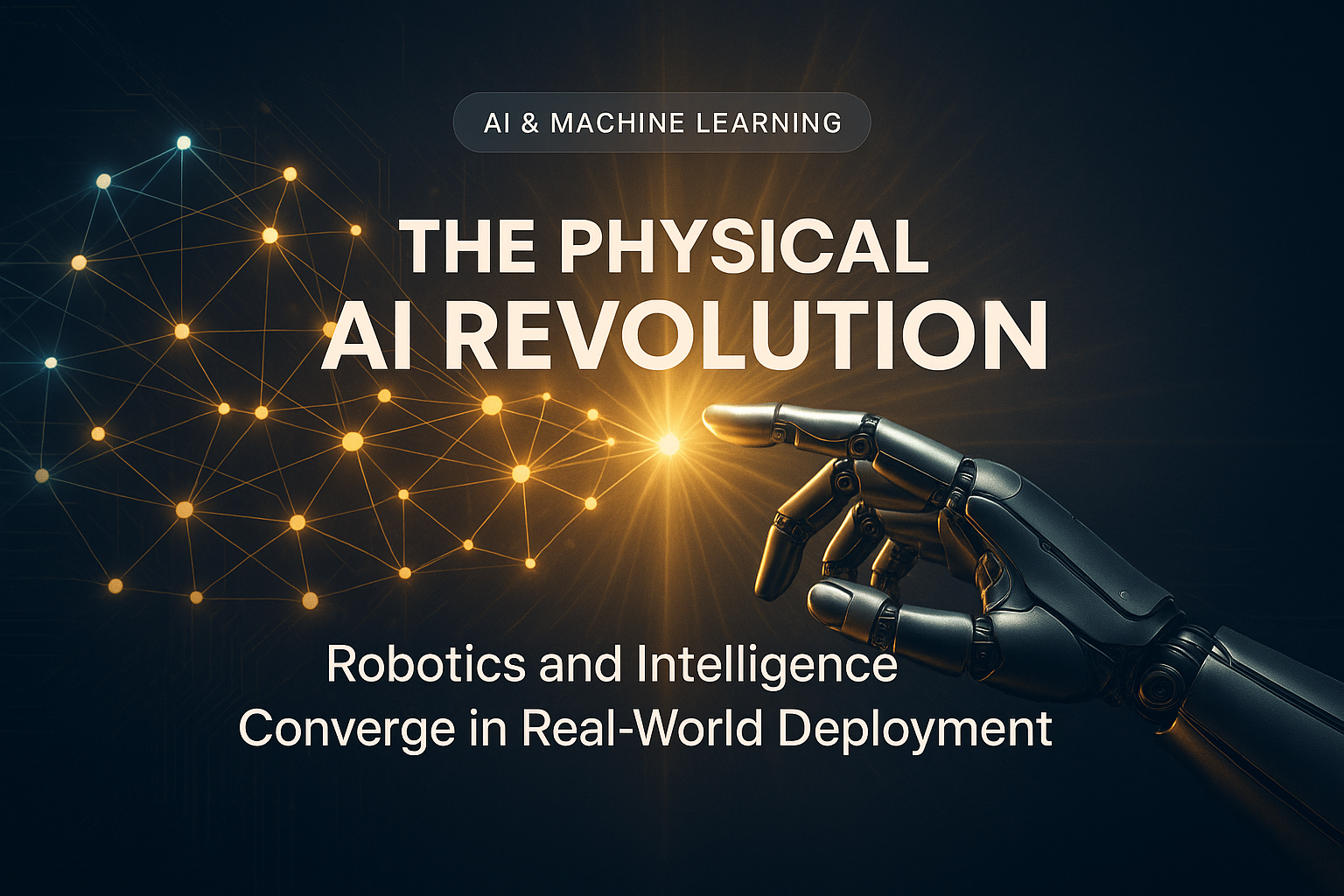
# The Physical AI Revolution: How Robotics & AI Are Converging in 2026
The boundary between digital intelligence and physical machines is dissolving. In 2026, we’re witnessing the most significant convergence of artificial intelligence and robotics since the field’s inception—a moment when embodied AI systems are transitioning from research labs into real-world production environments, fundamentally transforming how industries approach automation.
What Is Physical AI Convergence?
Physical AI convergence represents the integration of advanced large language models, computer vision, and decision-making algorithms into autonomous robotic systems capable of perceiving, understanding, and physically manipulating their environment. Unlike previous generations of robots programmed for narrow, repetitive tasks, these systems are learning to adapt, reason, and perform complex, unstructured work.
The key difference lies in embodied intelligence—AI that learns through physical interaction with the world rather than existing purely in digital space. When a robot arm encounters an unexpected object configuration or a humanoid robot must navigate an unfamiliar warehouse layout, it’s not following pre-programmed sequences. It’s applying learned reasoning to novel situations, much like a human worker would.
This convergence is accelerated by breakthroughs in transformer-based models, real-time computer vision, and reinforcement learning from human feedback—technologies that have matured dramatically since 2023-2025.
The Industrial Leaders Reshaping Manufacturing
Tesla’s Optimus program continues to evolve as a flagship example of physical AI deployment at scale. The humanoid robot’s ability to perform dexterous manipulation tasks—from assembly line work to parts handling—demonstrates how general-purpose robots can reduce labor costs while addressing workforce shortages in manufacturing-heavy economies.
Boston Dynamics, now owned by Hyundai, has transitioned its Atlas platform from impressive demonstrations to practical industrial applications. The company’s focus on logistics and warehouse automation shows how embodied AI excels in dynamic, unpredictable environments where traditional industrial robots struggle.
Other major players—including Figure AI (backed by OpenAI and Microsoft), Sanctuary AI, and Unitree Robotics—are racing to deploy humanoid and quadrupedal robots for everything from construction site management to autonomous delivery.
According to industry analysis, the global robotics market is experiencing accelerated adoption curves, with physical AI systems commanding premium pricing due to their versatility and reduced programming overhead compared to traditional industrial automation.
Real-World Deployment: Where the Convergence Matters Most
The convergence is proving most impactful in sectors where task variability historically required human workers:
Logistics & Warehousing: Embodied AI robots can sort packages, identify damage, and navigate dynamic warehouse environments without constant human oversight. This addresses critical labor shortages in e-commerce fulfillment.
Manufacturing & Assembly: Humanoid robots can work alongside human teams, adapting to design changes and handling delicate components—tasks that previously required expensive retooling or manual labor.
Construction & Infrastructure: Physical AI systems are beginning to handle repetitive, dangerous tasks like concrete finishing, material handling, and site inspection, improving safety while accelerating project timelines.
Healthcare & Hospitality: Robots with advanced perception are assisting in elder care facilities, performing disinfection tasks, and handling logistics in hospitals—domains requiring both precision and social awareness.
The competitive advantage goes to organizations that can integrate these systems quickly, training robots on their specific workflows through demonstration learning and simulation rather than traditional programming.
The Technology Stack Behind Physical AI
The convergence isn’t accidental—it’s the result of converging technological breakthroughs:
- Large Language Models provide reasoning and planning capabilities, allowing robots to understand complex instructions and adapt to novel scenarios
- Vision Transformers enable robots to perceive and classify objects with superhuman accuracy in real-time
- Reinforcement Learning from Human Feedback (RLHF) allows robots to learn preferred behaviors from human demonstrations
- Physics Simulation Engines enable robots to train in virtual environments before deploying to physical ones
- Edge AI Computing allows robots to make decisions locally without constant cloud connectivity
This technological stack is increasingly standardized and commoditized, lowering barriers to entry for smaller manufacturers and integrators.
Challenges and the Road Ahead
Despite rapid progress, significant hurdles remain. Safety certification for autonomous systems in human-shared spaces requires robust regulatory frameworks that are still emerging. Energy efficiency remains a constraint—most humanoid robots operate on battery cycles measured in hours rather than days.
Additionally, the data requirements for training embodied AI systems are substantial. Companies investing in physical AI must build proprietary datasets of their specific tasks, creating a competitive moat but also a significant upfront investment.
However, these challenges are being addressed. By mid-2026, we’re seeing the emergence of standardized robot platforms that reduce customization costs, and simulation-to-reality transfer learning techniques that reduce the need for extensive real-world training data.
The Future: Toward Autonomous Workforces
The trajectory is clear: physical AI convergence will accelerate through 2026 and beyond. Within 12-24 months, we expect to see:
- Widespread deployment of humanoid robots in manufacturing and logistics across Asia, Europe, and North America
- Emergence of robot-as-a-service (RaaS) business models, making physical AI accessible to mid-market manufacturers
- Integration of physical robots with existing enterprise software, creating seamless workflows between digital and physical automation
- Regulatory frameworks emerging in major economies to govern autonomous system deployment
The organizations that master this convergence—integrating physical AI into their operations, training workforces to collaborate with robots, and building data feedback loops—will capture disproportionate competitive advantages.
The Convergence Is Here
The age of purely digital AI is giving way to an era of embodied, physical intelligence. Robots that can see, reason, and act in the real world are no longer science fiction—they’re reshaping factory floors, warehouses, and service environments today.
The question for business leaders isn’t whether physical AI will transform their industry, but how quickly they can integrate these systems and what competitive advantages they’ll capture in the process.
What challenges do you anticipate in deploying physical AI systems in your industry? Share your insights in the comments below.
—
### 📖 Recommended Sources:
• **Boston Dynamics & Hyundai Official Announcements** – Real-world robotics deployment updates and technical specifications for Atlas and other platforms
• **Tesla AI & Robotics Blog** – Optimus development progress and manufacturing integration case studies
• **MIT CSAIL & Stanford AI Index** – Academic research on embodied AI, physical reasoning, and robot learning
• **McKinsey Future of Work Reports** – Industry analysis on automation adoption, labor market impacts, and ROI metrics for robotic systems
────────────────────
⚠️ **Disclaimer**: This content is AI-generated based on training data through January 2026. While grounded in established industry developments, specific product timelines and deployment metrics should be verified against current manufacturer announcements and industry reports. The field of physical AI is rapidly evolving, and new developments may supersede information presented here.