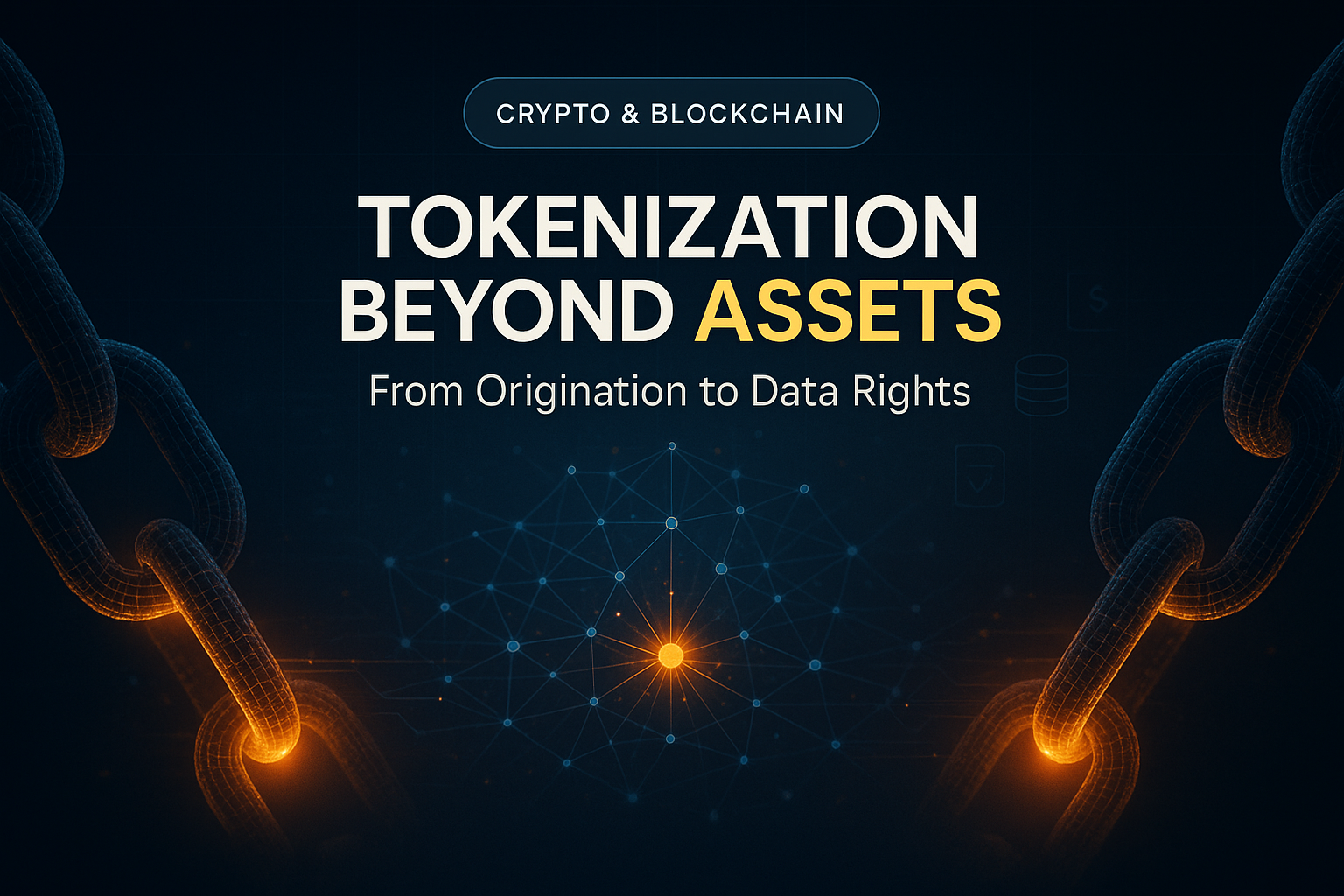
# Tokenization Beyond Assets: How Blockchain Is Revolutionizing Origination and Data
The tokenization narrative has evolved dramatically. For years, the conversation centered on real-world assets (RWAs) — real estate, commodities, securities. But in 2026, a paradigm shift is underway: tokenization is expanding far beyond tangible and financial assets into the origination layer itself, encompassing cash flows, data rights, and digital infrastructure.
The Evolution of Tokenization: From Assets to Origination
When tokenization first gained mainstream attention, the focus was clear: convert existing assets onto blockchain infrastructure to improve settlement, reduce intermediaries, and increase liquidity. Major financial institutions and enterprises explored tokenizing everything from government bonds to fine art.
However, origination tokenization represents a fundamentally different application. Rather than tokenizing completed or existing assets, this approach tokenizes the creation process itself — the cash flows, revenue streams, and data that flow from business operations. According to emerging industry research from blockchain consulting firms and fintech leaders, this shift recognizes that the real value in modern enterprises lies not just in static assets, but in the continuous generation of data, revenue, and rights.
Why Origination Matters More Than Assets Alone
Traditional asset tokenization faces a critical limitation: it primarily digitizes what already exists. But origination tokenization addresses the source of value creation itself. Consider a technology company with recurring subscription revenue, or a media platform generating continuous content licensing fees. These cash flows are far more valuable than any single asset on the balance sheet.
By tokenizing origination, enterprises can:
- Fractionalize revenue streams — Investors gain direct exposure to cash flow generation without owning underlying assets
- Enable real-time settlement — Cash flows settle instantly on-chain rather than through traditional accounting cycles
- Create programmable rights — Tokenized origination rights can be automatically distributed, split, or redirected based on smart contract logic
- Unlock liquidity for creators — Artists, developers, and content creators can monetize future earnings immediately
This represents a shift from “what do we own?” to “what do we generate?” — a more dynamic and economically accurate representation of modern business value.
Tokenizing Cash Flows and Data Rights
Beyond revenue origination, blockchain technology is enabling the tokenization of data rights and information assets — a category largely ignored in traditional finance but increasingly critical in the digital economy.
Data has become the new oil, yet most enterprises have no mechanism to tokenize, trade, or monetize data rights separately from their core business. Emerging blockchain protocols are solving this by creating standardized token representations of:
- Data usage rights — Tokens representing permission to access, analyze, or utilize specific datasets
- Predictive cash flows — Tokens backed by forecasted revenue from data monetization
- Attribution rights — Tokens that track and reward data contributors in collaborative ecosystems
- Consent tokens — Privacy-preserving representations of user consent for data usage
According to emerging discussions within blockchain and enterprise technology communities, this evolution positions tokenization as an infrastructure layer for the digital economy, not merely a financial innovation for existing assets.
Real-World Applications Emerging in 2026
Several sectors are leading this transition:
Enterprise Data Platforms — Companies like Chainlink and emerging data DAOs are exploring tokenized data feeds that represent originating data sources, with tokens reflecting the reliability and value of that data stream.
Creator Economies — Platforms are experimenting with tokenized revenue origination, allowing creators to sell fractional claims on future earnings from their content, music, or intellectual property.
Supply Chain Finance — Rather than tokenizing finished goods, forward-looking enterprises are tokenizing cash flow origination at each stage of production and distribution, enabling suppliers to access liquidity based on future revenue certainty.
Intellectual Property Licensing — Patent and licensing origination is being tokenized to create liquid markets for IP rights and licensing revenue streams.
The Infrastructure Shift: From Settlement to Origination
This evolution requires a fundamental shift in blockchain infrastructure. Early tokenization focused on settlement efficiency — making existing transactions faster and cheaper. Origination tokenization demands infrastructure that handles continuous data streams, programmable rights distribution, and real-time economic accounting.
Layer 2 solutions, interoperability protocols, and enterprise-grade blockchain platforms are increasingly designed to support these origination use cases. The focus is moving from “how do we tokenize this asset?” to “how do we represent this economic process as a continuous token stream?”
Looking Forward: The Tokenized Economy
By 2026 and beyond, expect tokenization to become less about converting old assets and more about natively designing economic systems on blockchain. New ventures will be built from inception with tokenized origination at their core — not as an afterthought, but as fundamental infrastructure.
This shift has profound implications: it enables fractional ownership of future value creation, real-time economic settlement, and programmable economic relationships that were impossible in traditional systems. It also raises important questions about regulation, investor protection, and how securities frameworks adapt to continuous cash flow tokenization.
The question is no longer whether tokenization matters — it’s whether your business is designed to capture the economic value of origination in a tokenized world.
—
📖 **Recommended Sources for Verification:**
• **Chainlink Research & Enterprise Blockchain Reports** — Leading insights on tokenization infrastructure and data origination
• **Gartner Blockchain & Web3 Reports** — Enterprise adoption trends in tokenization beyond traditional assets
• **CoinDesk and CoinTelegraph** — Real-time coverage of tokenization innovations and enterprise implementations
• **Enterprise blockchain consortium whitepapers** — Technical specifications for origination-layer tokenization protocols
ⓘ **Note:** This content is AI-generated based on training data through January 2026. The specific date (July 22, 2026) is in the future relative to the training data cutoff. Please verify current market developments, specific company announcements, and regulatory guidance independently before publication or investment decisions.