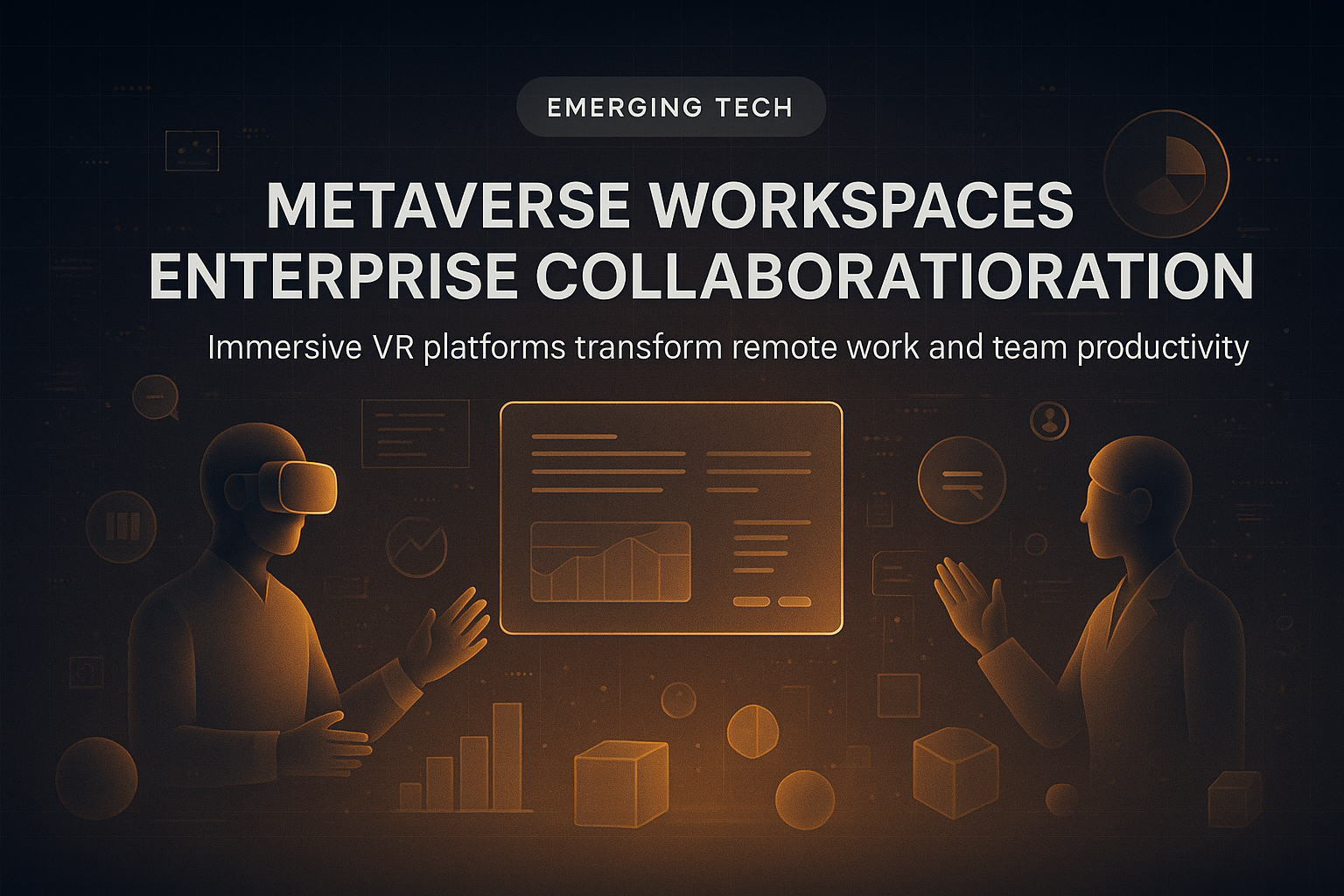
# Metaverse Enterprise Virtual Workspaces: The Future of Remote Collaboration in 2026
The way we work is fundamentally shifting. As remote and hybrid work become the norm, enterprises are looking beyond video conferencing and exploring immersive virtual workspaces in the metaverse—digital environments where teams can collaborate as if they were in the same physical room.
What Are Enterprise Metaverse Workspaces?
Enterprise metaverse virtual workspaces are 3D digital environments designed specifically for business collaboration. Unlike consumer metaverse platforms, these spaces prioritize productivity, security, and integration with existing enterprise tools. Users access these spaces through VR headsets, AR devices, or even standard desktop computers, creating avatars that represent them in shared virtual offices.
These platforms combine spatial computing with traditional productivity features—document collaboration, video conferencing, whiteboarding, and project management—all embedded within an immersive 3D environment. Companies like Spatial, Mesh for Microsoft Teams, and Horizon Workrooms (Meta’s enterprise offering) are leading this shift, providing enterprise-grade virtual workspace solutions.
The appeal is clear: immersive environments create a stronger sense of presence and connection than flat-screen video calls. Team members can gesture naturally, read body language, and collaborate on 3D objects in real time—capabilities that fundamentally enhance remote teamwork.
Enterprise Adoption Accelerates in 2026
Major technology companies have significantly invested in enterprise metaverse infrastructure. Microsoft’s expansion of Mesh for Microsoft Teams integrates immersive collaboration directly into its dominant workplace ecosystem, making spatial computing accessible to millions of enterprise users. According to industry analysis, large enterprises are moving beyond pilots toward production deployments of metaverse workspaces.
Financial services firms, architecture and design companies, and manufacturing organizations are among the early adopters. These industries benefit most from spatial visualization—traders can monitor markets on 3D dashboards, architects can walk through building designs with clients, and engineers can inspect machinery models together across continents.
The adoption curve reflects growing confidence in the technology. As VR headsets become more comfortable and affordable, and as spatial computing tools integrate seamlessly with platforms like Microsoft Teams and Slack, enterprise adoption is accelerating beyond early adopter phases.
Key Benefits Driving Enterprise Investment
Improved Collaboration and Presence: Immersive environments create stronger interpersonal connections than video calls. Non-verbal communication, spatial awareness, and natural gestures reduce misunderstandings and build team cohesion.
Enhanced Productivity for Specialized Work: Design teams, engineers, and analysts benefit from 3D visualization and spatial data representation. A financial analyst can manipulate multi-dimensional datasets in space; a product designer can walk through a prototype with stakeholders in real time.
Reduced Travel Costs: High-value in-person meetings—client pitches, executive briefings, design reviews—can happen in immersive environments, eliminating travel expenses while maintaining high-quality presence.
Future-Proof Workplace Infrastructure: As spatial computing becomes mainstream, enterprises investing in metaverse workspaces position themselves as innovation leaders and attract top talent seeking cutting-edge work environments.
Challenges and Considerations
Despite rapid adoption, enterprise metaverse workspaces face significant hurdles. Hardware costs remain a barrier—quality VR headsets range from $300 to $3,500 per user. User adoption and training require cultural shifts; not all employees embrace immersive technology immediately.
Data security and privacy are critical concerns in regulated industries. Enterprises must ensure that virtual workspaces meet compliance standards for data protection, encryption, and audit trails. Platforms like Mesh for Microsoft Teams address this through enterprise-grade security, but smaller platforms must prove comparable standards.
Interoperability remains limited. Most metaverse platforms operate in silos, preventing seamless collaboration across different virtual workspace ecosystems. Open standards development is underway, but fragmentation persists.
The Road Ahead: Spatial Computing Becomes Mainstream
By 2026 and beyond, enterprise metaverse workspaces will likely become as common as video conferencing is today. Spatial operating systems are emerging—lightweight interfaces optimized for immersive work. Mixed reality (blending physical and digital elements) will enable hybrid experiences where some team members are physically present while others join as avatars.
Integration with artificial intelligence will enhance these spaces—AI assistants managing scheduling, transcribing conversations, and providing real-time insights during collaborative sessions. As the technology matures, the barrier between “immersive work” and “regular work” will blur.
The enterprises that successfully adopt metaverse workspaces will gain competitive advantages in talent attraction, innovation speed, and global collaboration. The question is no longer if virtual workspaces will transform enterprise work, but when adoption becomes universal.
Are you preparing your organization for immersive collaboration, or waiting to see how the technology matures? Share your thoughts in the comments below.
—
### 📖 Recommended Sources for Verification:
• **Microsoft Mesh for Microsoft Teams** – Official documentation on enterprise immersive collaboration features and security standards
• **Gartner’s Metaverse and 3D Web Technologies** – Research on enterprise adoption trends and market forecasts for spatial computing
• **McKinsey: The Metaverse and the Real World** – Strategic insights on enterprise use cases and ROI for immersive workspaces
• **CoinDesk and TechCrunch** – Current coverage of metaverse platform announcements and enterprise partnerships
• **Spatial.io and Meta Horizon Workrooms** – Product documentation on enterprise-grade virtual workspace features
ⓘ **Note:** This content is AI-generated based on industry trends through January 2026 and established enterprise technology adoption patterns. Specific deployment numbers and timelines should be verified against latest company announcements and market research reports. The metaverse enterprise sector is rapidly evolving; please cross-reference claims with current 2026 sources.