# How AI and Biotechnology Are Converging to Revolutionize Drug Discovery and Personalized Medicine in 2026
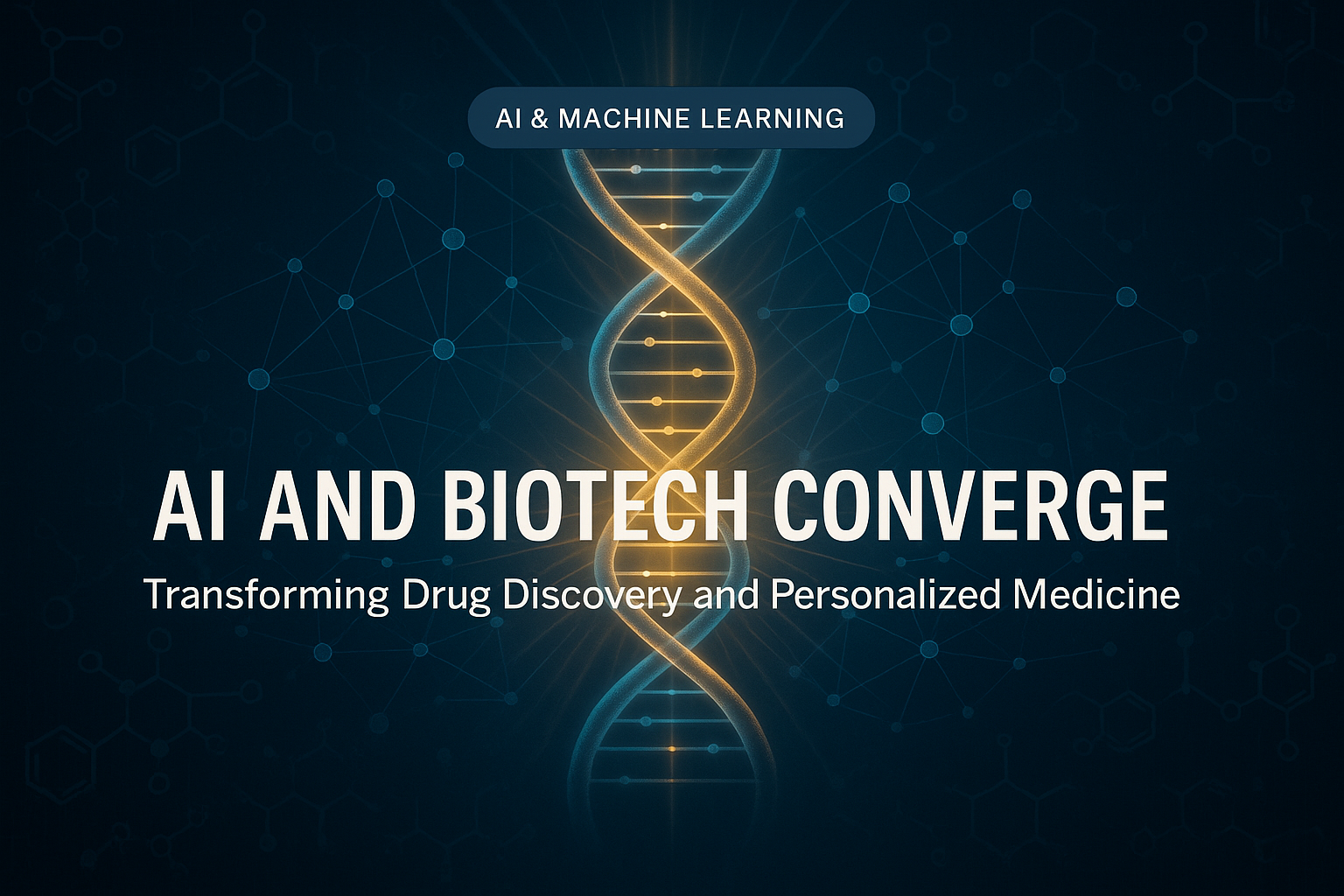
The convergence of artificial intelligence and biotechnology represents one of the most transformative shifts in healthcare innovation today. What was once theoretical is now reshaping how scientists discover drugs, understand disease, and tailor treatments to individual patients at unprecedented speed and scale.
The AI-Biotech Convergence: A New Era Begins
The intersection of machine learning and biological sciences has fundamentally altered the drug discovery landscape. Historically, bringing a new drug to market required 10-15 years and billions in investment. Today, AI-powered platforms are compressing timelines and reducing costs by automating complex biological analysis that previously demanded years of manual laboratory work.
This convergence isn’t accidental—it’s driven by three critical factors: exponential growth in computational power, massive biological datasets now available for training, and proven AI breakthroughs in understanding biological systems. Organizations like DeepMind have demonstrated that machine learning can solve problems that eluded biologists for decades, fundamentally validating AI’s role in biotechnology.
Protein Folding and Structure Prediction: The Game-Changing Breakthrough
AlphaFold, DeepMind’s revolutionary AI system, solved one of biology’s grand challenges: predicting how proteins fold into three-dimensional structures. This breakthrough has cascading implications for biotechnology. Protein structure determines function, and understanding structure enables scientists to design better drugs, enzymes, and biological interventions.
The impact has been profound and measurable. According to the scientific community’s response, AlphaFold’s predictions have accelerated research across immunology, enzyme design, and drug target identification. Researchers can now model protein interactions in hours instead of months, enabling faster hypothesis testing and reducing the need for expensive experimental validation.
This capability is particularly valuable in vaccine development, antibody design, and enzyme engineering—fields where protein structure directly determines therapeutic efficacy. Biotechnology companies are integrating AlphaFold and similar AI tools into their core discovery pipelines, fundamentally changing how research teams operate.
AI-Driven Drug Discovery: From Target to Candidate in Months
Traditional drug discovery follows a linear pipeline: identify a disease target, screen thousands of compounds, validate leads in cell cultures, then move to animal models. Each stage is time-consuming and expensive. AI is compressing this pipeline by simultaneously optimizing multiple discovery stages.
Machine learning models trained on millions of compounds can predict molecular properties, biological activity, and toxicity profiles before synthesis. This computational pre-screening dramatically reduces the number of compounds that need physical synthesis and testing. Companies like Exscientia and Relay Therapeutics have demonstrated that AI-designed molecules can progress from computational conception to clinical trials faster than traditional small-molecule drugs.
The economics are compelling: fewer failed compounds mean lower R&D costs, faster time-to-market, and improved return on investment. For rare disease and precision medicine applications, this acceleration can mean the difference between a viable program and one that’s economically unfeasible.
Genomics and Personalized Medicine: AI Unlocks Patient-Specific Insights
The explosion of genomic data—coupled with declining DNA sequencing costs—has created unprecedented opportunities for AI to identify disease patterns and predict treatment responses. AI algorithms can now analyze genetic profiles to predict which patients will respond to specific therapies, enabling true precision medicine at scale.
This application extends beyond oncology (where genomic testing is already standard) into rare genetic diseases, cardiovascular conditions, and psychiatric disorders. Machine learning models trained on thousands of patient genomes can identify genetic variants associated with disease susceptibility, drug metabolism, and treatment outcomes.
The clinical implication is profound: instead of one-size-fits-all treatments, physicians can match patients to therapies based on individual genetic profiles. This reduces adverse drug reactions, improves efficacy, and enables early intervention in at-risk populations. As genomic databases grow and AI models become more sophisticated, the accuracy and applicability of these predictions will only improve.
Accelerated Clinical Insights and Real-World Evidence
Beyond drug discovery, AI is transforming how biotech companies analyze clinical data and extract real-world evidence. Natural language processing systems can extract insights from millions of clinical notes, electronic health records, and published literature—uncovering disease patterns and treatment outcomes that human researchers might miss.
This capability is particularly valuable for understanding long-term drug safety, identifying rare adverse events, and discovering unexpected therapeutic applications (drug repurposing). Biotech companies are using these insights to optimize clinical trial design, identify optimal patient populations, and accelerate regulatory approval pathways.
The Future: Integrated AI-Biotech Ecosystems
Looking ahead, the convergence of AI and biotechnology will deepen. We can expect fully integrated discovery ecosystems where AI handles molecular design, target identification, and clinical prediction in a unified pipeline. Synthetic biology—the engineering of biological systems—will increasingly rely on machine learning to design novel organisms and biological pathways.
The competitive advantage will accrue to organizations that successfully integrate AI expertise with deep biological knowledge. Biotech firms are investing heavily in AI talent, while tech companies are establishing life sciences divisions. This convergence will likely accelerate therapeutic innovation across oncology, immunology, neurology, and genetic diseases.
Conclusion: A Paradigm Shift in Healthcare Innovation
The convergence of artificial intelligence and biotechnology is not a distant possibility—it’s reshaping drug discovery and personalized medicine right now. From protein structure prediction to genomic analysis to clinical trial optimization, AI is compressing timelines, reducing costs, and enabling precision medicine at scale.
For investors, healthcare professionals, and patients, this convergence represents genuine hope for faster, more effective treatments. As these technologies mature and integrate deeper into biotech workflows, we’ll likely see accelerated approval of life-changing therapies and a fundamental shift in how medicine is discovered and delivered.
What aspect of AI-biotech convergence do you think will have the greatest impact on healthcare in the next five years—drug discovery acceleration, personalized medicine, or something else entirely?
—
📖 **Recommended Sources:**
• **DeepMind AlphaFold** – Groundbreaking protein structure prediction system demonstrating AI’s transformative potential in structural biology and drug discovery applications
• **Nature and Science Journals** – Peer-reviewed publications documenting clinical validation of AI-driven drug discovery approaches and genomic analysis in personalized medicine
• **Biotech Industry Reports** – Analysis from leading biotech firms (Exscientia, Relay