# Enterprise Augmented Reality in 2026: Transforming Workforce Productivity and ROI
The enterprise augmented reality market is experiencing explosive growth, and 2026 marks a pivotal inflection point where AR transitions from experimental pilot programs to mission-critical business infrastructure. Organizations across manufacturing, healthcare, field service, and logistics are discovering that AR isn’t just a cool technology—it’s a measurable driver of operational efficiency, safety, and bottom-line profitability.
The Market Explosion: By the Numbers
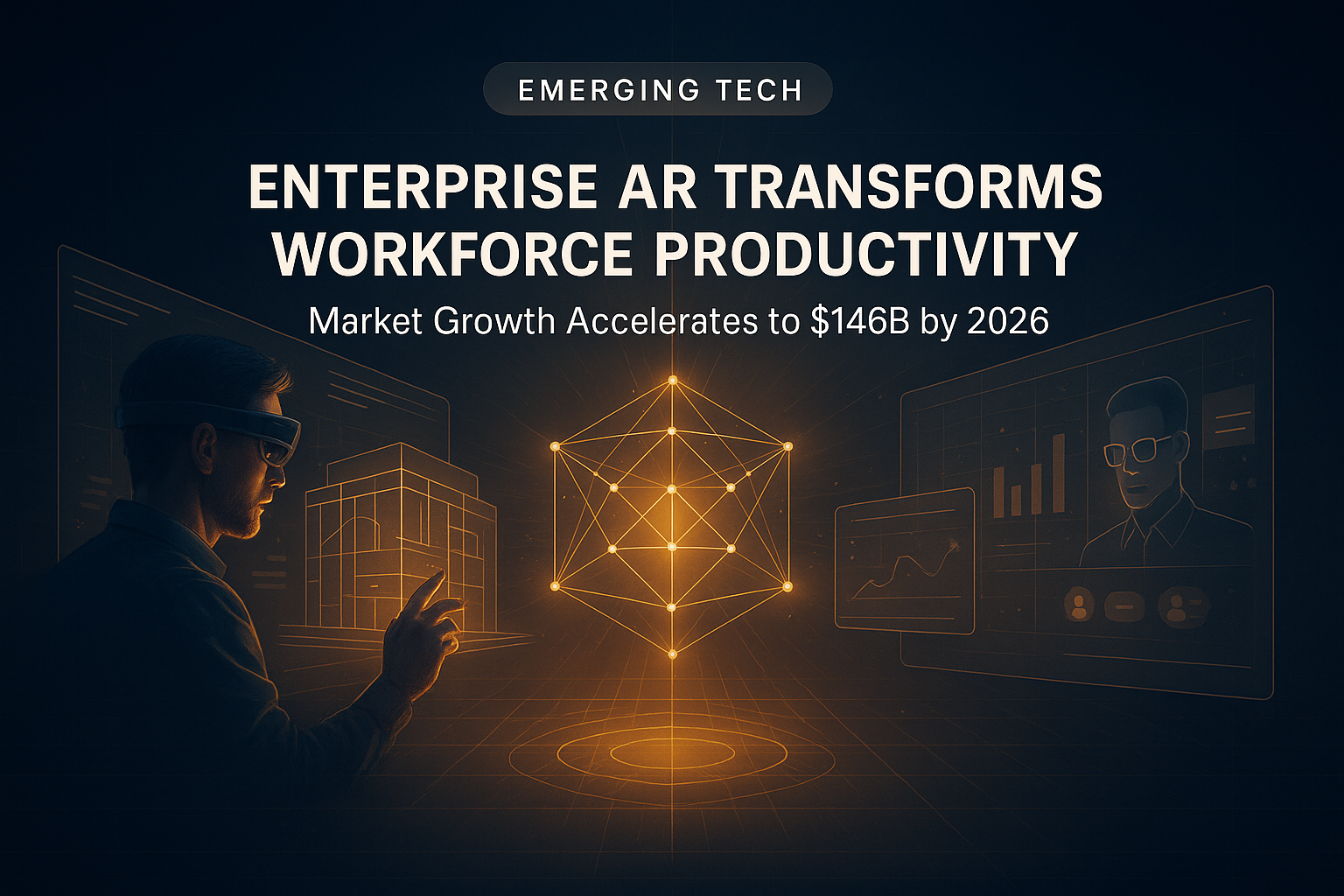
According to recent market analysis, the Enterprise Augmented Reality Market is valued at USD 146.05 billion in 2026 and is growing at a compound annual growth rate (CAGR) of 29.35%, projected to reach USD 528.79 billion by 2031. This explosive trajectory reflects a fundamental shift in how enterprises view AR—no longer as a consumer novelty, but as essential infrastructure for digital transformation.
The hardware segment is accelerating even faster. According to ABI Research, the AR hardware market size is projected to grow 64.8% year-over-year in 2026, reaching $9.7 billion. This surge reflects increased investment in enterprise-grade AR devices like Microsoft HoloLens 3, spatial computing platforms, and mobile AR solutions that deliver tangible business value.
Where Enterprise AR Delivers the Highest ROI
Remote Collaboration and Field Service Excellence
One of the most immediate applications gaining traction is remote expertise delivery. Field technicians equipped with AR glasses can now receive real-time guidance from expert engineers located anywhere in the world. A technician repairing complex machinery can overlay digital annotations, step-by-step work instructions, and remote expert views directly into their field of vision—eliminating costly travel, reducing downtime, and accelerating problem resolution.
This capability is transforming field service economics. Remote assistance through AR reduces the need for on-site expert visits, cuts first-time fix rates, and enables knowledge transfer at scale. Industries like telecommunications, manufacturing, and industrial equipment maintenance are seeing measurable improvements in service delivery times and customer satisfaction.
Training and Skill Development at Scale
AR-based training and simulation is emerging as a game-changer for workforce development. Rather than relying on classroom instruction or expensive physical simulators, enterprises can now deploy immersive, hands-on training experiences at scale. New technicians can practice complex procedures in virtual environments before touching real equipment—reducing errors, accelerating time-to-competency, and improving safety outcomes.
Healthcare organizations are particularly aggressive in adopting AR for surgical training and procedure simulation. Manufacturing facilities are using AR to train maintenance teams on equipment that may only fail once per decade, ensuring staff are prepared for rare but critical scenarios. The economic value of AR-integrated training in manufacturing is substantial, with projections suggesting AR-integrated IoT in manufacturing could reach USD 90-110 billion in economic value by 2030 (Treeview Studio, 2025).
Inspection, Quality Control, and Compliance
AR transforms how enterprises conduct inspections and maintain compliance. Workers can use AR to overlay inspection checklists, historical data, and compliance requirements directly onto physical assets. This reduces human error, accelerates inspection cycles, and creates an auditable digital record of every inspection—critical for regulated industries like pharmaceuticals, aerospace, and food production.
Enterprise Adoption Across Key Verticals
Manufacturing remains the largest adopter, using AR for equipment maintenance, assembly verification, and production optimization. Healthcare is rapidly scaling AR for surgical guidance, anatomical visualization, and patient education. Field Service organizations are leveraging AR to reduce truck rolls and improve first-time fix rates. Logistics and Warehousing are implementing AR for picking accuracy, inventory management, and worker safety.
The common thread across all these verticals: AR delivers measurable ROI through improved productivity, reduced errors, faster training cycles, and enhanced safety outcomes.
The Hardware and Platform Landscape
The enterprise AR ecosystem is maturing rapidly. Microsoft HoloLens remains the dominant platform for enterprise spatial computing, with strong adoption in manufacturing and healthcare. Google Glass Enterprise Edition continues to serve field service and logistics use cases. Mobile AR solutions powered by ARCore and ARKit are expanding accessibility for broader enterprise deployments.
Beyond headsets, the ecosystem includes cloud-based AR platforms, enterprise software integrations, and AI-powered analytics that transform raw AR data into actionable business intelligence. This convergence of hardware, software, and AI is what’s driving the dramatic market expansion.
What’s Driving Enterprise AR Adoption Right Now
Several factors are accelerating enterprise AR adoption in 2026:
- Improved Hardware Economics: AR devices are becoming more affordable, lighter, and more battery-efficient—removing barriers to large-scale deployment.
- Mature Software Ecosystems: Enterprise AR platforms now offer robust integration with existing business systems, ERP, and workflow tools.
- Proven ROI Case Studies: Organizations can now point to documented cost savings, productivity gains, and safety improvements from AR implementations.
- Workforce Expectations: Younger workers expect modern, technology-enabled work environments—AR is becoming a recruitment and retention tool.
- Supply Chain Resilience: AR enables knowledge transfer and remote expertise, reducing dependency on specialized personnel and improving operational resilience.
The Future of Enterprise AR: Beyond 2026
The trajectory is clear: enterprise AR will become as ubiquitous as email and video conferencing within the next 3-5 years. As hardware costs decline, software matures, and more organizations publish success stories, adoption will accelerate across mid-market and smaller enterprises—not just large corporations.
Emerging trends to watch include AI-augmented AR (where machine learning enhances AR insights), digital twin integration (linking physical assets to virtual replicas for predictive maintenance), and spatial computing ecosystems that blur the line between AR, VR, and traditional computing.
The Bottom Line
For enterprise leaders, the question is no longer “Should we invest in AR?” but rather “How quickly can we deploy AR to capture competitive advantage?” Organizations that move decisively in 2026 will establish operational advantages in productivity, safety, and training that compound over time.
The $146 billion enterprise AR market in 2026 isn’t hype—it’s the early stage of a fundamental transformation in how work gets done. The next wave of competitive advantage belongs to organizations that master augmented reality.
What’s holding your organization back from deploying enterprise AR? Is it technology maturity, ROI clarity, or organizational readiness? Share your perspective in the comments below.
—
📖 **Recommended Sources:**
– **ABI Research** – AR hardware market forecasts and growth projections for 2026
– **Treeview Studio (2