# X402 Protocol: How Stablecoins Enable Programmable AI Agent Payments
The internet was never designed for native payments. For decades, digital transactions required intermediaries, manual verification, and account setup. But a new standard is changing that: X402, an HTTP-native protocol that makes stablecoin payments as simple as sending an API request.
This shift matters because AI agents are becoming economic actors. They need to purchase compute, access data, and pay for services—autonomously, instantly, and without human intervention. X402, paired with stablecoins like USDC, is the infrastructure making this possible at scale.
What is X402? The Missing HTTP Payment Standard
X402 is an open, neutral standard for internet-native payments that leverages the HTTP 402 status code—”Payment Required”—which has existed in the HTTP specification since 1997 but was never widely implemented. The protocol enables clients (including AI agents) to pay for web resources and APIs directly in the same place they request them: the HTTP layer itself.
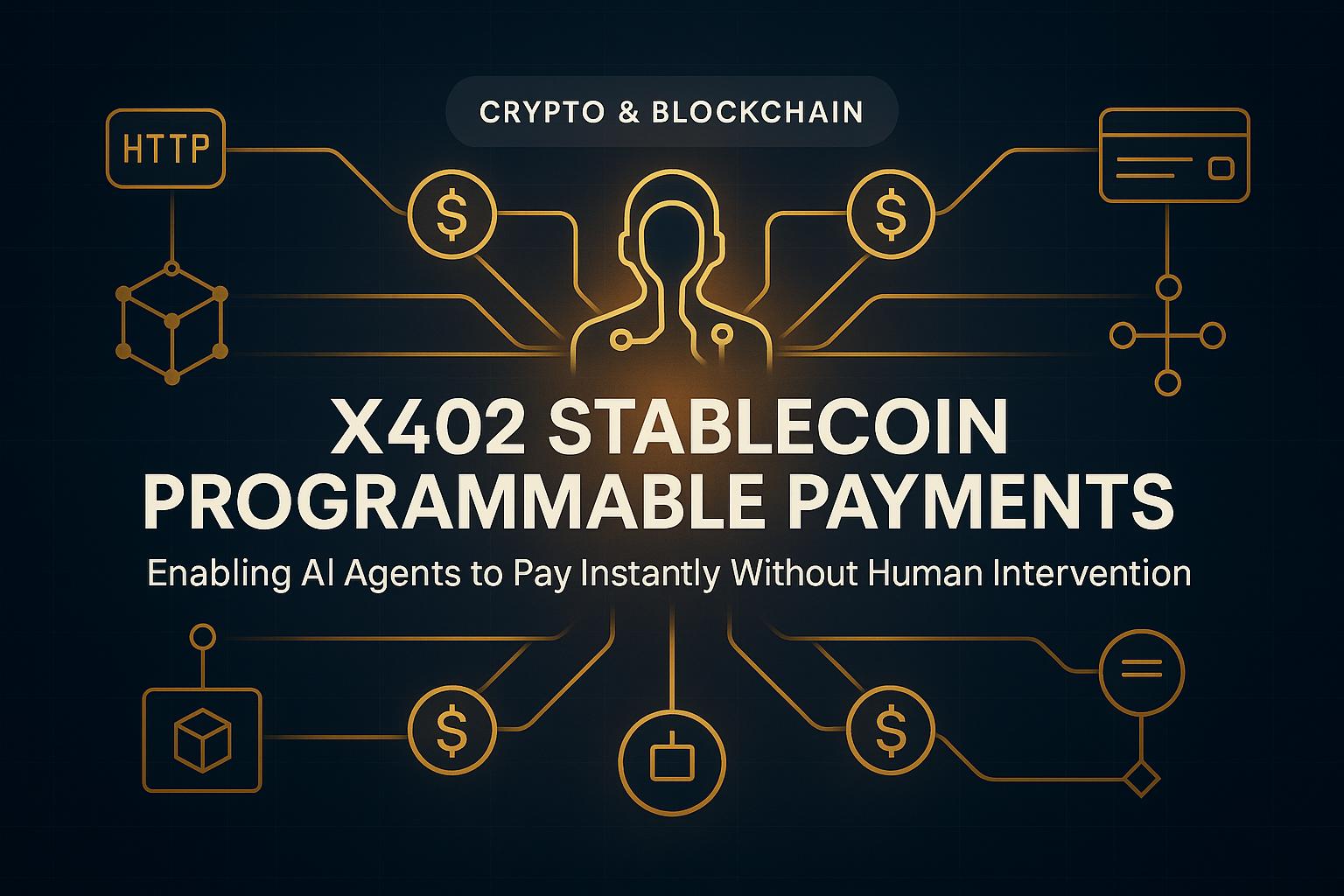
Here’s how it works in practice: An AI agent sends an HTTP request to access a service or resource. The server responds with a 402 Payment Required status code and payment instructions. The agent instantly pays with stablecoins—no account creation, no KYC, no delays. The resource is delivered. This creates a permission-less, frictionless payment flow that scales to billions of micro-transactions.
Unlike traditional payment systems that require account setup and trust relationships, X402 is designed for instant onboarding and atomic settlement. The protocol is agnostic to the underlying blockchain or stablecoin, though USDC and other blockchain-native stablecoins are the natural fit for settlement.
Why Stablecoins Are Essential to X402
Stablecoins are the critical ingredient that makes X402 practical for real-world payments. AI agents and autonomous systems need price certainty and instant finality—properties that volatile cryptocurrencies don’t provide. Stablecoins like USDC maintain a 1:1 peg to the US dollar, eliminating price volatility and making them suitable for paying for real-world services.
The combination is powerful: X402 provides the payment protocol, while stablecoins provide the settlement layer. An AI agent can programmatically allocate a budget in USDC, make thousands of per-request payments across different services, and maintain predictable cost structures. For enterprises running AI workloads at scale, this is transformative.
According to industry sources, stablecoins are increasingly being adopted for B2B settlement, cross-border payments, and treasury operations. X402 extends this use case to agentic workflows, where autonomous systems execute transactions without human approval.
The AI Agent Economy: Programmable Autonomous Payments
X402 enables what industry leaders call the “agentic payments” revolution—where AI agents become economic actors capable of making independent financial decisions. This unlocks several transformative use cases:
1. Autonomous API Consumption
AI agents can now pay-per-use for data APIs, compute resources, and specialized services. A machine learning model training on cloud infrastructure can automatically pay for additional GPU hours as needed. A content recommendation engine can pay for real-time market data feeds. Payments happen instantly and programmatically.
2. Composable Blockchain Infrastructure
Standards like X402 enable blockchains to quietly power AI and crypto workflows without requiring agents to understand blockchain mechanics. The protocol abstracts away complexity, making stablecoin payments as natural as HTTP requests.
3. Micro-Transaction Economies
Traditional payment systems collapse under the friction of micro-transactions (sub-$1 payments). X402 and stablecoins eliminate this friction. AI agents can now participate in high-frequency, low-value payment ecosystems—opening entirely new business models.
4. Cross-Border Instant Settlement
Stablecoins settle globally without intermediaries. An AI agent in one jurisdiction can pay a service provider in another instantly and transparently, removing the need for correspondent banking or multi-day settlement windows.
Enterprise and Developer Adoption
Early adoption signals are strong. Developers are integrating X402 into API frameworks, enabling service providers to accept stablecoin payments alongside traditional payment methods. Enterprises evaluating USDC for treasury operations, cross-border payments, and programmable B2B settlement are discovering that X402 provides a native integration layer.
The standard appeals to several constituencies:
- API Providers can monetize services through instant, permission-less payments without building payment infrastructure
- AI/ML Companies can reduce operational costs by paying only for resources consumed, in real-time
- Enterprises gain programmatic control over payments and transparent settlement
- Developers get a simple, HTTP-native standard that integrates seamlessly with existing web infrastructure
The Broader Implications: Crypto Powering the AI Stack
X402 represents a quiet but profound shift: blockchains and stablecoins are becoming invisible infrastructure for AI systems. Rather than requiring agents to “understand” crypto, X402 makes stablecoin payments a natural extension of HTTP APIs.
This convergence has major implications. As AI agents proliferate—handling customer service, data analysis, autonomous trading, and more—the need for instant, programmable payments becomes critical. X402 and stablecoins provide that infrastructure.
Additionally, the protocol is open and neutral, not controlled by any single company or blockchain. This makes it attractive to enterprises that need interoperability and don’t want to depend on proprietary payment networks.
Looking Ahead: Standardization and Scale
As of early 2026, X402 adoption is accelerating among developers and forward-thinking enterprises. The protocol is gaining traction in Web3 infrastructure, AI agent frameworks, and fintech platforms. The next phase will likely involve broader standardization efforts, integration with major cloud providers, and enterprise-grade tooling.
The convergence of programmable stablecoins, HTTP-native payment standards, and autonomous AI agents is creating a new layer of digital infrastructure. This isn’t about replacing traditional finance—it’s about enabling new economic models that weren’t possible before.
Conclusion: The Future of Programmable Payments
X402 and stablecoins represent a fundamental shift in how digital payments work. By making payments native to the internet itself, the protocol removes friction that has existed for decades. For AI agents, this means autonomy. For enterprises, it means cost efficiency and programmability. For the broader economy, it means new business models become viable.
As AI systems become increasingly autonomous, how will programmable payments change the competitive landscape for your industry? The answer may depend on how quickly you adopt standards like X402.
—