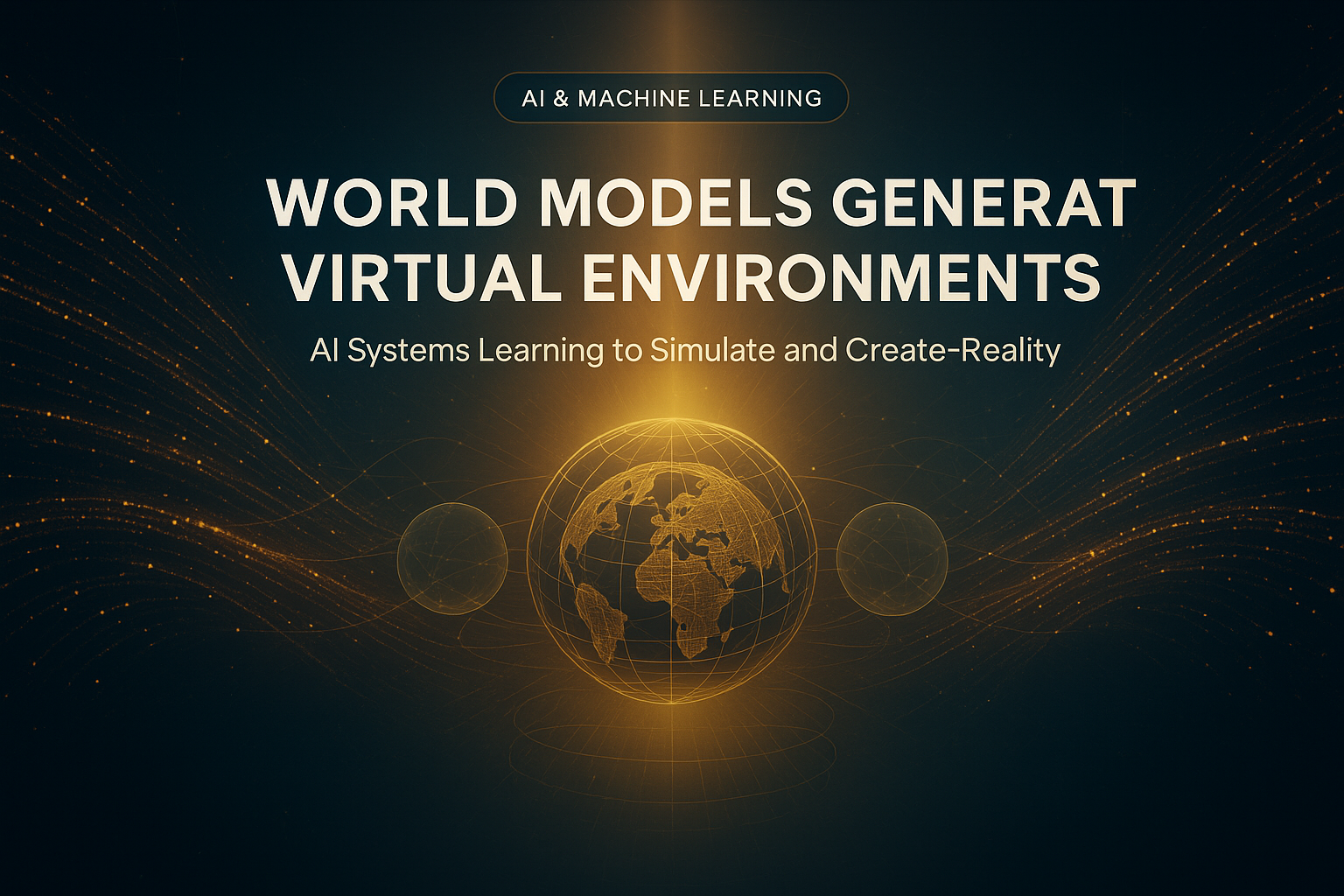
# World Models and Generative Virtual Environments: The Future of AI-Powered Simulation
The next frontier in artificial intelligence isn’t just about understanding the world—it’s about machines learning to imagine, simulate, and generate entirely new ones.
What Are World Models?
World models represent a fundamental shift in how AI systems process and understand reality. Rather than simply analyzing static images or text, world models enable AI to build an internal representation of how the world works—understanding causality, physics, object interactions, and temporal dynamics. These models learn the underlying rules governing environments and can predict future states based on current conditions.
Think of it as teaching a machine to develop intuition about how things move, collide, and change over time. This capability is transformative because it moves AI from passive observation to active understanding and prediction. According to recent developments in generative AI research, world models serve as the cognitive foundation for more advanced reasoning, planning, and decision-making systems.
The Rise of Generative Virtual Environments
Building on world models, generative virtual environments take the next leap: AI systems that can synthesize entirely new, photorealistic digital worlds from text descriptions, images, or simple prompts. These aren’t pre-built game engines or hand-crafted 3D scenes—they’re dynamically generated simulations created on-the-fly by neural networks trained on vast amounts of visual and spatial data.
OpenAI’s Sora represents a landmark achievement in this space, demonstrating the ability to generate high-quality video sequences that exhibit physical consistency and realistic object behavior. The technology learns implicit world models during training, allowing it to understand physics, lighting, and object persistence well enough to generate coherent, extended sequences.
This capability has profound implications: instead of requiring teams of 3D artists and programmers to build virtual environments, AI can generate them instantly, adapting to specific requirements and scaling production to meet demand.
Core Technologies Enabling This Shift
Several technical breakthroughs have made generative virtual environments possible:
Diffusion Models and Transformers: Modern generative systems use diffusion-based architectures combined with transformer attention mechanisms to model complex spatial and temporal relationships. These architectures excel at capturing the hierarchical nature of visual information—from low-level pixels to high-level semantic concepts.
Latent Space Compression: Rather than working directly with high-resolution pixel data, contemporary systems compress visual information into learned latent representations. This allows models to reason about worlds more efficiently while maintaining semantic fidelity.
Temporal Consistency Mechanisms: A critical challenge in generating videos or interactive environments is maintaining physical consistency across frames. Advanced world models use recurrent processing, causal masking, and physics-aware constraints to ensure that generated content respects the laws of motion and interaction.
Multimodal Conditioning: The most powerful systems can accept diverse input modalities—text, images, sketches, or even user interactions—and translate them into coherent virtual environments. This flexibility is essential for real-world applications.
Real-World Applications and Industry Impact
The implications of world models and generative virtual environments extend far beyond entertainment:
Entertainment and Gaming: Game developers can use generative environments to rapidly prototype levels, create infinite procedural worlds, and reduce production timelines. Rather than spending months building a single game level, artists can iterate on AI-generated variations in hours.
Scientific Research and Simulation: Researchers can generate synthetic training data for computer vision systems, simulate complex physical systems for hypothesis testing, and create interactive environments for studying human behavior without ethical constraints of real-world experiments.
Autonomous Systems: Self-driving vehicles and robotics benefit enormously from world models. By understanding how environments evolve, autonomous systems can better predict the behavior of other agents, plan safer trajectories, and handle edge cases more robustly.
Architecture and Urban Planning: Architects can generate photorealistic visualizations of buildings and urban spaces from sketches or specifications, allowing stakeholders to explore designs interactively before construction begins.
Training and Simulation: Industries from aviation to military operations use high-fidelity simulations for training. Generative virtual environments could democratize access to realistic training scenarios, reducing costs and enabling more personalized instruction.
Challenges and Considerations
Despite remarkable progress, significant hurdles remain. Computational costs for training and running these models remain substantial, limiting accessibility. Physical accuracy varies—while models excel at generating visually plausible content, ensuring strict adherence to real-world physics is an ongoing challenge.
Scaling and generalization present another frontier: models trained on specific domains sometimes struggle when asked to generate content outside their training distribution. Additionally, control and predictability matter for professional applications—users need reliable, reproducible results, not merely impressive-looking generations.
From a societal perspective, the ability to generate realistic virtual content raises important questions about authenticity, deepfakes, and misinformation. As these technologies mature, robust authentication and detection methods will become essential.
The Road Ahead: Integration with Broader AI Systems
World models and generative virtual environments won’t exist in isolation. The most powerful applications will emerge when these technologies integrate with other AI capabilities: large language models for semantic understanding, reinforcement learning for interactive control, and multimodal systems that reason across text, vision, and action.
We’re moving toward embodied AI agents that can not only generate and understand virtual environments but also act within them, learn from interaction, and adapt their behavior based on experience. This convergence represents a step toward more general, flexible AI systems capable of handling complex real-world problems.
Conclusion: A New Era of AI Creativity and Understanding
World models and generative virtual environments mark a watershed moment in artificial intelligence—the transition from systems that analyze reality to systems that can imagine and create it. As these technologies mature and become more accessible, they’ll reshape industries from entertainment to scientific research, autonomous systems to architecture.
The question isn’t whether generative virtual environments will become mainstream, but how quickly industries will adapt to harness their potential. What applications in your field could be transformed by AI systems that understand and generate realistic worlds?
—
📖 Recommended Sources:
• **OpenAI Research** – Sora and world models in video generation technology
• **DeepMind Publications** – Research on world models and predictive learning in AI systems
• **ArXiv and AI Research Conferences** – Latest peer-reviewed papers on generative models and environmental simulation
• **CoinDesk/CoinTelegraph** – Coverage of AI infrastructure and emerging technology trends
• **Technology News Outlets** – Bloomberg, Reuters coverage of AI breakthroughs and industry adoption
ⓘ This content is AI-generated based on training data through January 2026. Please verify specific claims independently, particularly regarding latest product releases and company announcements.