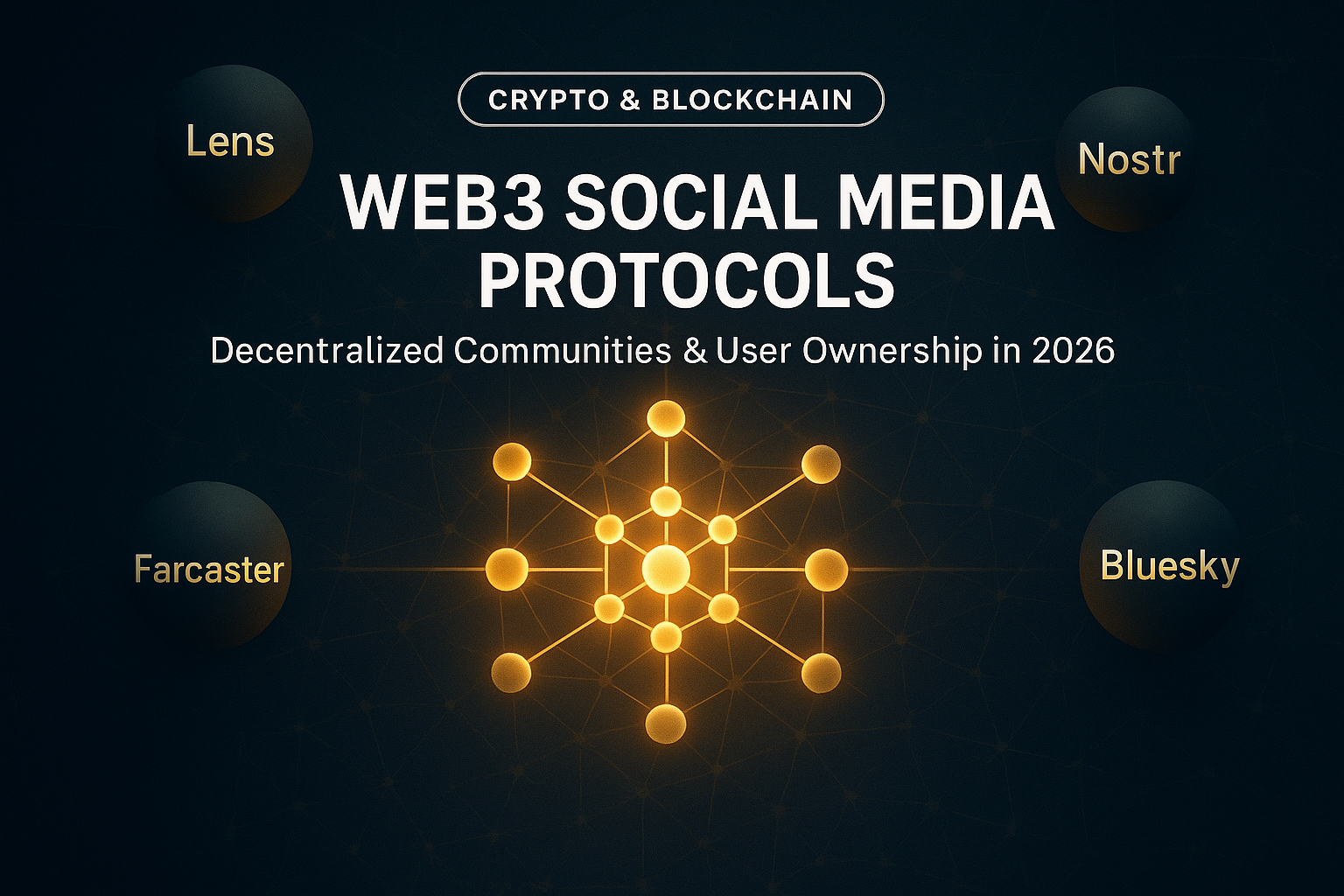
# Web3 Social Media Protocols: The Decentralized Future of Digital Communities in 2026
As centralized social media platforms face mounting scrutiny over data privacy, content moderation, and algorithmic control, Web3 social media protocols are emerging as a compelling alternative that puts power back into users’ hands. In 2026, these decentralized networks are gaining traction among creators, developers, and privacy-conscious users seeking genuine ownership of their digital identities and content.
What Are Web3 Social Media Protocols?
Web3 social media protocols are blockchain-based networks that enable peer-to-peer social interaction without reliance on centralized servers or corporate intermediaries. Unlike traditional platforms where companies own user data and control content visibility, Web3 protocols distribute governance and data ownership across network participants. Users maintain custody of their profiles, content, and social graphs—fundamental principles that distinguish decentralized social networks from their Web2 predecessors.
These protocols operate on public blockchains such as Ethereum, Polygon, and other Layer 2 solutions, enabling transparent, censorship-resistant communication. The architecture allows developers to build applications on top of the protocol layer, creating an ecosystem of competing frontends and services—all accessing the same underlying social data.
Leading Web3 Social Protocols Reshaping the Landscape
Several prominent protocols have emerged as key players in the decentralized social space. Lens Protocol, built on Polygon, enables creators to own their social graphs and monetize content directly. Farcaster, an Ethereum-based protocol, focuses on lightweight, real-time social interactions with strong emphasis on creator economics. Nostr (Notes and Other Stuff Transmitted by Relays) emphasizes censorship resistance and simplicity, operating across multiple relay networks. Bluesky, originally developed by Twitter’s former CEO Jack Dorsey, offers an AT Protocol (Authenticated Transfer) approach to decentralized social networking.
According to research findings, Farcaster peaked at approximately 80,000 monthly active users before experiencing a decline to under 20,000 by late 2025, illustrating the adoption challenges even leading protocols face. This volatility reflects broader struggles with mainstream user acquisition in the Web3 social space.
Key Advantages Driving Web3 Social Adoption
Data Ownership and Portability stand as the primary advantage. Users own their content, followers, and engagement history—portable across any application built on the protocol. This eliminates platform lock-in and empowers users to migrate freely without losing their digital identity.
Censorship Resistance is another critical differentiator. Decentralized networks distribute content across multiple nodes, making it virtually impossible for any single entity to suppress speech or remove content arbitrarily. This appeals particularly to creators and communities facing moderation challenges on centralized platforms.
Creator Economics improve dramatically on Web3 protocols. Direct monetization mechanisms, token-based rewards, and transparent revenue sharing replace opaque algorithmic prioritization. Creators retain higher percentages of earnings and build sustainable income streams independent of platform algorithms.
Transparent Governance enables communities to participate in protocol decisions through decentralized governance tokens, contrasting sharply with top-down corporate decision-making on traditional platforms.
The Adoption Challenge: Why Mainstream Breakthrough Remains Elusive
Despite compelling advantages, Web3 social protocols face significant barriers to mainstream adoption. User unfamiliarity with blockchain technology, scalability limitations causing slow transaction times, and high gas fees on certain networks create friction for average users. The user experience remains complex compared to intuitive Web2 platforms like Twitter, Instagram, and TikTok.
Additionally, network effects strongly favor established platforms. Users gravitate toward networks where their friends and favorite creators already participate—a chicken-and-egg problem that Web3 protocols struggle to overcome. The fragmentation across multiple competing protocols further dilutes network effects.
Content moderation presents another paradox: pure decentralization can enable harmful content proliferation, yet community-driven moderation lacks the resources and sophistication of corporate safety teams. Finding this balance remains an unsolved challenge.
Future Outlook: Integration and Interoperability
The trajectory for Web3 social protocols points toward increased interoperability and integration with mainstream platforms. Rather than completely replacing centralized networks, these protocols may evolve into complementary layers—enabling users to own their data while accessing it through familiar interfaces. Improvements in Layer 2 scaling solutions and user experience design will be critical to reducing friction.
Major technology companies and venture capital firms continue investing in decentralized social infrastructure, signaling confidence in long-term viability despite current adoption plateaus. The 2026 landscape suggests a consolidation phase where the strongest protocols gain developer mindshare while others fade.
The Verdict: Decentralization Gains Momentum Despite Headwinds
Web3 social media protocols represent a genuine paradigm shift in how digital communities can be structured—prioritizing user autonomy, data ownership, and censorship resistance over platform control and advertising surveillance. While mainstream adoption remains limited, the underlying value proposition resonates strongly with creators, developers, and privacy advocates.
The critical question for 2026 is not whether decentralized social networks will eventually succeed, but rather which protocols will achieve the scale and user experience necessary to compete with entrenched platforms. Are you ready to explore decentralized alternatives, or do you believe Web2 platforms will ultimately maintain their dominance? Share your perspective in the comments below.
—
📖 **Recommended Sources:**
– **Alchemy Dapp Store** – Comprehensive directory of 54+ Web3 social media dapps across major blockchain ecosystems
– **Lens Protocol Documentation** – Official resources on decentralized social graph ownership and creator economics
– **Nostr Protocol Research** – Analysis of censorship-resistant relay networks and decentralized architecture
– **Farcaster Adoption Metrics** – Historical user growth data and protocol development tracking
ⓘ This content is AI-generated based on research through June 2026. Please verify specific adoption metrics and protocol developments independently through official sources.