# Sovereign AI National Models: How Countries Are Building Digital Independence in 2026
The race for sovereign AI has officially become a defining geopolitical competition. As nations worldwide grapple with data security, regulatory control, and technological independence, they’re investing billions into building their own national AI models—a strategic shift that’s fundamentally reshaping the global technology landscape.
The Sovereign AI Movement: Why Nations Can’t Wait
For years, most countries relied on AI systems developed by U.S. tech giants like OpenAI, Google, and Meta. But 2026 marks a critical inflection point. Sovereign AI—artificial intelligence systems developed, trained, and controlled within national borders—has moved from theoretical discussion to urgent national priority.
The motivation is clear: data security, regulatory autonomy, and strategic independence. Governments recognize that AI systems trained on sensitive national data, healthcare records, and financial information shouldn’t depend on foreign infrastructure. Additionally, geopolitical tensions have accelerated this shift. Countries want to avoid scenarios where critical AI systems could be restricted, regulated, or shut down by external powers.
According to recent market analysis, sovereign AI will not completely replace AI from global cloud providers. Instead, 2026 will mark the start of a more federated model. Organizations will increasingly mix global and local AI depending on the sensitivity of use cases, with highly regulated workloads running on sovereign infrastructure.
Europe’s Multi-Country Strategy
Europe is leading the sovereign AI charge with coordinated, region-wide initiatives. Germany recently announced its own AI plan called the Sovereign Open Source Foundation Models (SOOFI)—an ambitious attempt to build powerful open-source AI models that don’t depend on U.S. tech companies. SOOFI brings together leading research institutions, startups, and technology associations across Germany to create a distributed, hybrid ecosystem.
France has similarly invested heavily in sovereign AI development, positioning itself as a counterweight to American AI dominance. The European Union’s broader regulatory framework—including the AI Act—has created both incentives and requirements for European organizations to develop homegrown AI capabilities.
The challenge Europe faces is significant: building competitive large language models requires massive computational resources, specialized talent, and sustained funding. However, the distributed approach across multiple European nations allows them to pool resources and expertise, creating a more resilient ecosystem than any single country could achieve alone.
China and the UAE: Different Paths to Independence
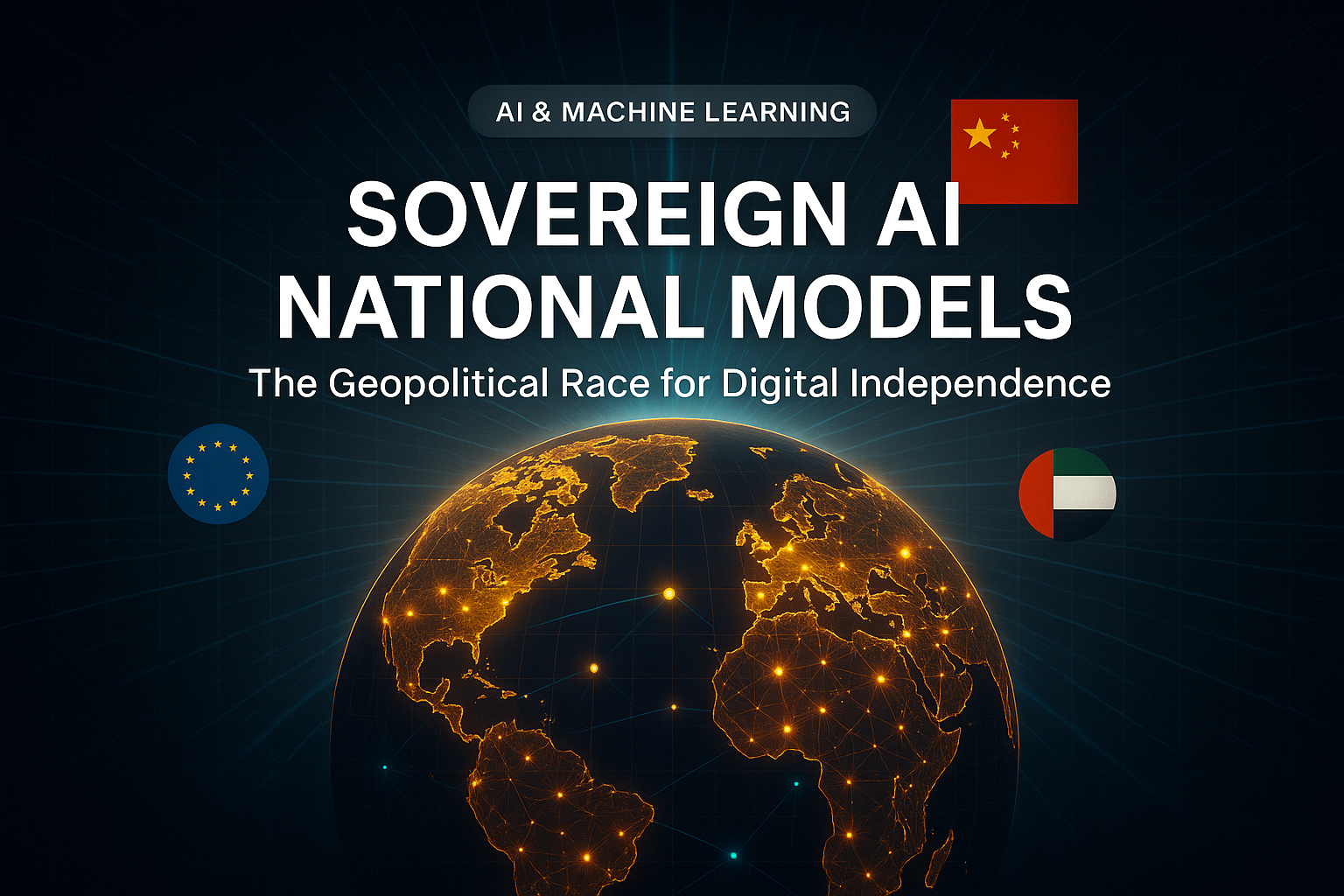
The push for sovereign AI is visible on nearly every continent, with China and the United Arab Emirates demonstrating distinctly different approaches.
China has long pursued AI independence as part of its broader technology self-sufficiency strategy. With strict data residency requirements and restrictions on foreign AI systems, China has invested heavily in developing domestic AI champions. Companies like Alibaba, Baidu, and Tencent have created powerful language models that operate entirely within Chinese borders.
The United Arab Emirates represents a different model—a smaller nation leveraging partnerships and strategic investments to build sovereign AI capabilities without requiring the scale China commands. The UAE’s approach emphasizes collaboration, foreign talent recruitment, and positioning itself as a regional AI hub while maintaining data sovereignty.
These divergent strategies highlight a critical insight: there’s no one-size-fits-all sovereign AI model. Nations are adapting their approaches based on existing tech ecosystems, regulatory environments, and geopolitical positioning.
The Business Implications: A Federated Future
For enterprises and technology organizations, the sovereign AI movement creates both opportunities and complexity. The emerging federated model means companies will need to manage multiple AI systems—some from global providers, others from national or regional sovereign systems.
This shift has profound implications for cloud infrastructure, data governance, and compliance. Organizations operating across multiple countries will need to understand which AI systems are available in which jurisdictions, how data flows between sovereign and global systems, and how regulatory requirements vary by region.
Additionally, this creates opportunities for regional AI providers and startups. European, Asian, and other regional companies are positioning themselves to fill the gap between global giants and purely national systems, offering AI solutions that balance performance with regulatory compliance.
The Challenges Ahead
Building competitive sovereign AI models is extraordinarily expensive. Training large language models requires billions in computational resources, specialized semiconductor access, and world-class talent. Many nations simply lack the scale or resources to compete with U.S. tech giants independently.
This has led to an interesting dynamic: some countries are pursuing sovereign AI through open-source collaboration (like Germany’s SOOFI), recognizing that pooling resources across borders—while maintaining data sovereignty—may be more practical than purely national efforts.
Another challenge is the talent war. The world’s leading AI researchers are concentrated in a few hubs, primarily in the United States and China. Attracting and retaining top talent is critical for sovereign AI success, yet many nations struggle to compete on salary and research resources.
Looking Ahead: 2026 and Beyond
The sovereign AI movement will accelerate throughout 2026 and beyond. Expect to see:
- Increased government funding for national and regional AI initiatives across Europe, Asia, and other regions
- More strategic partnerships between countries pursuing similar sovereign AI goals
- Regulatory frameworks that increasingly favor or require sovereign AI for sensitive applications
- Hybrid deployments becoming the norm, with organizations strategically choosing between sovereign and global AI systems based on use case sensitivity
The geopolitical competition for AI dominance is just beginning. Unlike previous technology races, this one directly impacts national security, economic competitiveness, and technological autonomy.
The Bottom Line
Sovereign AI national models represent far more than a technical trend—they’re a fundamental restructuring of global technology power. Countries worldwide are betting that AI independence is worth the enormous investment required. Whether through coordinated European efforts, China’s homegrown approach, or the UAE’s strategic positioning, nations are making clear that relying entirely on foreign AI systems is no longer acceptable.
For technology leaders, investors, and policymakers, the question isn’t whether sovereign AI will matter—it already does. The question is how to navigate this increasingly fragmented, geopolitically complex AI landscape. Which national or regional sovereign AI initiatives will your organization need to integrate with?
📖 **Recommended Sources:**
• **Gartner Research** – Analysis of federated AI models and sovereign infrastructure adoption across regions
• **McKinsey & Company** – Geopolitical implications of sovereign AI and national technology strategies
• **CoinDesk/CoinTelegraph** – Coverage of blockchain-based sovereign AI initiatives and decentralized alternatives
• **Government announcements** – Germany’s SOOFI initiative, EU AI Act, and national AI strategies from France, UK, China, and UAE
ⓘ This content is AI-generated based on research data through March 2026. Please verify specific claims and latest developments independently.