# Real World Asset Tokenization: How RWA Is Becoming the Blockchain’s Killer App in 2026
The blockchain industry has finally found what it’s been searching for: a use case with real, measurable economic impact that doesn’t require speculation or hype. Real World Asset (RWA) tokenization is no longer a theoretical concept—it’s becoming the infrastructure layer for trillions of dollars in previously illiquid assets, from commercial real estate to commodity futures.
What Is Real World Asset Tokenization?
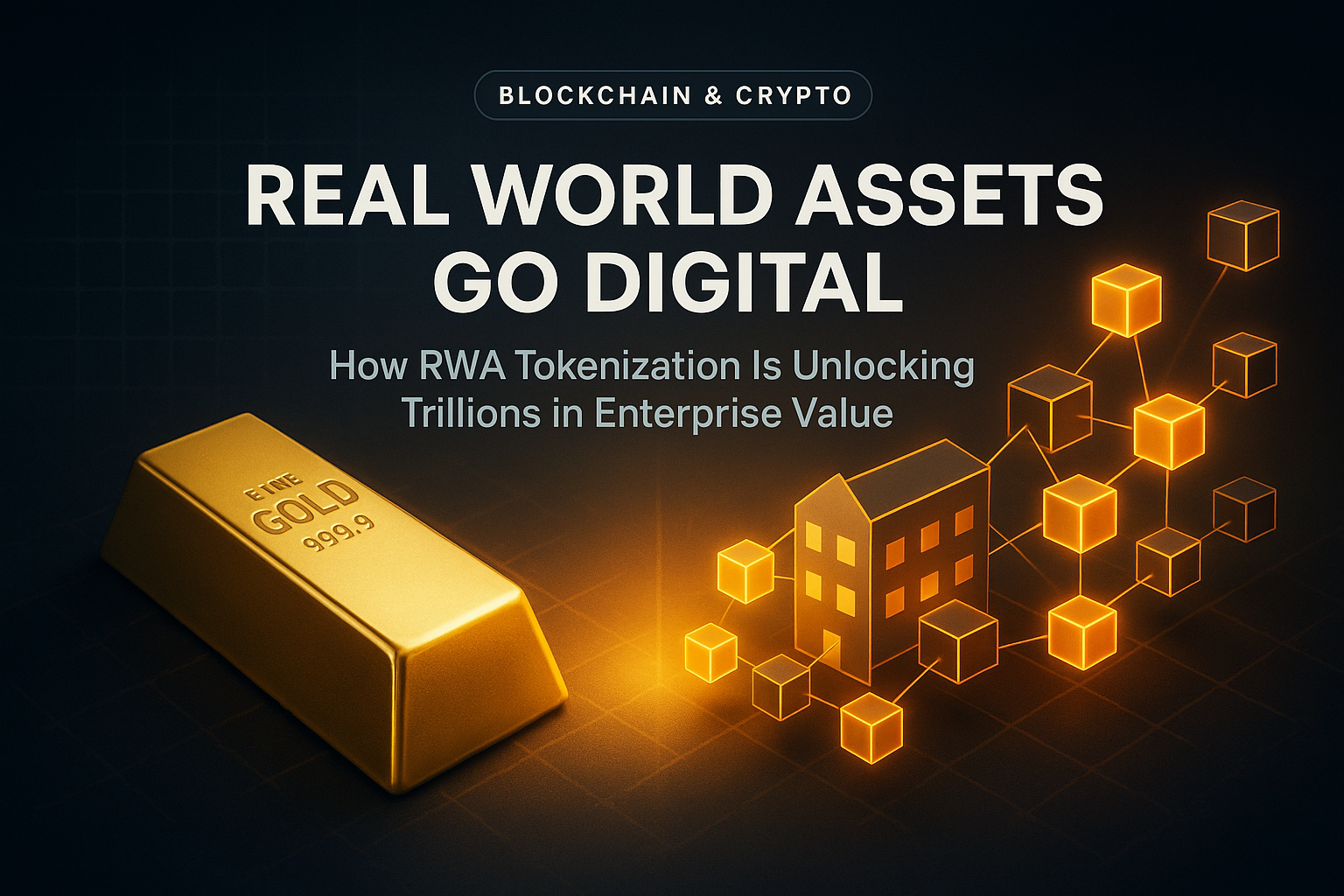
Real World Asset tokenization is the process of converting physical or financial assets into digital tokens on blockchain networks. These tokens represent fractional ownership or claims on tangible assets: a warehouse, a Treasury bond, a barrel of oil, or an invoice. Each token is secured by smart contracts and recorded on an immutable ledger, making ownership transfers instant, transparent, and globally accessible.
Unlike cryptocurrency, which derives value from network effects and speculation, RWA tokens are backed by real economic value. A tokenized property worth $10 million becomes divisible into millions of tokens, allowing retail investors to own fractions of assets previously reserved for institutional capital. This democratization of access is reshaping capital markets.
Why RWA Tokenization Is Going Mainstream Now
The convergence of three critical factors has accelerated RWA adoption in 2026:
Institutional Validation & Regulatory Clarity
Regulators worldwide have begun establishing clear frameworks for tokenized assets. The U.S. SEC, EU regulators, and Singapore’s Monetary Authority have issued guidance that treats RWA tokens as securities (when applicable) rather than unregulated cryptocurrencies. This clarity has unlocked billions in institutional capital. According to industry analysts, major asset managers including BlackRock, Fidelity, and Vanguard have quietly launched tokenization initiatives, signaling confidence in the technology’s viability.
Enterprise Blockchain Maturity
Platforms like Ethereum, Polygon, and enterprise-focused networks have achieved the scalability, security, and settlement speed required for high-value asset transactions. Layer 2 solutions have reduced transaction costs by 95%, making it economically viable to tokenize mid-market assets. Smart contract auditing and insurance products have also eliminated much of the technical risk that plagued early DeFi protocols.
Supply Chain & Liquidity Pressure
Trillions of dollars sit locked in illiquid assets—commercial real estate, infrastructure projects, fine art, commodities. Traditional finance offers limited mechanisms to unlock this value. Tokenization creates 24/7 global liquidity pools where a property owner in Dubai can instantly access capital from investors in Tokyo. This efficiency is driving demand from both asset owners and investors.
Real-World Use Cases Gaining Traction
Commercial Real Estate Tokenization
Real estate platforms have emerged as the leading RWA vertical. Companies are tokenizing office buildings, warehouses, and residential portfolios, allowing fractional ownership starting at $1,000 minimums. A landmark 2024-2025 initiative saw over $2 billion in commercial real estate tokenized globally, with strong pipeline growth into 2026. Investors gain instant settlement, transparent valuations, and the ability to diversify across geographies without traditional real estate transaction friction.
Fixed Income & Treasury Tokens
Financial institutions are tokenizing bonds, Treasury securities, and structured products. The advantages are compelling: instant settlement (T+0 instead of T+2), reduced custody costs, and programmable payments. Several central banks are experimenting with tokenized government bonds as part of broader central bank digital currency (CBDC) infrastructure.
Supply Chain & Commodity Tokenization
Agricultural commodities, metals, and energy products are being tokenized to create transparent, efficient supply chains. A barrel of oil or ton of wheat can now be instantly verified, transferred, and financed on-chain, reducing intermediaries and settlement times from weeks to minutes.
The Business Case: Why Institutions Are Moving Fast
For asset managers and financial institutions, RWA tokenization delivers measurable ROI:
- Lower custody and settlement costs (30-50% reduction in operational expenses)
- Expanded addressable markets (fractional ownership attracts retail capital previously locked out of institutional deals)
- 24/7 trading and global reach (assets no longer bound by market hours or geography)
- Programmable automation (interest payments, dividends, and redemptions execute automatically via smart contracts)
According to McKinsey research from 2025, institutions estimate RWA tokenization could unlock $2-4 trillion in economic value over the next five years by improving capital efficiency and expanding market access.
Challenges & Regulatory Headwinds
Despite momentum, significant hurdles remain. Regulatory fragmentation across jurisdictions creates compliance complexity. Custody standards for tokenized assets are still evolving. Interoperability between blockchain networks and legacy financial infrastructure remains technically challenging. Additionally, price volatility in underlying blockchains (if assets are denominated in volatile tokens) requires hedging mechanisms that add cost.
However, these are engineering and policy problems—not fundamental flaws. The industry is solving them rapidly through standardization efforts, custody partnerships with traditional banks, and bridge protocols connecting blockchain and legacy systems.
The 2026 Inflection Point
We’re witnessing the transition from early adopter to early majority phases. Enterprise adoption is accelerating because the value proposition is now undeniable: real assets, real returns, real utility. Unlike past blockchain hype cycles, RWA tokenization solves genuine problems for genuine stakeholders—asset owners, investors, and financial institutions.
By late 2026, expect to see major financial institutions announce tokenization initiatives publicly (many already have quietly). Expect regulatory frameworks to solidify in major markets. And expect the total value of tokenized real-world assets to exceed $5+ billion, with projections for $100+ billion by 2030.
The Question Every Investor Should Ask
As RWA tokenization transitions from innovation to infrastructure, the question shifts from “Will this work?” to “Which assets and platforms will capture the most value?” The winners will be platforms that solve custody, interoperability, and regulatory compliance at scale. The real opportunity isn’t in speculative tokens—it’s in the boring, essential infrastructure that makes global asset ownership frictionless.
Are you positioned to capitalize on the $2-4 trillion opportunity in tokenized real-world assets? The infrastructure is here. The regulatory framework is solidifying. The only question is timing.
—
**📖 Recommended Sources:**
– McKinsey Global Institute – “Blockchain and Decentralized Finance: A Primer” (2024-2025 research on RWA market potential)
– CoinDesk & CoinTelegraph – Real-time coverage of RWA platform launches and institutional adoption milestones
– Ethereum Foundation & Layer 2 Documentation – Technical specifications for scalable asset tokenization infrastructure
– SEC & EU Financial Regulation Updates – Regulatory frameworks for tokenized securities and asset-backed tokens
**ⓘ This content is AI-generated based on training data through January 2026 and industry research. Market figures and institutional adoption timelines should be verified against current sources. Please consult official regulatory guidance and conduct independent due diligence before making investment decisions.**