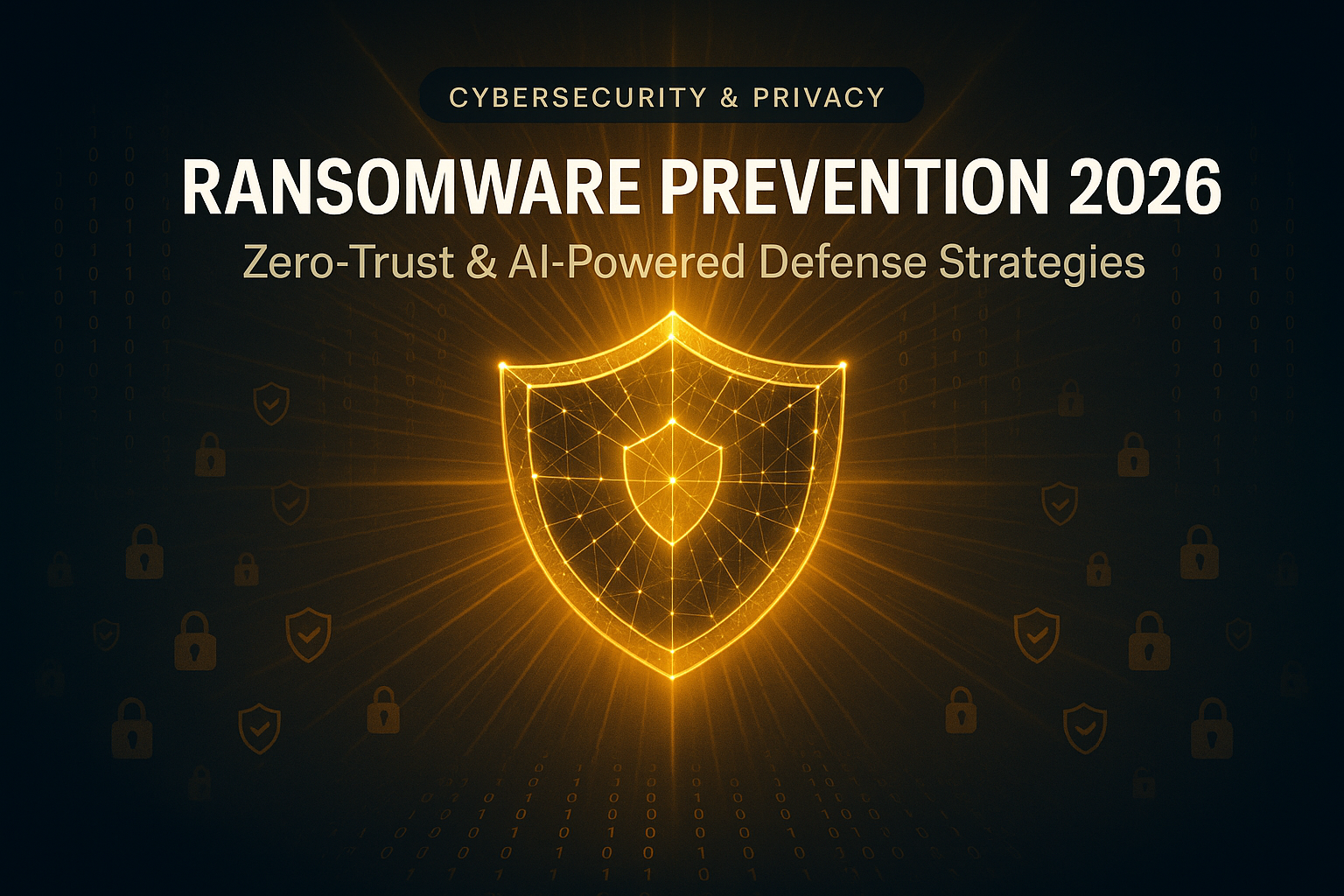
# Ransomware Attack Prevention 2026: Zero-Trust Architecture and AI-Powered Defense Strategies
The ransomware threat landscape has evolved dramatically, with attackers deploying increasingly sophisticated techniques that bypass traditional perimeter defenses. In 2026, organizations are shifting from reactive incident response to proactive, layered prevention strategies that fundamentally change how security teams approach threat mitigation.
The Evolving Ransomware Threat Landscape
Ransomware attacks have become more targeted and destructive. Unlike early iterations that relied on mass distribution, modern ransomware campaigns often combine multi-stage exploitation, data exfiltration, and double-extortion tactics—threatening both operational disruption and public disclosure of sensitive information.
The complexity of these attacks demands a fundamental rethinking of defense strategies. Organizations can no longer rely solely on signature-based detection or network perimeter controls. Instead, security leaders are implementing defense-in-depth architectures that assume breach scenarios and focus on rapid detection and containment.
Zero-Trust Architecture: The Foundation of Modern Prevention
Zero-trust security has become the gold standard for ransomware prevention. Rather than trusting users, devices, or networks based on their location, zero-trust models require continuous authentication and authorization for every access request—regardless of whether the request originates from inside or outside the network.
Key components of zero-trust ransomware prevention include:
- Microsegmentation: Dividing the network into smaller zones to prevent lateral movement after initial compromise
- Continuous verification: Implementing multi-factor authentication (MFA) and behavioral analytics across all access points
- Least-privilege access: Ensuring users and systems have only the minimum permissions required for their function
- Encrypted data protection: Implementing encryption at rest and in transit to limit data exfiltration impact
Organizations adopting zero-trust frameworks report significantly reduced dwell time for attackers—the period between initial breach and detection—making it harder for ransomware operators to establish persistence and execute large-scale encryption campaigns.
AI and Machine Learning: Intelligent Threat Detection
Artificial intelligence and machine learning are transforming ransomware detection from reactive to predictive. AI-powered security solutions analyze behavioral patterns across millions of endpoints, identifying anomalies that human analysts would miss.
Modern AI-driven approaches include:
- Behavioral analysis: Detecting unusual file access patterns, encryption operations, or mass data movement indicative of ransomware activity
- Threat intelligence automation: Processing global threat feeds to identify emerging attack signatures and tactics
- Endpoint detection and response (EDR): Using machine learning to correlate suspicious activities across the endpoint ecosystem and trigger automated containment
- Predictive vulnerability assessment: Identifying which systems are most likely to be targeted based on historical attack patterns
According to industry cybersecurity frameworks, organizations leveraging AI-powered detection capabilities reduce time-to-detection from hours to minutes, dramatically limiting the scope of potential encryption and data theft.
Endpoint Hardening and Immutable Backups
Endpoint security remains critical, but 2026 approaches go beyond traditional antivirus. Advanced endpoint hardening includes:
- Application whitelisting: Restricting execution to known, trusted applications to prevent malicious code from running
- Exploit prevention: Using kernel-level protections to block code injection and privilege escalation techniques
- Ransomware-specific behavioral blocking: Detecting and terminating processes that exhibit encryption or file-locking behaviors
Equally important is immutable backup infrastructure. Even with strong prevention controls, backups serve as the ultimate recovery mechanism. Immutable backups—stored on isolated, air-gapped systems with write-once properties—cannot be encrypted or deleted by attackers, enabling organizations to restore operations without paying ransoms.
Incident Response and Recovery Readiness
Prevention alone is insufficient. Organizations must combine technical controls with robust incident response planning and recovery capabilities. This includes:
- Regular tabletop exercises simulating ransomware scenarios
- Pre-established communication protocols with stakeholders and law enforcement
- Documented recovery procedures for critical systems
- Cyber insurance policies aligned with current threat sophistication
Future Outlook: Convergence of Security Disciplines
The future of ransomware prevention lies in the convergence of IT security, OT (operational technology) security, and data protection. As attackers target supply chains and interconnected systems, organizations will need integrated defense strategies that protect not only enterprise networks but also manufacturing systems, cloud infrastructure, and third-party ecosystems.
Additionally, regulatory frameworks like NIST Cybersecurity Framework and emerging standards will likely mandate zero-trust implementations and advanced threat detection capabilities, making these practices industry baselines rather than competitive advantages.
Conclusion: Defense as a Strategic Imperative
Ransomware prevention in 2026 is no longer a technical checkbox—it’s a strategic business imperative requiring investment in people, processes, and technology. Organizations that combine zero-trust architecture, AI-powered detection, endpoint hardening, and immutable backups create resilient defenses that make them unattractive targets.
The question for security leaders is no longer if they will implement these strategies, but how quickly they can execute them. How is your organization approaching ransomware prevention—and what gaps exist in your current defense posture?
—
📖 **Recommended Sources:**
– **NIST Cybersecurity Framework** – Foundational guidance for zero-trust architecture and ransomware mitigation strategies
– **Gartner’s Ransomware Prevention Research** – Industry analysis on detection technologies and defense best practices
– **CrowdStrike and Microsoft Security Research Reports** – Real-world threat intelligence and emerging attack patterns in 2025-2026
– **CISA (Cybersecurity & Infrastructure Security Agency)** – Government guidance on ransomware prevention and incident response
⚠️ **Note:** This content is based on established cybersecurity principles and industry best practices through early 2026. For the most current threat intelligence and vendor-specific recommendations, consult your security team and official CISA advisories.