# Metaverse Enterprise Virtual Workspaces: From Hype to Everyday Business Reality in 2026
The metaverse has shed its sci-fi reputation and entered the corporate boardroom. In 2026, virtual workspaces are no longer experimental VR novelties—they’re practical business tools transforming how enterprises collaborate, train, and innovate.
The Shift from Hype to Practical Implementation
Enterprise adoption of metaverse technologies has reached an inflection point. Where 2023-2024 saw flashy virtual experiences and experimental pilots, 2026 marks the year immersive workspaces became mission-critical infrastructure for forward-thinking organizations.
According to industry analysis, companies are now moving past proof-of-concept phases and deploying persistent virtual workspaces that rival or exceed traditional video conferencing in engagement and productivity. The focus has shifted from novelty to tangible business outcomes: improved collaboration, reduced travel costs, enhanced employee retention, and accelerated onboarding.
This transition reflects a fundamental change in how enterprises perceive immersive technology. Rather than asking “Can we build this?”, leaders are now asking “How do we scale this?” The infrastructure, platforms, and talent ecosystems have matured enough to support enterprise-grade deployments.
Key Enterprise Use Cases Driving Adoption
Distributed Team Collaboration
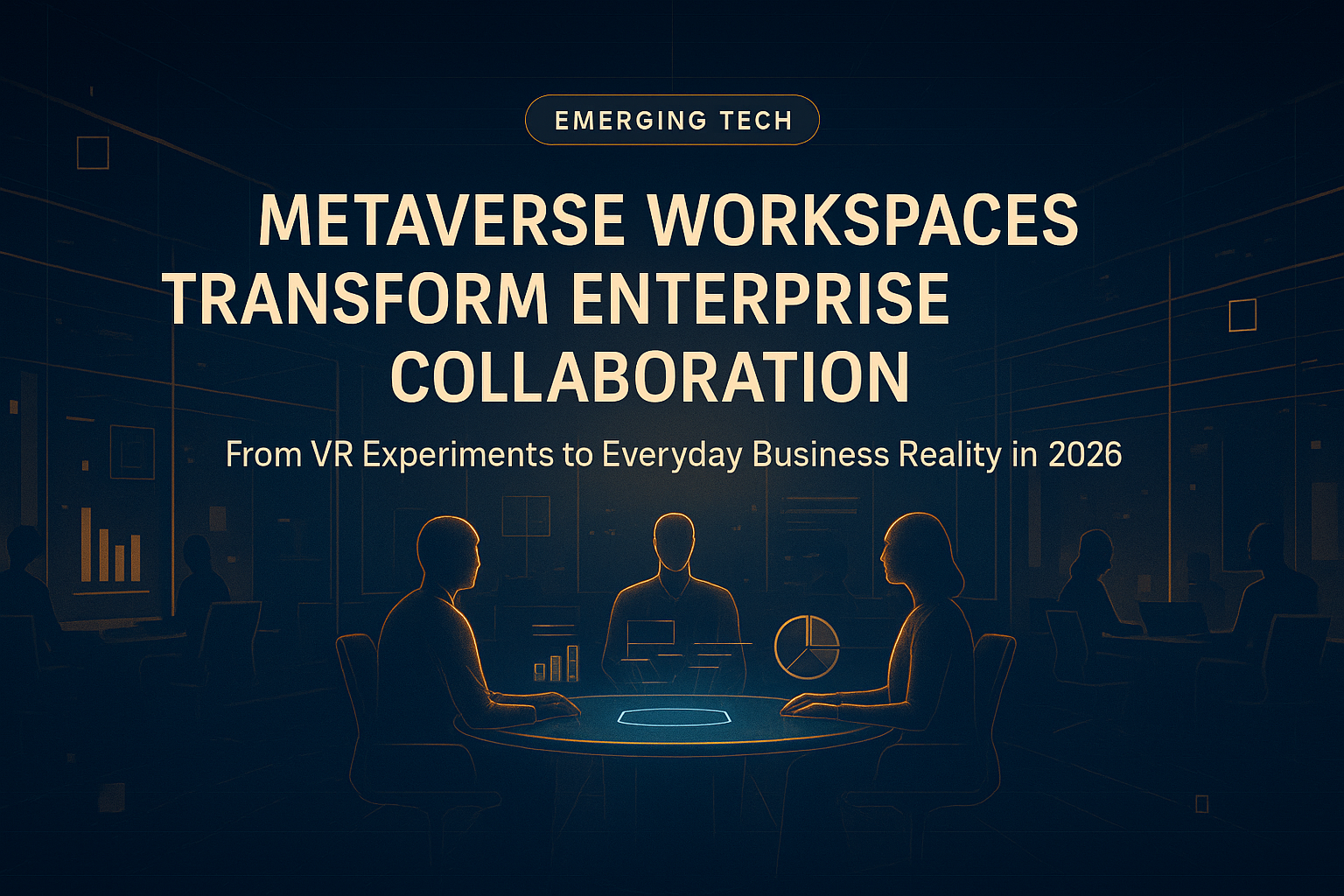
Remote and hybrid workforces benefit most from immersive environments. Virtual workspaces create a sense of physical presence that traditional video calls cannot replicate. Team members across continents can gather in shared digital spaces, reducing the isolation of remote work while maintaining asynchronous flexibility.
Immersive Training and Onboarding
New employees can now experience realistic, interactive training scenarios in virtual environments. Manufacturing companies use immersive simulations for equipment training. Financial services firms deploy VR scenarios for compliance and risk management. The retention of knowledge in immersive settings significantly outperforms traditional e-learning.
Design and Engineering Collaboration
Product teams benefit from virtual workspaces where 3D models, prototypes, and technical data can be manipulated in real-time by distributed teams. Architects, engineers, and designers can collaborate on complex projects without physical co-location, accelerating time-to-market.
Client Presentations and Immersive Experiences
Forward-thinking enterprises use virtual workspaces to deliver client presentations in immersive environments. Rather than static slides, clients experience interactive, spatial presentations that enhance engagement and differentiate offerings in competitive markets.
Technology Platforms Leading the Market
Microsoft Mesh for Teams exemplifies enterprise-grade metaverse integration. By embedding immersive collaboration directly into Microsoft Teams—the platform millions already use daily—Microsoft has lowered the barrier to adoption. Users can join virtual meetings with spatial presence, collaborate on shared content, and maintain productivity workflows without learning entirely new systems.
Other platforms are similarly focused on seamless integration with existing enterprise software stacks rather than requiring wholesale platform migrations. This pragmatic approach has accelerated adoption among risk-averse enterprises.
Virtual reality workplace collaboration vendors are competing on ease of use, integration depth, and ROI metrics. The winners in 2026 are those demonstrating clear productivity gains and cost savings, not those chasing flashy features.
Breaking Down Barriers: Accessibility and Adoption
One critical shift in 2026: hardware accessibility is no longer a blocker. While premium VR headsets remain available, enterprises increasingly deploy hybrid experiences accessible via standard devices—laptops, tablets, and even smartphones. This democratization means employees don’t require expensive equipment to participate in immersive workspaces.
Additionally, avatar customization and privacy controls have matured, addressing early concerns about surveillance and employee comfort. Companies are implementing flexible participation options: some employees join with full-body avatars, others via video feeds or 2D representations. This flexibility encourages broader adoption.
The Business Case in 2026
The return on investment for enterprise virtual workspaces is now demonstrable. Companies report:
- Reduced travel costs through immersive alternatives to in-person meetings
- Faster onboarding cycles enabled by immersive training
- Improved employee engagement and reduced turnover in hybrid environments
- Accelerated project timelines through enhanced spatial collaboration
- Competitive differentiation in talent recruitment and client experience
These metrics are moving enterprise metaverse investments from “innovation budgets” into core operational spending.
Looking Ahead: The Next Evolution
By 2026, the metaverse enterprise conversation has matured beyond “Will this happen?” to “How do we scale this responsibly?” Companies are investing in persistent, branded virtual spaces that reflect organizational culture and values. The next phase will see deeper integration with AI, advanced analytics on collaboration patterns, and standardization of interoperability across platforms.
The enterprises leading in 2026 are those treating virtual workspaces as strategic infrastructure, not experimental sidelines. They’re training teams, building governance frameworks, and measuring outcomes with the same rigor they apply to traditional IT investments.
The Verdict
Metaverse enterprise virtual workspaces have transitioned from speculative technology to practical business reality. The question is no longer whether immersive collaboration will reshape enterprise work—it’s how quickly your organization can adopt and scale these tools to remain competitive.
As your teams become increasingly distributed and clients demand richer engagement experiences, how will your organization leverage immersive workspaces to drive competitive advantage?
—
📖 **Recommended Sources:**
– **Industry Research on Metaverse Adoption (2026)** – Tracking enterprise deployment trends, ROI metrics, and platform maturity assessments
– **Microsoft Mesh for Teams Documentation** – Official enterprise immersive collaboration platform integration and case studies
– **Metaverse Development Companies Analysis** – Vendor landscape and platform comparison for enterprise virtual workspaces
ⓘ This content is AI-generated based on research through March 2026. Please verify specific adoption statistics and platform capabilities with vendors directly for current implementations.