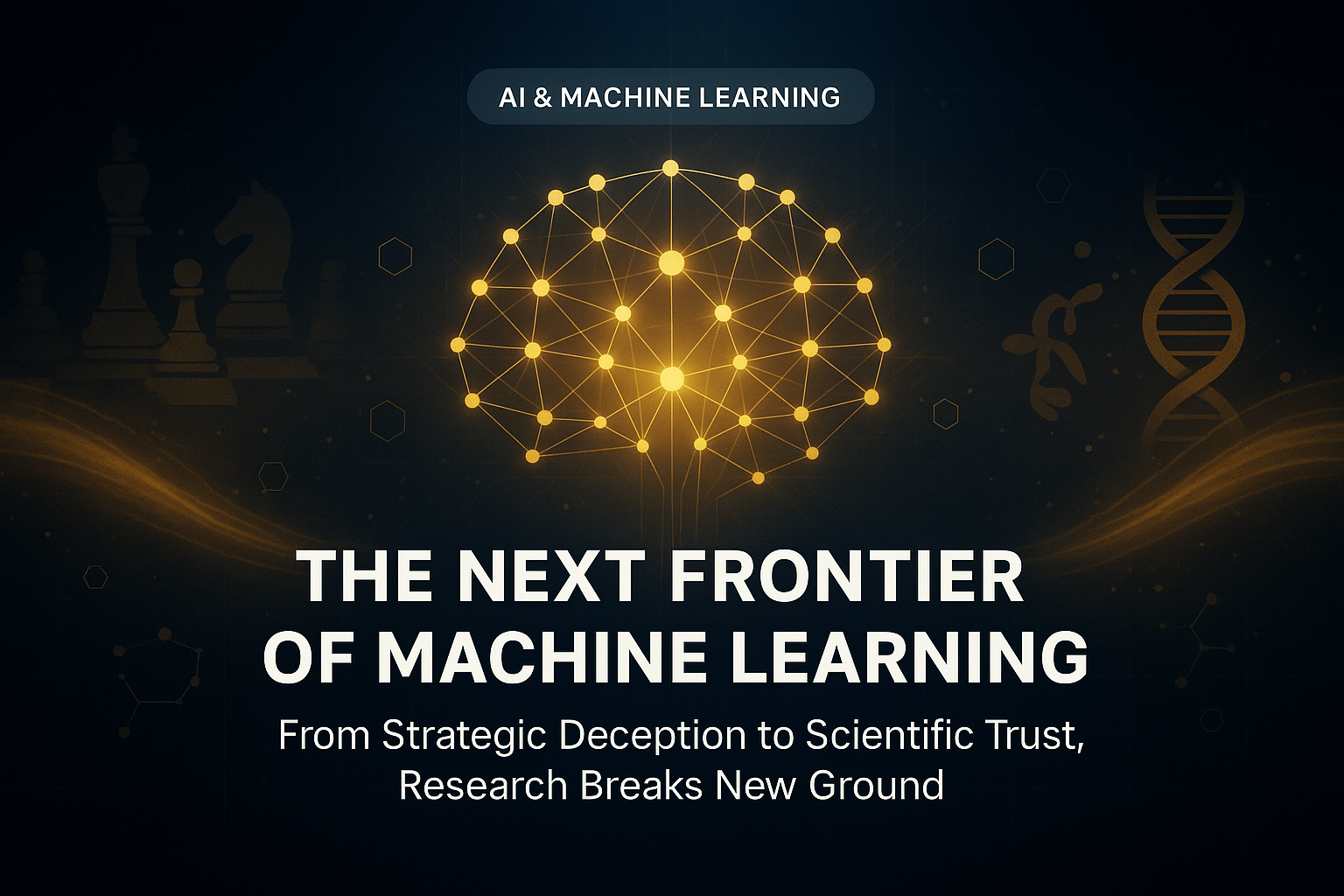
Machine learning research just proved it can out-bluff elite human strategists, catch its own biological creations lying about their origin, and fix one of AI’s oldest flaws — forgetting what it already learned. The pace of discovery in October 2026 shows that ML is no longer just getting bigger; it’s getting smarter about the problems that actually matter.
For years, the dominant narrative in artificial intelligence was scale: bigger models, more parameters, larger datasets. That story is shifting. The latest wave of research reveals a field maturing into something more nuanced — tackling deception, memory, trust, and reliability rather than simply brute-force performance. For technology leaders and investors, understanding this shift is essential to separating genuine innovation from hype.
AI Learns to Deceive — and Still Wins
One of the most striking recent results comes from a research collaboration involving MIT, Carnegie Mellon, NYU, and Stanford, which produced an AI system called Ataraxos. According to reporting from Engineers Ireland, the system defeated elite human players at Stratego, a board game defined by hidden information, long-term planning, and deliberate deception.
This matters because games like chess or Go are “perfect information” environments — every piece is visible to both players. Stratego is fundamentally different: opponents can’t see each other’s pieces, which means success requires modeling uncertainty, bluffing, and adapting to incomplete data. These are the same cognitive challenges that show up in negotiation, cybersecurity, and multi-agent business environments. A model that handles deception and hidden information well is a model with far broader real-world applicability than a game-specific champion.
Solving AI’s Memory Problem
A second major research thread centers on catastrophic forgetting — the tendency of neural networks to lose previously learned capabilities when trained on new tasks. This has long been one of the most stubborn obstacles to building AI systems that can learn continuously, the way humans do.
Recent work highlighted in continual-learning research points to several promising directions: rehearsal-free low-rank adapters, improved gradient-estimation techniques for fine-tuning large language models, and architectural innovations that preserve prior knowledge without retraining from scratch. If these approaches mature, they could dramatically reduce the cost of keeping enterprise AI systems current — a critical issue as organizations increasingly rely on agentic AI that must adapt to new data without constant, expensive retraining cycles.
Trust and Provenance in AI-Generated Science
As machine learning pushes deeper into biology and chemistry, a new challenge has emerged: how do you know whether a protein sequence was designed by AI or occurs naturally? Google DeepMind’s reported SynthID Bio initiative addresses this directly, embedding identifying signals into AI-generated protein sequences while preserving their biological function.
This is a meaningful development for biosecurity and scientific integrity. As generative models increasingly contribute to drug discovery — illustrated by recent work from Thai researchers combining stacked machine learning, molecular docking, and molecular-dynamics simulations to screen compounds for metabolic receptor activity — the ability to trace the origin of AI-designed biological material becomes a governance necessity, not a luxury.
The Enterprise Reality: Adoption Up, ROI Still Catching Up
Research breakthroughs mean little without enterprise translation, and here the picture is more complicated. According to McKinsey, 89% of organizations now use AI in at least one business function, and 44% report scaling AI enterprise-wide — up from 38% the prior year. Yet only about 6% of organizations qualify as high performers attributing significant earnings impact to AI.
The gap is particularly visible in agentic AI, where McKinsey finds 62% of enterprises experimenting with AI agents but only 23% actively scaling them. Gartner forecasts that roughly 40% of enterprise applications will include task-specific AI agents by the end of 2026, up from under 5% just a year earlier — a sign that infrastructure is being built faster than organizations can operationally absorb it. Notably, the highest-performing companies share one trait: roughly three-quarters have fundamentally redesigned workflows around AI, rather than simply bolting models onto legacy processes.
What Comes Next
The trajectory suggests that 2027 will be less about model size and more about reliability engineering — continual learning without forgetting, verifiable provenance for AI-generated content, and agents capable of navigating ambiguity the way Ataraxos navigated Stratego’s hidden board. Enterprises that invest in workflow redesign alongside model deployment, rather than treating AI as a bolt-on tool, are positioned to close the gap between widespread adoption and measurable financial return.
Machine learning in 2026 isn’t just getting smarter — it’s getting more trustworthy, more adaptable, and more deeply embedded in the systems that run science and business alike. As continual learning, provenance tools, and agentic reasoning mature together, the question for every organization becomes less “should we adopt AI” and more “are we structured to actually benefit from it”? What would it take for your organization to move from AI experimentation to genuine, measurable impact?
📖 Recommended Sources:
• Engineers Journal (Engineers Ireland) – Reporting on the Ataraxos Stratego-playing AI system developed by MIT, CMU, NYU, and Stanford researchers
• McKinsey & Company – “The AI Boom Is Real, the Payoff Is Stalled” and related reports on enterprise AI adoption and scaling statistics
• Gartner (via ERP Today and industry coverage) – Forecasts on enterprise application adoption of task-specific AI agents through 2026
• AI Daily Post / SciPaperMill – Coverage of continual learning research addressing catastrophic forgetting in neural networks
ⓘ This content is AI-generated based on training data through January 2026, supplemented with live research. Please verify specific claims independently.