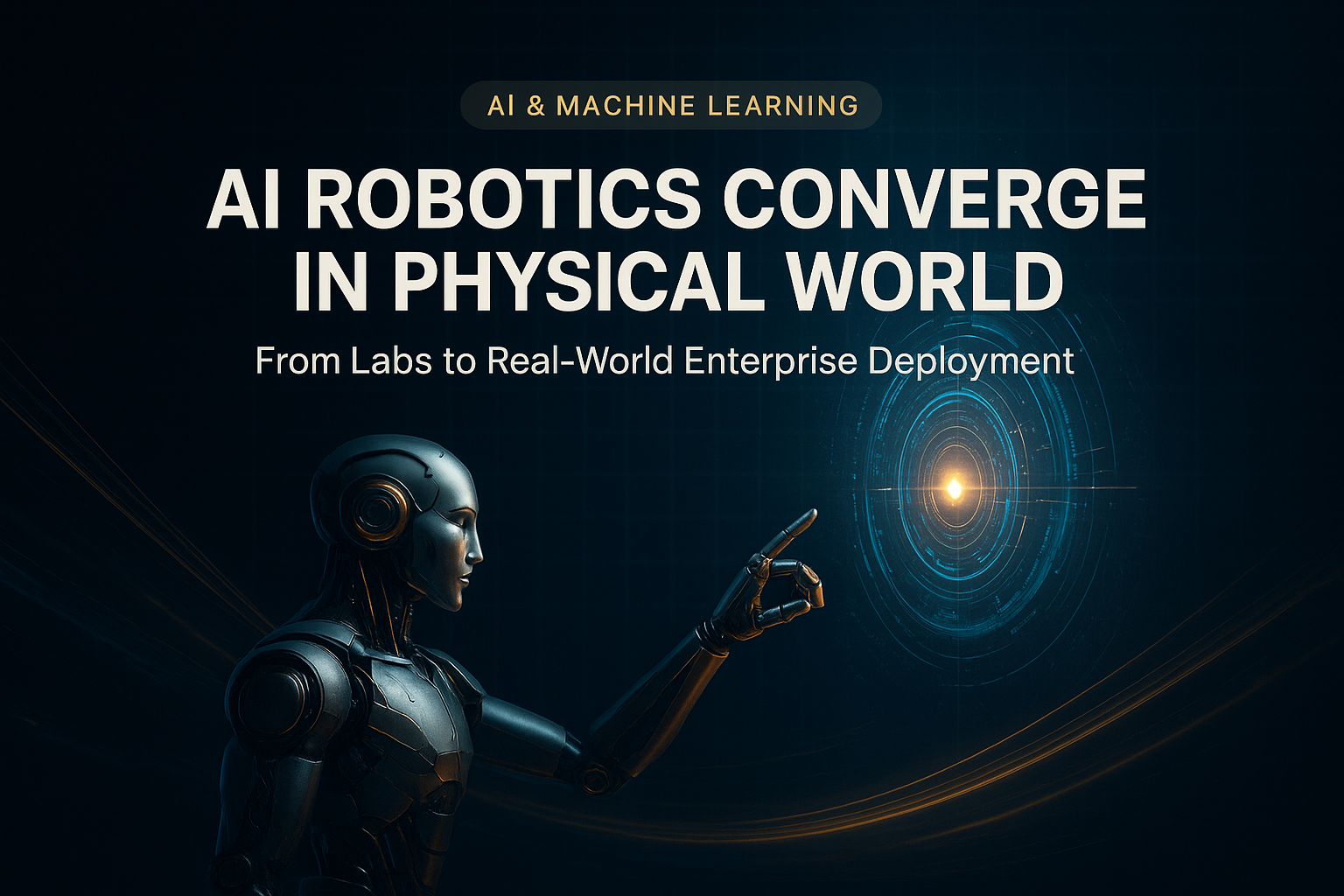
The Physical AI Revolution: Robotics and Intelligence Converge in 2026
The line between digital intelligence and physical capability is blurring faster than ever. Artificial intelligence is no longer confined to data centers and cloud servers—it’s moving into robots, manufacturing floors, and real-world environments where it must perceive, decide, and act in physical space. This convergence of AI and robotics represents one of the most significant technological shifts of 2026, with profound implications for manufacturing, logistics, healthcare, and enterprise operations.
Understanding the Convergence: What’s Happening Now
For decades, AI and robotics developed on largely separate tracks. Traditional robots followed pre-programmed instructions with limited adaptability, while AI systems processed data in isolated digital environments. The 2026 convergence represents a fundamental shift: robots are now being equipped with advanced AI models that enable them to perceive their environment, make real-time decisions, and adapt to unpredictable situations.
This isn’t merely incremental improvement—it’s a qualitative transformation. Modern embodied AI systems combine computer vision, large language models, and reinforcement learning to enable robots to understand context, learn from experience, and handle tasks that would have been impossible just a few years ago. A robot can now observe a manufacturing error, understand what went wrong, and adjust its approach without human intervention.
The enabling technologies include improved sensor fusion, edge computing capabilities that process AI models locally on robotic hardware, and large-scale pre-training on diverse physical tasks. Companies across industries are racing to deploy these systems because the competitive advantage is substantial.
Real-World Applications Driving Adoption
The theoretical promise of embodied AI is rapidly becoming operational reality. Manufacturing and logistics are leading the charge, with companies deploying AI-powered robots for assembly, quality control, parts handling, and warehouse automation. These systems can work alongside human workers, learning from demonstrations and adapting to production changes without extensive reprogramming.
Healthcare is another frontier. Surgical robots enhanced with AI can perform more precise procedures, and autonomous mobile robots equipped with vision and reasoning capabilities are being deployed in hospitals for material handling and disinfection. The ability for these robots to navigate complex, dynamic environments and make contextual decisions is transformative.
In supply chain and logistics, AI-powered autonomous systems are optimizing warehouse operations, reducing inefficiencies, and improving throughput. These aren’t simple automated systems—they’re learning systems that improve with scale and adapt to changing conditions.
Consumer-facing applications are also emerging. Delivery robots, service robots in retail and hospitality, and home automation systems are becoming increasingly sophisticated as AI integration deepens. The difference between a robot that follows fixed routes and one that can navigate dynamic environments, understand user intent, and respond intelligently is night and day.
The Technical Breakthroughs Enabling Convergence
Several technical advances converged in 2025–2026 to make this shift possible. Large vision-language models trained on billions of images and videos have given robots genuine visual understanding. These systems can recognize objects, understand spatial relationships, and even infer intent from context—capabilities that were pure science fiction a few years ago.
Edge AI deployment has improved dramatically. Processing AI models directly on robotic hardware, rather than relying on cloud connectivity, enables real-time decision-making and reduces latency to near-zero. This is critical for safety-sensitive applications and environments where network connectivity is unreliable.
Simulation and synthetic data have accelerated training timelines. Robots can now be trained in virtual environments and transfer learned behaviors to physical systems with high fidelity. This dramatically reduces the time and cost of developing new robotic capabilities.
Improved hardware including better sensors, faster processors, and more efficient power systems have made embodied AI economically viable at scale. The cost-per-unit is declining while performance is rising—the classic trajectory of transformative technologies.
Industry Impact and Market Implications
The convergence of AI and robotics is reshaping competitive dynamics across industries. Companies that successfully integrate embodied AI into their operations are gaining measurable advantages in productivity, quality, and operational flexibility. This creates strong incentives for rapid adoption, particularly in labor-constrained markets and high-value manufacturing.
The global robotics market is responding accordingly. Investment in AI-enhanced robotic systems has accelerated, with both established industrial automation companies and innovative startups competing to capture market share. The convergence is also driving consolidation, as companies seek to combine AI expertise with robotics hardware and integration capabilities.
Workforce implications are significant but nuanced. Rather than simple job displacement, we’re seeing job transformation. Workers increasingly supervise and collaborate with robots rather than perform routine tasks. The demand for skilled technicians, roboticists, and AI specialists is strong and growing.
Challenges and Considerations
Despite rapid progress, significant challenges remain. Safety and liability in human-robot environments require robust standards and careful deployment. Data privacy becomes complex when robots operate in sensitive environments. Regulatory frameworks are still catching up to the pace of technological change.
There’s also the challenge of generalization. While AI-powered robots excel at specific, well-defined tasks, broader generalization across diverse environments and task types remains difficult. The most successful deployments tend to be in controlled or semi-controlled environments where the problem space is well-defined.
Cost remains a barrier for smaller organizations. While prices are declining, sophisticated embodied AI systems still represent significant capital investment, which can limit adoption to larger enterprises and well-funded operations.
Looking Ahead: The Physical AI Era
The convergence of AI and robotics is still in early stages, but the trajectory is clear. By 2027 and beyond, embodied AI will be the default expectation for new robotic systems rather than a premium feature. We’ll see deeper integration of AI reasoning into manufacturing processes, more autonomous systems operating in dynamic environments, and broader adoption across industries beyond manufacturing.
The companies and organizations that master this convergence—that develop the expertise to deploy, train, and optimize embodied AI systems—will have substantial competitive advantages. The race is on, and 2026 is proving to be an inflection point.
What aspects of AI-robotics convergence are most relevant to your industry? Are you preparing your organization for embodied AI integration, or waiting to see how the technology matures? The convergence is accelerating, and the window to gain early advantage is narrowing.
—
📖 **Recommended Sources:**
• **SerpAPI Research Database** – Current industry tracking and technology trend analysis across AI robotics convergence
• **Manufacturing and Logistics Industry Reports** – Real-world deployment data from leading robotics integrators and industrial automation companies
• **Enterprise AI Adoption Studies** – Case studies documenting embodied AI implementation in manufacturing, healthcare, and logistics sectors
ⓘ This content is AI-generated