# How AI and Biotechnology Convergence Is Revolutionizing Drug Discovery in 2026
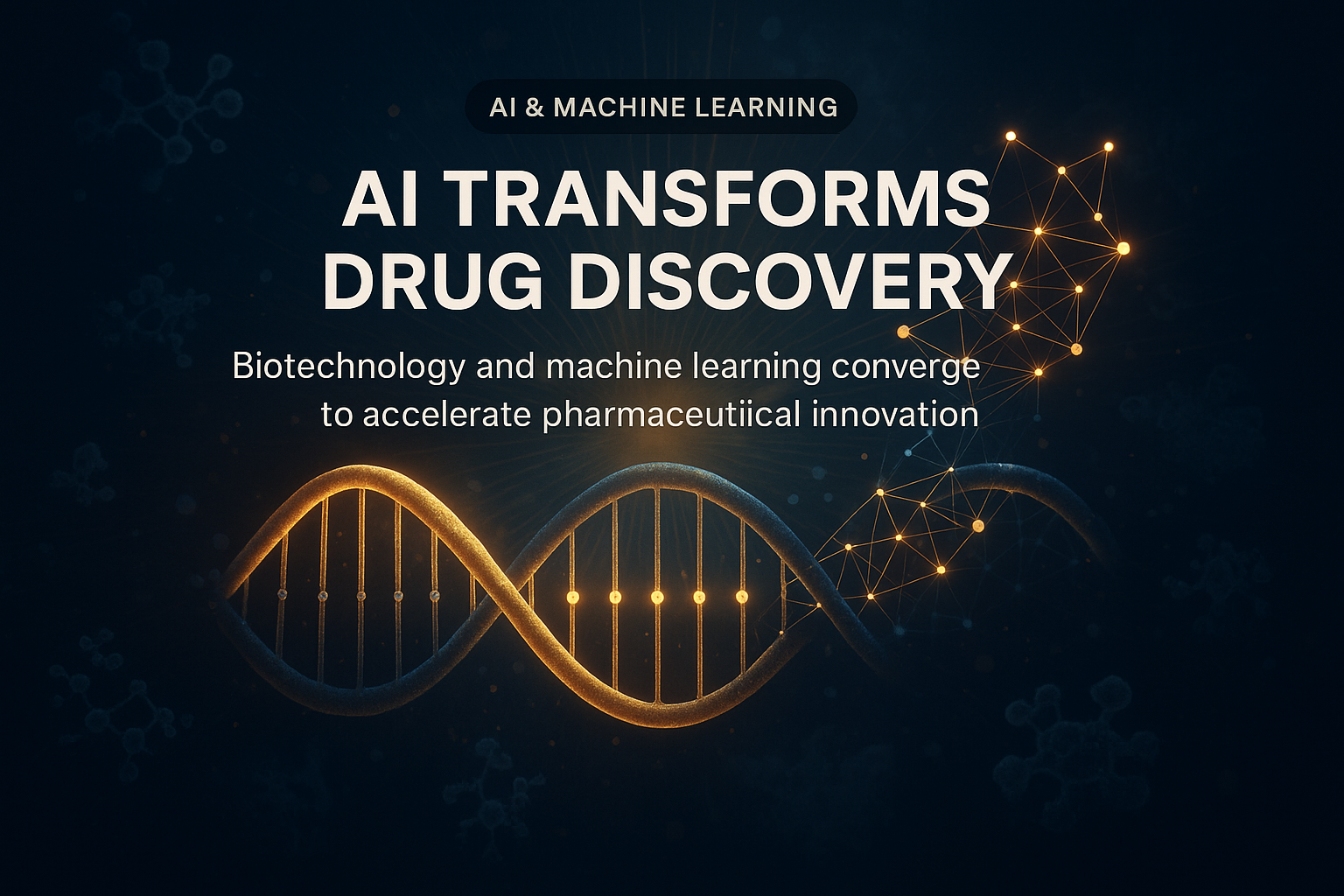
The pharmaceutical industry stands at an inflection point. Artificial intelligence and biotechnology are converging to fundamentally reshape how drugs are discovered, developed, and brought to market—and 2026 marks the pivotal year when this transformation moves from laboratory promise to clinical reality.
The Breakthrough That Changed Everything
The catalyst for this revolution was AlphaFold, DeepMind’s groundbreaking AI system that solved one of biology’s greatest challenges: predicting protein structure with unprecedented accuracy. For decades, determining how proteins fold into their three-dimensional shapes was a painstaking process that could take months or years. AlphaFold compressed this timeline to seconds, unlocking a fundamental bottleneck in drug discovery.
Now, with AlphaFold 3 delivering even greater precision in predicting biomolecular interactions, the pharmaceutical industry has gained a computational superpower. Understanding protein structures is essential because drugs work by binding to specific proteins and modulating their function. When you can predict protein behavior instantly, you accelerate the entire drug development pipeline.
AI Drug Discovery Enters Clinical Validation
As AI drug discovery enters 2026, the industry faces a pivotal transition: clinical testing, regulatory clarity, and market consolidation. This is no longer theoretical. Companies like Schrödinger are actively participating in industry summits—such as the AI Convergence: Small Molecule Drug Discovery Summit held in Boston in March 2026—where the focus has shifted from proof-of-concept to real-world pharmaceutical applications.
The convergence is producing tangible results. Machine learning models are now capable of:
- Predicting molecular binding affinities with high accuracy, reducing failed compounds before expensive lab synthesis
- Identifying novel drug targets by analyzing vast biological datasets that would be impossible for humans to process manually
- Optimizing drug candidates for efficacy, safety, and manufacturability simultaneously
- Accelerating lead compound discovery from years to months
These capabilities compress development timelines while simultaneously improving the probability of clinical success—a dual benefit that directly impacts pharmaceutical economics.
Industry Implications and Market Transformation
The biotechnology-AI convergence is reshaping competitive dynamics across the pharmaceutical sector. Traditional drug discovery relied on intuition, extensive screening, and serendipity. Today’s AI-driven approach is systematic, reproducible, and quantifiable.
This shift favors organizations that can effectively integrate AI capabilities into their R&D operations. Biotech startups with strong computational teams are competing directly with legacy pharmaceutical giants. Established companies are partnering with AI specialists or acquiring computational biology talent to remain competitive.
The impact extends beyond speed. Regenerative medicine and precision therapies—historically difficult to develop—are becoming more tractable. Horizon-scanning for 2026–2027 suggests that AI-designed therapies will enter trial networks at an accelerating pace, fundamentally expanding the therapeutic landscape.
The Regulatory and Investment Landscape
As AI-discovered drugs advance through clinical trials, regulatory frameworks are evolving to accommodate novel development approaches. The FDA and EMA are establishing guidelines for AI-assisted drug discovery, creating clarity for investors and developers alike.
This regulatory maturation is attracting significant capital. Venture funding for AI-driven biotech remains robust, and pharmaceutical companies are increasing their computational biology budgets. The market recognizes that AI competency is now a core competitive requirement, not a nice-to-have innovation lab experiment.
Looking Ahead: The Next Frontier
The convergence of AI and biotechnology is still in its early innings. Current applications focus on small-molecule drugs and protein structure prediction. Emerging frontiers include AI-designed biologics, personalized medicine at scale, and multi-target drug optimization.
The real transformative potential lies ahead: as AI systems become more sophisticated and integrate with real-time biological data, drug discovery will shift from sequential, linear processes to dynamic, adaptive systems that continuously learn and improve.
Conclusion
The biotechnology-AI convergence is no longer a future scenario—it’s the defining reality of pharmaceutical innovation in 2026. Organizations that embrace AI-augmented drug discovery are compressing timelines, reducing failure rates, and accessing therapeutic possibilities previously out of reach.
For investors, biotech professionals, and healthcare stakeholders, the question is no longer whether AI will transform drug discovery. It’s how quickly your organization can integrate these capabilities and capitalize on the opportunity.
What aspects of AI-driven drug discovery are most relevant to your organization’s strategy? Share your thoughts in the comments below.
—
📖 **Recommended Sources:**
• **DeepMind AlphaFold** – Breakthrough AI system for protein structure prediction; foundational technology enabling the biotech-AI convergence
• **Schrödinger AI Convergence Summit 2026** – Industry event highlighting practical applications of AI in small-molecule drug discovery and clinical development
• **Pharmaceutical Industry Reports (2026)** – Analysis of clinical validation timelines, regulatory frameworks, and market consolidation in AI-driven drug discovery
ⓘ This content is AI-generated based on research through March 2026. Please verify specific clinical trial data and regulatory guidance independently with official sources.