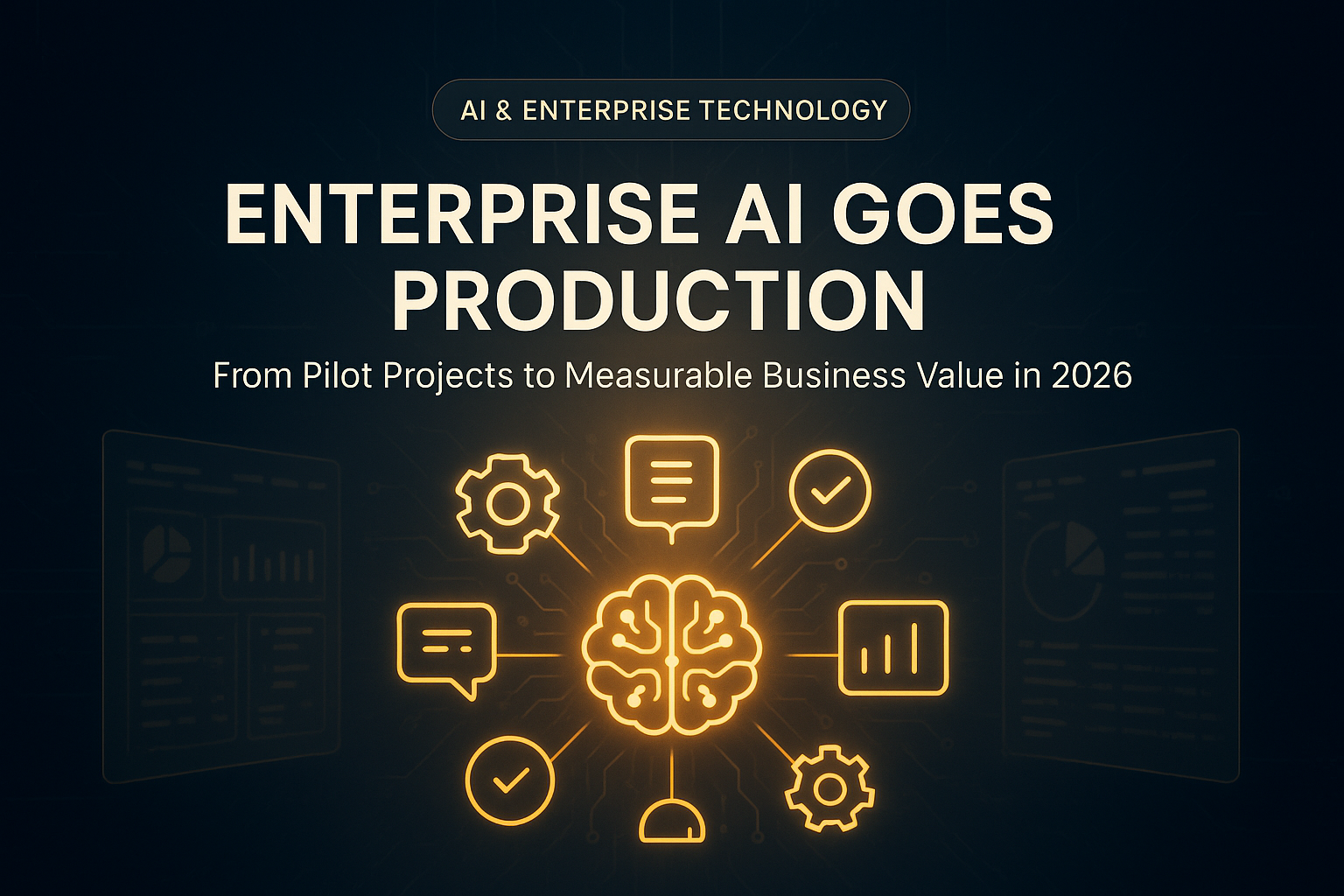
The era of generative AI as a sandbox experiment is over. In 2026, enterprises are being judged not by how many pilots they’ve launched, but by how much measurable value those pilots have actually delivered.
Generative AI has moved from novelty to infrastructure inside the modern enterprise. According to McKinsey’s ongoing research into AI adoption, roughly 88% of organizations now use AI in at least one business function — yet only about a third have managed to scale it across the enterprise. This gap between widespread experimentation and genuine transformation is the defining story of enterprise AI in late 2026, and it’s reshaping how CIOs, CFOs, and line-of-business leaders evaluate every new deployment.
The Shift from Chatbots to Autonomous Agents
The most consequential trend this year is the rise of agentic AI — systems that don’t just generate text but execute multi-step tasks across CRM, ERP, ITSM, and back-office platforms. Gartner forecasts that by 2026, 40% of enterprise applications will be integrated with task-specific AI agents, up from less than 5% just a few years earlier. Platforms like Microsoft’s Copilot Studio are explicitly being positioned as enterprise agent builders, enabling non-technical teams to assemble multi-model, extensible agents without engineering overhead.
This is a meaningful architectural shift. Where early generative AI deployments were largely conversational — a chatbot layered on top of existing software — the current wave embeds AI directly into workflow execution. Industry analysts estimate agentic AI already represents roughly 22% of total AI-generated enterprise value in 2026, a figure projected to climb toward 39% by 2030 as organizations mature beyond single-turn prompts into persistent, task-completing systems.
Where the Real Value Is Showing Up
Across industries, a handful of enterprise application areas are consistently delivering measurable returns:
- Customer service — context-aware support agents and automated case resolution, with cost reductions cited around 27% in service-heavy organizations
- Software engineering — code generation, automated testing, and incident response shortening development cycles
- Finance and operations — document extraction, reconciliation, and forecasting that reduce manual error and cycle time
- Knowledge management — retrieval-augmented enterprise search replacing fragmented internal documentation systems
- Marketing and sales — content generation and sales research tools boosting throughput and personalization at scale
Industry-specific automation in logistics, healthcare operations, and construction is reportedly producing direct cost reductions in the range of 20–35% in some deployments, according to recent enterprise-value studies. These aren’t marginal efficiency gains — they represent genuine operational transformation when workflows are redesigned around the technology rather than simply bolted on top of it.
The ROI Reality Check
Despite the optimism, the numbers reveal a sobering truth: adoption is dramatically outpacing proven return. A widely cited estimate suggests that roughly 95% of generative AI pilots fail to produce measurable P&L impact, and consultancy research from BearingPoint found that only 13% of organizations have scaled AI initiatives as originally planned, even though about three-quarters report some measurable revenue or cost benefit.
Bain’s research introduces a useful lens here — the “realization rate” — estimating that enterprises are currently capturing only about 38% of generative AI’s potential value across the processes they’ve measured. The gap isn’t about model quality; it’s about execution. According to a recent Wharton and GBK Collective study, companies that measure revenue growth alongside operational efficiency are nearly three times more likely to report strong ROI than those tracking efficiency metrics like “hours saved” in isolation.
What Separates Winners from the Pack
The organizations pulling ahead share a common discipline. They start with a specific, measurable business constraint — claims-processing time, software release velocity, forecast accuracy — rather than deploying AI for its own sake. They integrate deeply with systems of record instead of running AI as a bolt-on layer, and they insist on human review wherever the cost of error is high, particularly in finance, healthcare, and legal functions. Perhaps most importantly, top performers measure financial outcomes directly: gross margin impact, cost per transaction, first-contact resolution, and risk incidents — not just adoption rates or token volume. Leading organizations in this category are reportedly generating as much as $3.70 to $10 for every dollar invested in generative AI initiatives, according to recent enterprise benchmarking.
The Road Ahead
Looking toward 2027, the enterprise AI conversation will increasingly center on governance, orchestration, and trust rather than raw model capability. As agentic systems take on more autonomous responsibility across business-critical workflows, the winners will be organizations that pair ambitious automation with rigorous financial measurement and risk controls — treating AI not as a novelty layer, but as core infrastructure worthy of the same discipline applied to ERP or cloud migration a decade ago.
Generative AI enterprise applications in 2026 are no longer a question of if — they’re a question of how well. The technology is mature enough; the differentiator now is organizational discipline, workflow redesign, and a willingness to measure what actually matters. As your organization evaluates its next AI investment, the real question isn’t which model to choose — it’s whether you’re prepared to redesign the workflow around it. Where is your enterprise on that journey?
📖 Recommended Sources:
• McKinsey & Company – State of AI survey data on enterprise adoption, scaling rates, and EBIT impact
• Gartner – Forecasts on AI agent integration into enterprise applications and agentic AI hype cycle analysis
• Bain & Company – “Realization Rate” research on enterprise AI value capture
• BearingPoint / Wharton-GBK Collective studies – ROI measurement and AI scaling benchmarks
ⓘ This content is AI-generated based on training data through January 2026 and supplemented with live research. Please verify specific claims independently.