# Generative AI Enterprise Applications: From Pilot to Production-Scale Impact in 2026
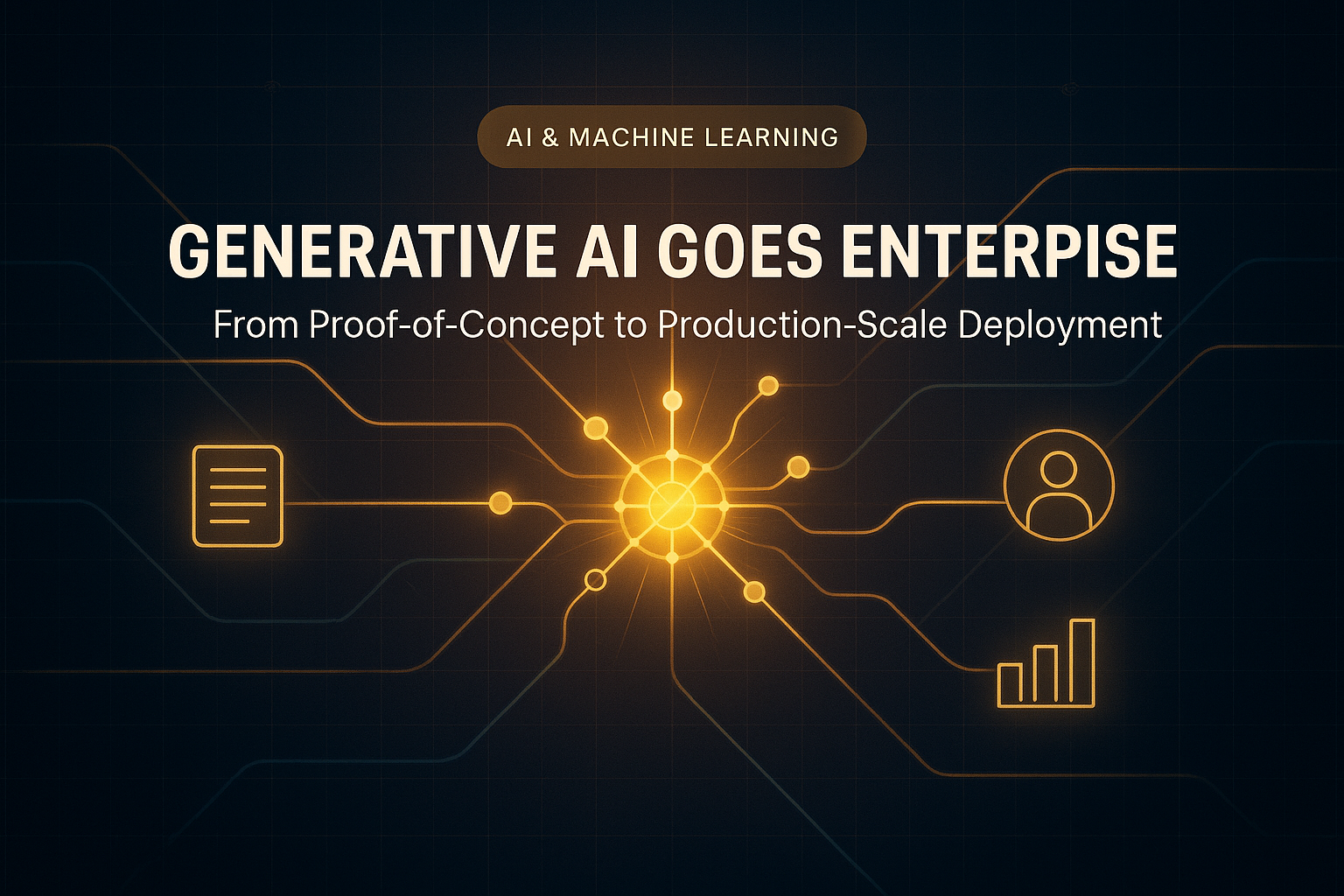
The era of generative AI experimentation in the enterprise is over. What began as ChatGPT proof-of-concepts and internal hackathons has evolved into mission-critical systems driving measurable business value across Fortune 500 companies, mid-market enterprises, and ambitious startups alike.
The Maturation of Enterprise Generative AI
By early 2026, generative AI has transitioned from novelty to necessity for competitive enterprises. Organizations are no longer asking “Should we use AI?” but rather “How do we scale AI safely and effectively across our operations?” This fundamental shift reflects both the technology’s proven capabilities and the growing urgency to capture productivity gains before competitors do.
The deployment landscape has matured significantly. Rather than isolated experiments, enterprises are now building integrated AI platforms that connect multiple generative models—both large language models (LLMs) and specialized models for code, images, and domain-specific tasks—into cohesive workflows. According to industry analysts, enterprise adoption of generative AI has accelerated dramatically, with organizations moving from pilot projects to production deployments at unprecedented speed.
Key Enterprise Applications Driving Value
Customer Service and Support Automation remains the most widely deployed generative AI use case. Organizations are deploying AI-powered chatbots and support agents that handle routine inquiries, technical troubleshooting, and knowledge base searches with human-level accuracy. These systems reduce support ticket volume by 30-40% while improving first-contact resolution rates. Unlike earlier rule-based chatbots, modern generative AI support agents understand context, handle nuance, and escalate appropriately to human specialists when needed.
Knowledge Work Acceleration is emerging as the highest-ROI application for many enterprises. Generative AI is augmenting workers across legal, financial, HR, and consulting functions—automating contract analysis, financial report generation, employee onboarding documentation, and research synthesis. A significant portion of the workforce now uses AI-assisted tools daily, with productivity gains ranging from 15-25% in knowledge-intensive roles. The key to success is treating AI as a co-pilot, not a replacement, with humans retaining control over high-stakes decisions.
Code Generation and Software Development has become a standard part of the developer workflow. Generative AI tools assist with code completion, bug detection, documentation generation, and architectural design. Development teams report faster iteration cycles and reduced time spent on boilerplate code, allowing engineers to focus on complex problem-solving and innovation rather than routine implementation tasks.
Content Creation and Marketing applications continue to expand. Enterprises use generative AI to draft marketing copy, generate social media content, create product descriptions, and personalize customer communications at scale. While human oversight remains essential for brand voice and accuracy, AI dramatically reduces content production time and enables hyper-personalization that would be impossible with manual workflows.
Business Process Automation is increasingly leveraging generative AI to understand unstructured data—emails, documents, images, customer feedback—and trigger automated workflows. Expense reports are processed, customer inquiries are routed, and contract terms are extracted with minimal human intervention, freeing teams from repetitive administrative work.
Critical Success Factors for Enterprise Implementation
Successful generative AI deployment requires more than technology—it demands organizational alignment and governance. Leading enterprises establish clear guidelines around data privacy, model selection, output validation, and human oversight. They invest in change management to help employees understand how AI augments their work rather than threatens it.
Data quality and integration remain foundational challenges. Generative AI performs best when trained on or provided access to high-quality, well-organized enterprise data. Organizations without robust data governance struggle to realize full value from their AI investments.
Model selection and customization have become critical differentiators. Rather than relying solely on public models like GPT-4 or Claude, leading enterprises are fine-tuning models on proprietary data, building retrieval-augmented generation (RAG) systems that ground AI responses in company-specific knowledge, and even developing specialized models for domain-specific tasks. This hybrid approach balances the speed of public models with the accuracy of custom solutions.
Cost management is increasingly important as enterprises scale AI usage. Token costs, infrastructure expenses, and human oversight time can become significant. Organizations are optimizing prompt engineering, implementing caching strategies, and carefully evaluating when to use expensive frontier models versus smaller, faster alternatives.
The Road Ahead: 2026 and Beyond
As we move deeper into 2026, several trends are accelerating. Multimodal AI applications—systems that seamlessly integrate text, images, audio, and video—are becoming more practical for enterprise use. Agentic AI, where AI systems take autonomous actions based on defined goals and constraints, is moving from research to early production deployments in specific domains like customer service and data analysis.
Regulation is also shaping the landscape. Organizations are increasingly implementing AI governance frameworks to ensure compliance with emerging regulations around transparency, bias mitigation, and data usage. This is not a burden but an opportunity—enterprises that build responsible AI practices early gain competitive advantage and customer trust.
The Competitive Imperative
The question is no longer whether generative AI will transform enterprises—it clearly will. The question is whether your organization will lead or lag in capturing the productivity, innovation, and customer experience benefits. The enterprises winning in 2026 are those that have moved past experimentation into disciplined, scaled deployment with clear governance, robust data practices, and a focus on human-AI collaboration rather than replacement.
What generative AI application would create the most value in your organization right now—and what’s preventing you from deploying it?
—
📖 **Recommended Sources:**
• **McKinsey & Company** – Quarterly AI Index reports tracking enterprise adoption rates, ROI metrics, and implementation challenges across industries
• **Gartner** – Magic Quadrant for Generative AI Platform Services; enterprise AI governance frameworks and maturity assessments
• **CoinDesk/TechCrunch** – Real-time coverage of AI product launches, enterprise deployments, and market trends
• **Company AI Research Labs** – OpenAI, Anthropic, Google DeepMind research papers on enterprise applications and safety
ⓘ **This content is AI-generated based on training data through January 2026 and current industry trends. Specific statistics and deployment timelines should be verified against latest analyst reports and company announcements.**