A quiet mathematical shift is now powering some of the most impressive AI-generated images, videos, and audio you’ve seen this year — and most people have never heard its name.
Flow matching has moved from a niche academic concept to the foundation of flagship generative models, including Stability AI’s Stable Diffusion 3 and Black Forest Labs’ FLUX. As generative AI races toward faster, higher-fidelity, and more controllable outputs, flow matching is emerging as the technique that diffusion-model pioneers are increasingly betting on. Understanding why requires a look at both the math and the market forces now converging around it.
What Makes Flow Matching Different
Traditional diffusion models work by gradually adding noise to data and then training a network to reverse that noisy process step by step. It’s effective, but computationally expensive and often requires dozens or hundreds of sampling steps to produce a clean result.
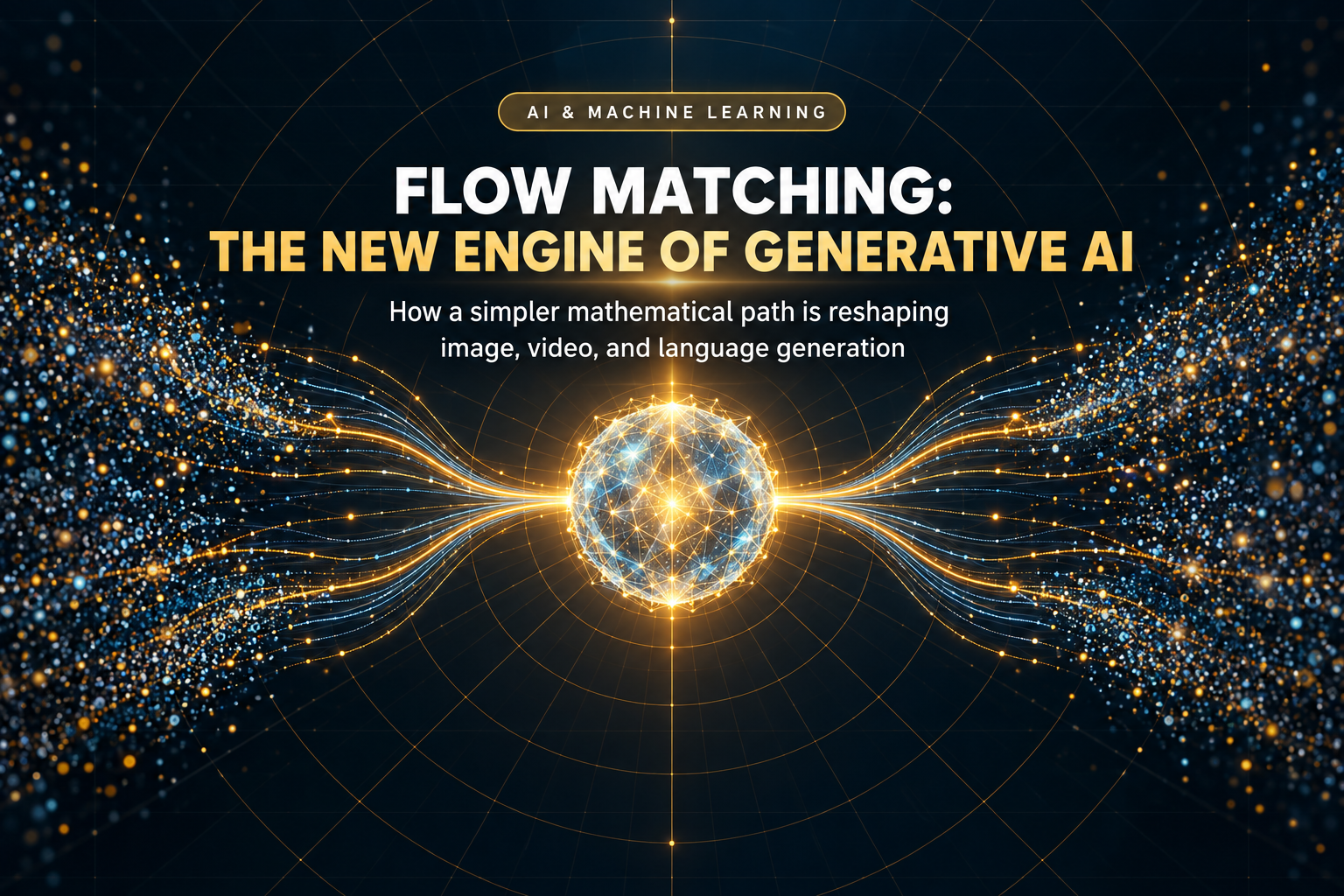
Flow matching takes a more direct route. Instead of learning to denoise iteratively, it trains a model to learn a velocity field — essentially a straight, efficient path that transports random noise directly toward realistic data. Because the paths are simpler and more direct (often implemented as “rectified flows”), models can rely on more efficient ODE-based sampling, cutting inference time while preserving — or even improving — output quality and text-image alignment.
This distinction matters enormously at scale. Fewer sampling steps translate directly into lower compute costs, faster user-facing products, and the ability to serve generative AI to millions of users without prohibitive infrastructure spend.
From Research Paper to Commercial Powerhouse
Flow matching’s leap from theory to production is one of the more striking stories in recent AI history. Stable Diffusion 3 was among the first major releases to swap out traditional noise-prediction training for a flow-matching objective, training a transformer-based architecture to follow these simplified noise-to-data paths.
But it’s FLUX, developed by Black Forest Labs, that has driven the clearest commercial validation. According to reporting on the deal, Meta reportedly agreed to pay Black Forest Labs $140 million for access to FLUX’s technology — a signal that flow matching had graduated from an interesting research direction into a strategically valuable commercial capability. FLUX has also expanded into image editing and reportedly secured integrations across major platforms including Adobe, Microsoft Azure AI Foundry, and NVIDIA, extending flow matching’s footprint well beyond standalone image generators and into enterprise creative pipelines.
This is a notable pattern in AI infrastructure: a mathematical technique proves itself in open research, gets validated in a flagship open-weight model, and is then licensed and embedded into tools used by millions of creative professionals.
Beyond Images: Flow Matching Goes Multimodal
While image generation put flow matching on the map, 2026 research shows the technique spreading rapidly into other domains:
- Scientific computing and biology — Graph-guided flow matching models are now being combined with biological knowledge graphs to predict single-cell responses to perturbations, reportedly training dramatically faster than comparable deep learning approaches.
- Physics-constrained simulation — New “manifold attracting” flow matching variants nudge generated samples toward physical constraint boundaries without needing to retrain the underlying model, useful for engineering and inverse-problem solving.
- Language model acceleration — Techniques like few-step latent flow matching are being applied to speculative decoding, reportedly boosting inference throughput on large language models beyond existing acceleration methods.
- Protein and enzyme design — Flow-based models are being used to predict evolutionary mutations for protein engineering, with some generated binders and enzymes reportedly validated in laboratory settings.
- Video and preference alignment — Flow generators are being repurposed as their own reward signal for video generation, eliminating the need for separate reward models or vision-language scoring systems.
This diversification suggests flow matching isn’t just a clever trick for image synthesis — it’s becoming a general-purpose framework for any problem involving the transformation of one probability distribution into another, whether that’s noise into pixels, or a baseline protein into a functional enzyme.
Why Enterprises and Developers Should Pay Attention
For businesses building on generative AI, the shift toward flow matching has practical consequences. Lower sampling-step requirements mean cheaper inference costs at scale, which is critical for companies deploying generation features in consumer-facing products like design tools, advertising platforms, and content pipelines. The technique’s compatibility with transformer architectures also means it can ride the same scaling laws that have driven large language model progress.
Industry analysts tracking generative AI trends for 2026 point to multimodal workflows, agent-driven execution, and cost-controlled inference as dominant themes — all areas where flow matching’s efficiency advantages are directly relevant. Media, advertising, and design sectors in particular are positioned to benefit from faster, cheaper, high-fidelity generation, though production-wide adoption in film and VFX remains uneven due to ongoing concerns around consistency, copyright, and workflow integration.
The Road Ahead
Expect flow matching to keep expanding its reach beyond image generation into video, 3D asset creation, audio synthesis, and scientific simulation, with research increasingly focused on making generation respect real-world structure — geometric constraints, biological relationships, and physical laws — rather than treating outputs as purely statistical artifacts. As transfer-learning techniques mature, we’ll likely see flow-matching models that adapt efficiently to niche domains with minimal retraining, lowering the barrier for specialized applications in medicine, materials science, and engineering. The convergence of near-one-step generation speed with domain-aware constraints points toward a future where high-quality generative AI is both faster and more scientifically grounded.
Flow matching represents more than an incremental improvement over diffusion models — it’s a architectural rethink that’s already reshaping how billion-dollar AI companies build their core technology. As this technique continues branching into biology, language models, and physical simulation, the question worth asking is: which industry will be transformed next by a straighter path from noise to meaning?
📖 Recommended Sources:
• Black Forest Labs / FLUX model documentation and partnership announcements – details on commercial adoption and Meta licensing deal
• Stability AI – Stable Diffusion 3 technical announcements on flow-matching architecture
• arXiv preprints (November 2026) – recent research on graph-guided flow matching, manifold-attracting flow matching, and flow-based protein engineering
• Industry generative AI trend analyses for 2026 covering multimodal workflows and cost-controlled inference
ⓘ This content is AI-generated based on training data through January 2026, supplemented with live research. Please verify specific claims, figures, and partnership details independently.