# Federated Learning: The Privacy-Preserving AI Revolution Reshaping Enterprise Security in 2026
The way organizations train artificial intelligence is fundamentally changing. Rather than centralizing sensitive data in a single location, federated learning enables multiple parties to collaboratively build AI models while keeping their raw data private and distributed. This shift represents one of the most significant developments in enterprise AI security since the rise of machine learning itself.
What Is Federated Learning and Why It Matters Now
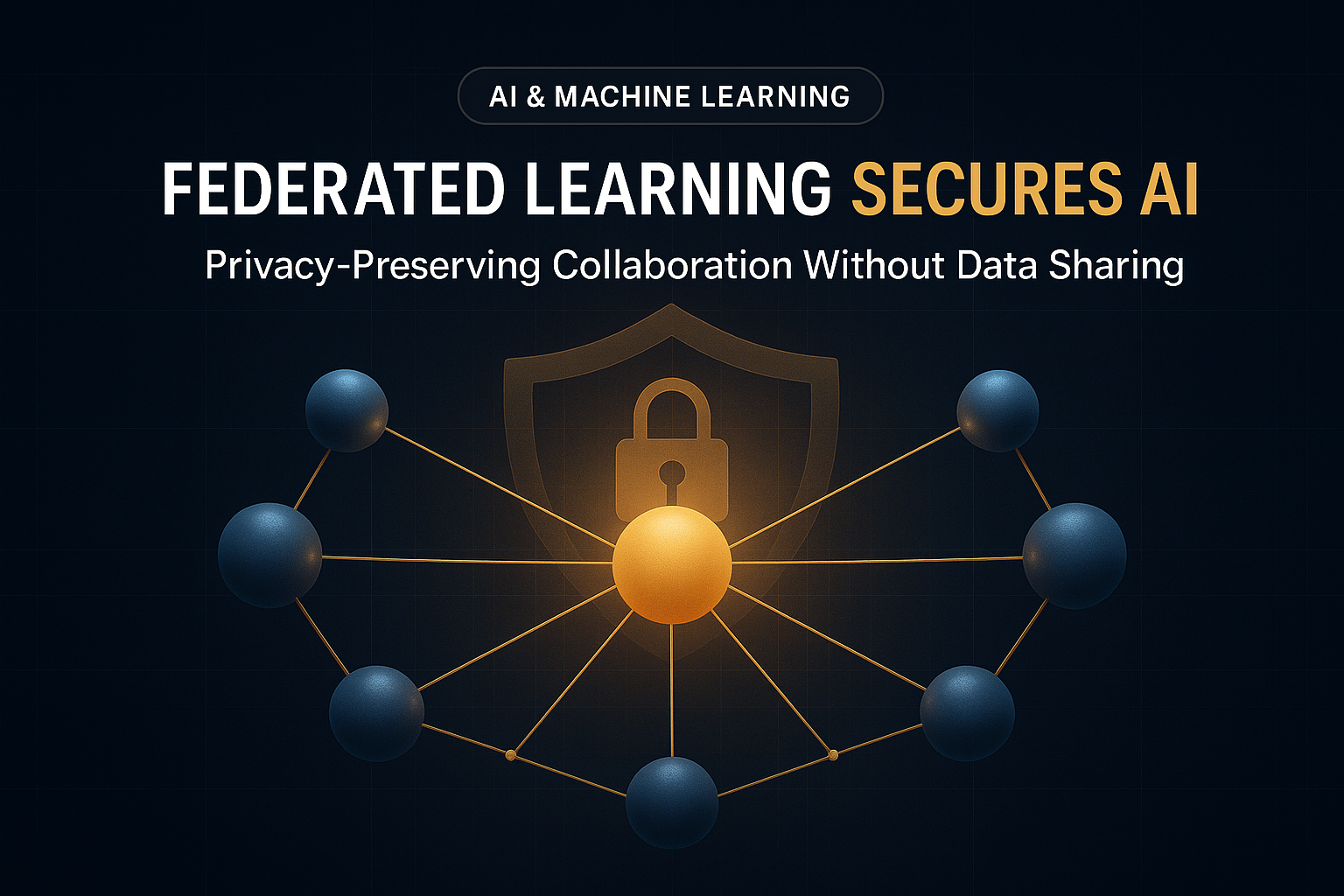
Federated learning is a data minimization approach that allows organizations to train machine learning models across decentralized data sources without ever transferring the underlying information to a central server. Instead, model training happens locally on each participant’s infrastructure, and only the model updates—not the raw data—are shared and aggregated to improve the overall system.
This distinction is critical for regulated industries and privacy-conscious organizations. According to recent research, federated learning frameworks are increasingly being paired with differential privacy techniques to add mathematical guarantees that individual data points cannot be reverse-engineered from model outputs. The combination creates a formidable defense against both data breaches and sophisticated privacy attacks.
The timing is particularly important in 2026. Regulatory pressure from frameworks like GDPR, emerging AI governance requirements, and high-profile data breaches have made traditional centralized data models increasingly untenable for enterprises handling sensitive information. Federated learning offers a technically elegant solution to this compliance and security challenge.
Recent Breakthroughs: MIT’s 81% Acceleration Leap
One of the most compelling recent developments comes from MIT researchers, who have developed a new method capable of accelerating privacy-preserving AI training by approximately 81 percent. This breakthrough addresses one of federated learning’s primary limitations: computational efficiency. Slower training times have historically made federated approaches less attractive for time-sensitive applications.
The MIT advancement suggests that performance concerns, which have previously hindered enterprise adoption, are rapidly being resolved. As these efficiency gains propagate through the industry, we can expect accelerated deployment of federated systems in production environments. This is not merely an incremental improvement—an 81% speedup fundamentally changes the cost-benefit calculus for organizations evaluating privacy-preserving AI investments.
These types of innovations are becoming more common. Research institutions and technology companies are actively publishing work in specialized venues like the Federated Machine Learning and Unlearning for Privacy-Preserving Networked Intelligence special issue, indicating sustained academic and commercial interest in advancing the field beyond its current capabilities.
Enterprise Applications: Healthcare, Finance, and Beyond
The real-world impact of federated learning is already visible across multiple industries. Healthcare organizations are using federated frameworks to train diagnostic AI models on patient data without centralizing sensitive medical records. Multiple hospitals can collaboratively improve a cancer detection algorithm, for instance, while each institution maintains complete control and sovereignty over its patient data.
Similarly, financial services firms are deploying federated learning for fraud detection across institutions. Banks can collectively train fraud-detection models that benefit from patterns across the entire financial ecosystem, yet no single organization sees another’s transaction data. This approach simultaneously improves model accuracy and maintains competitive confidentiality.
Beyond these sectors, federated learning is gaining traction in telecommunications, pharmaceutical research, and government agencies. Any industry handling sensitive, regulated, or competitive data can benefit from collaborative AI that preserves privacy. The versatility of the approach—combined with regulatory tailwinds—is driving what industry observers describe as strong growth in federated learning adoption.
Differential Privacy: The Mathematical Guardian
While federated learning distributes data, differential privacy provides mathematical guarantees that no individual’s information can be reliably extracted from the trained model. This technique adds carefully calibrated noise to data or model updates, ensuring that the contribution of any single data point cannot be reverse-engineered.
The combination of federated learning + differential privacy creates a defense-in-depth architecture. Even if someone gains access to the aggregated model updates, the differential privacy layer ensures they cannot isolate or identify individual data. This dual-layer approach has become the gold standard for privacy-preserving AI in regulated environments.
Research comprehensively examining the integration of differential privacy techniques within federated learning frameworks continues to advance rapidly, with ongoing work addressing remaining challenges around balancing privacy guarantees with model accuracy. The field is maturing beyond theoretical proofs into practical, production-ready implementations.
Regulatory Compliance and the GDPR Connection
Federated learning is increasingly recognized as a compliance enabler for organizations subject to GDPR, CCPA, and similar regulations. By design, federated systems minimize data collection and centralization—core principles of privacy-by-design frameworks that regulators favor.
However, it’s important to note that federated learning alone does not automatically guarantee GDPR compliance. Organizations must thoughtfully implement federated architectures with differential privacy, proper data governance, and transparent model auditing. When implemented comprehensively, however, federated learning significantly reduces regulatory risk and demonstrates a commitment to privacy-first AI development.
This regulatory alignment is accelerating enterprise investment. Compliance teams and privacy officers are increasingly advocating for federated approaches as part of broader AI governance strategies.
Challenges and the Road Ahead
Despite rapid progress, federated learning still faces real challenges. Communication overhead between distributed nodes can be substantial. Model convergence may be slower in heterogeneous environments where different participants have vastly different data distributions. Debugging and monitoring distributed AI systems is inherently more complex than centralized approaches.
Yet these challenges are being systematically addressed through academic research, open-source frameworks, and commercial platforms. The trajectory is clear: federated learning is transitioning from research curiosity to enterprise necessity.
The Future of Privacy-Preserving AI
As we move deeper into 2026 and beyond, expect federated learning to become a standard component of enterprise AI stacks, particularly for organizations in regulated industries. The combination of MIT-class breakthroughs in efficiency, strong regulatory tailwinds, and proven real-world applications creates a powerful catalyst for adoption.
Organizations that begin experimenting with federated learning architectures now will gain competitive advantage in the privacy-conscious economy. Those that wait risk falling behind as best practices crystallize and regulatory expectations harden around privacy-preserving AI development.
The shift from centralized to federated AI isn’t just a technical innovation—it’s a fundamental reset in how enterprises think about data, collaboration, and trust. In an era where data breaches make headlines weekly and privacy regulations proliferate, federated learning offers a genuinely compelling path forward.
Are you evaluating federated learning for your organization? What privacy and compliance challenges are driving your AI strategy decisions? Share your insights in the comments below.
—
📖 **Recommended Sources:**
– **MIT Research Breakthrough** – Recent development accelerating privacy-preserving AI training by 81%, advancing federated learning efficiency for enterprise deployment
– **Federated Machine Learning Special Issue** – Academic research venue publishing state-of-the-art work on federated learning and privacy-preserving networked intelligence
– **GDPR & Federated Learning Compliance** – Research on privacy-preservation techniques and regulatory alignment for federated systems in regulated industries
– **Healthcare & Finance Use Cases** – Real-world applications of federated learning for patient data protection and cross-institutional fraud detection without data sharing
ⓘ This content is AI-generated based on research through July 2026. Please verify specific claims and latest developments independently with primary sources.