Imagine dozens of hospitals training a single cancer-detection model together — without a single patient record ever leaving its home institution. That’s not a thought experiment anymore. It’s happening now, and it’s reshaping how enterprises think about AI and data privacy.
Federated learning, once a niche academic technique, has become one of the most consequential architectures in enterprise AI. As organizations face mounting pressure to extract value from sensitive data while complying with tightening privacy regulations, this decentralized training approach is proving it can deliver both performance and protection — without forcing a tradeoff between the two.
From Research Curiosity to Production Infrastructure
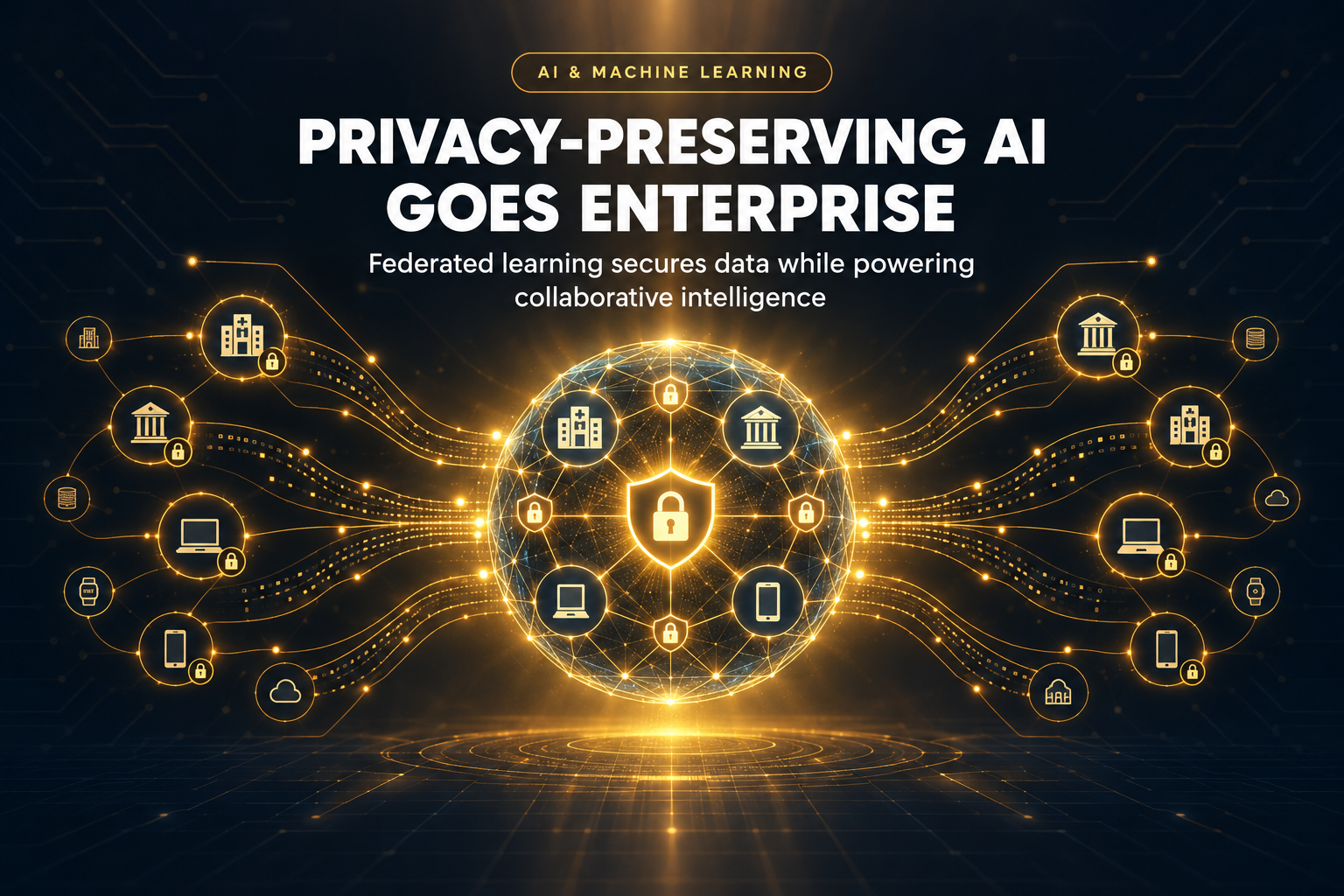
Federated learning allows multiple parties — hospitals, banks, factories, or even individual smartphones — to collaboratively train a shared AI model while keeping raw data local. Instead of pooling sensitive information in one place, only model updates (not the underlying data) are exchanged and aggregated.
What’s changed in 2026 is the sophistication of the surrounding privacy stack. According to recent research, federated learning is now routinely layered with secure aggregation, differential privacy, confidential computing, and homomorphic encryption to close gaps that model-update leakage could otherwise expose. One 2026 cryptographic framework reportedly achieved up to a 73-fold reduction in model-update size while preserving these layered privacy protections — a meaningful efficiency gain for organizations wary of the communication overhead that has historically limited federated deployments.
This shift signals a maturity milestone: federated learning is no longer just “training without centralizing data.” It’s becoming auditable, sovereign, multi-party AI collaboration — a phrase increasingly used to describe production-grade deployments rather than pilot projects.
Healthcare Leads the Charge
Healthcare remains the clearest and most advanced enterprise use case for privacy-preserving AI. Hospitals and research institutions can now collaborate on shared models without ever moving patient records outside their own walls.
A notable example is the National Cancer Institute’s FLAIMME program, which uses NVIDIA FLARE across multiple cancer centers to train shared oncology models for clinical-trial matching and multimodal research — all without centralizing patient data. Similarly, Owkin has advanced sovereign AI initiatives, including a partnership emphasizing national control over sensitive biomedical data, reflecting a broader trend toward “sovereign AI” where countries and institutions retain custody of their most sensitive datasets while still participating in collaborative model development.
These case studies illustrate a critical nuance: federated learning provides the technical architecture for data localization, but it is not, by itself, a compliance solution. Organizations still need documented lawful bases for processing, data protection impact assessments, and model-risk documentation to satisfy regulators.
Enterprise Adoption Beyond Healthcare
While healthcare leads, federated learning is expanding into several other sectors:
- Banking and insurance — cross-institution fraud detection and credit modeling where customer data legally cannot be pooled
- Manufacturing and industrial IoT — predictive maintenance across factories without exposing proprietary operational data
- Connected vehicles and smart cities — distributed traffic and mobility analytics
- Mobile devices — on-device personalization for keyboards, cameras, and recommendation engines
Edge AI is a particularly active frontier. Federated learning is increasingly paired with TinyML and on-device training, keeping raw sensor data local in smart cameras and wearables. Reported deployments show data-transfer reductions of up to 30%, a meaningful efficiency gain for bandwidth-constrained environments.
Researchers are also tackling the long-standing challenge of non-IID data — the reality that data distributions vary wildly across hospitals, bank branches, or countries. New techniques involving personalized learning, smarter client selection, and adaptive privacy budgets are helping maintain model accuracy despite this heterogeneity, a problem that has historically limited real-world federated accuracy compared to centralized training.
The Regulatory Reality Check
Despite the technical progress, federated learning does not automatically guarantee GDPR or EU AI Act compliance — a common misconception among enterprise adopters. Model updates can still leak information about underlying data, meaning organizations must pair federated architectures with threat modeling, differential privacy, and leakage testing.
For high-risk medical AI under the EU AI Act, federated systems can help document data provenance and local validation, but organizations still need comprehensive risk management, technical documentation, and post-market monitoring. Sovereignty, too, depends on more than data locality — it requires attention to encryption-key control, vendor jurisdiction, and administrator access policies.
What Comes Next
Looking ahead, expect federated learning to increasingly intersect with foundation model fine-tuning. Emerging techniques like federated low-rank adaptation (sometimes called Fed-PriLoRA) aim to adapt large language and multimodal models using smaller, privacy-noise-tolerant updates — a development that could bring privacy-preserving collaboration to generative AI, not just traditional predictive models. As communication efficiency and privacy accounting continue to improve, the barrier to routine production deployment will keep falling, pushing federated learning from a specialized healthcare tool toward a default pattern for any multi-party AI collaboration involving sensitive data.
Federated learning’s trajectory in 2026 makes one thing clear: privacy and AI performance are no longer framed as opposing forces, but as complementary design goals achievable through smarter architecture. As more industries confront the tension between data silos and collaborative intelligence, will your organization be building the governance and infrastructure needed to make privacy-preserving AI a competitive advantage — or playing catch-up once regulators and competitors force the issue?
📖 Recommended Sources:
• GIIResearch – 2026 market analysis of federated learning platforms in healthcare, including NVIDIA FLARE, NCI FLAIMME, and Owkin initiatives
• ScienceDirect / ACM Digital Library – Research on cryptographic frameworks combining differential privacy, secure aggregation, and homomorphic encryption for federated learning
• NVIDIA News – Coverage of NVIDIA FLARE deployments in multi-center oncology research
• MDPI Electronics Journal – Technical research on federated learning for IoT, non-IID data handling, and resource-efficient mobile training
ⓘ This content is AI-generated based on training data through January 2026 and live research conducted on November 13, 2026. Please verify specific claims independently.